
Trump says 'Iran really wants a deal', slams 'negative chirping'
 5 Min Read
The US president says Iran wants to reach a deal with Washington as military strikes and retaliations continue amid escalating tensions and ongoing ceasefire negotiations.
-
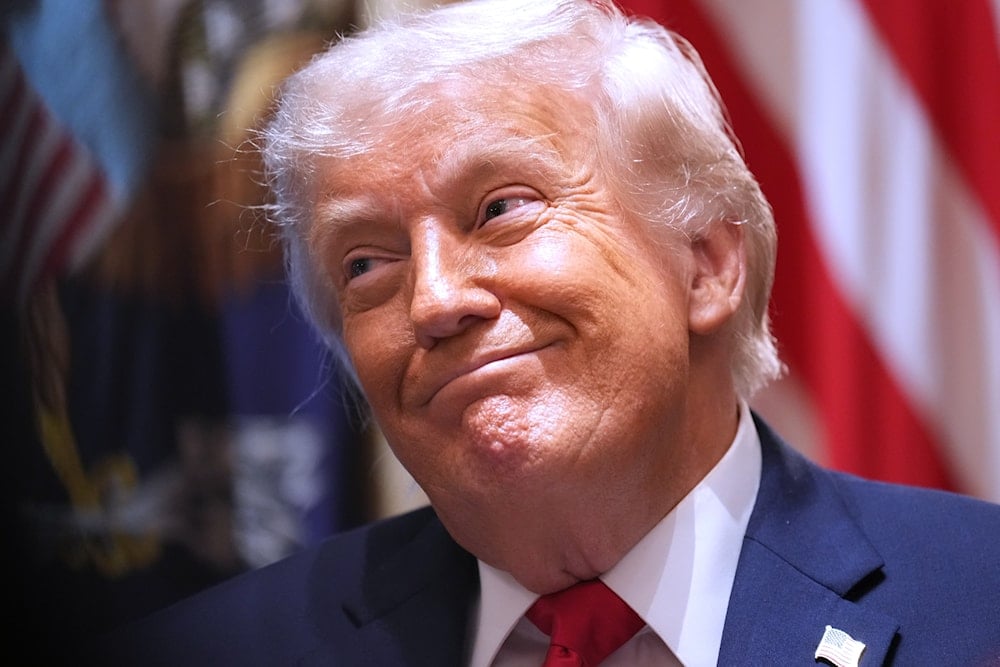
US President Donald Trump listens during a Cabinet meeting at the White House on May 27, 2026, in Washington (AP)
US President Donald Trump on Monday said that Iran really wanted to make a deal with the US and that it would be a good one for Washington and its allies.
His post came only hours after the US military said it struck Iranian military sites at the weekend and Iran's Islamic Revolution Guard Corps (IRGC) said they retaliated against a US base in response, which Trump made no mention of in his post.
"Iran really wants to make a deal, and it will be a good one for the USA and those that are with us," Trump posted on Truth Social an hour after midnight. However, Trump also said it was tougher for him to negotiate with Iran with all the negative political commentary surrounding the war.
In his Truth Social post, the president added that "... it is MUCH tougher for me to properly do my job and negotiate when political hacks keep negatively 'chirping', at levels never seen before, over and over again, that I should move faster, or move slower, or go to war, or not go to war, or whatever."
"Just sit back and relax, it will all work out well in the end, it always does!"
Trump had said on Friday he would soon decide on a proposed deal to extend the ceasefire with Iran.
Deal or defeat? Trump’s maximalist Iran goals crumble
Amid mounting criticism that the US-led war against Iran failed to achieve its stated objectives, Trump is increasingly turning to negotiations with Tehran after months of military aggression initiated by Washington and its ally, "Israel", The Guardian reported.
The United States and Iran are approaching an agreement that could extend the current ceasefire and reopen the Strait of Hormuz. The proposed arrangement, reportedly brokered with the assistance of Pakistani and Qatari mediators, would establish 60 days for negotiations over Iran's nuclear program.
The reported diplomatic breakthrough has prompted debate among analysts and political figures in Washington, with some arguing that the administration is retreating from the sweeping goals it outlined at the start of the war.
Surrender or settlement?
In an article published by The Atlantic, foreign policy analyst Robert Kagan wrote that "Trump's endgame is surrender," adding that the president "no doubt hopes that he can slip away without Americans noticing the magnitude of this defeat."
"The financial markets may stabilize if it is clear that oil will eventually start flowing again through a reopened strait, even if under the new Iran-controlled system," Kagan wrote. "A major strategic setback for the United States need not affect Wall Street."
Republican figures who have traditionally advocated a hardline stance toward Iran have also expressed concern over the possibility of a deal. Senators Lindsey Graham, Ted Cruz, and Roger Wicker, along with former Secretary of State Mike Pompeo, have reportedly warned against any agreement that would allow Iran to maintain uranium enrichment capabilities. Their concerns come after Trump stated last weekend that negotiations were "95% negotiated".
At the outset of the war, Trump sought to justify the US-led aggression against Iran by claiming Tehran posed a threat to US interests, while openly calling for "regime change" and encouraging efforts to destabilize the Islamic Republic. "Our objective is to defend the American people by eliminating imminent threats from the Iranian regime," Trump said after authorizing the initial strikes.
He also urged members of Iran's security forces to "lay down your weapons" and called on Iranians to "take over your own government … this is the moment for action."
Objectives remain unfulfilled
Analysts cited by The Guardian argue that many of those objectives remain unfulfilled. Sina Toossi of the Center for International Policy said the administration had entered the war with a broad set of goals that included "regime change", dismantling Iran's missile program, and weakening its regional alliances.
"Then we see that he ultimately acceded to a ceasefire. We know from all the reporting coming out since that Iran's military capabilities were not reduced as much as the White House presented – something like potentially 70% of their ballistic missiles, 70-80% of the drones are intact," Toossi said.
The report noted that despite Israeli strikes that killed several senior Iranian officials, including martyr Sayyed Ali Khamenei, Iran's political system remains in place. Sayyed Mojtaba Khamenei, who succeeded his father as leader, was recently quoted as predicting that "Israel" would cease to exist by 2040.
Questions also remain over Iran's nuclear capabilities. Although Trump previously said US strikes had "obliterated" Iran's uranium stockpile, the report stated that Tehran is still believed to possess roughly 970 pounds of highly enriched uranium stored in underground facilities.


