
Neocons see America’s war on Iran is draining power, money, prestige
 4 Min Read
Growing criticism from Western media and prominent neoconservative figures reflects mounting concern that the war on Iran is weakening Washington's global influence.
-
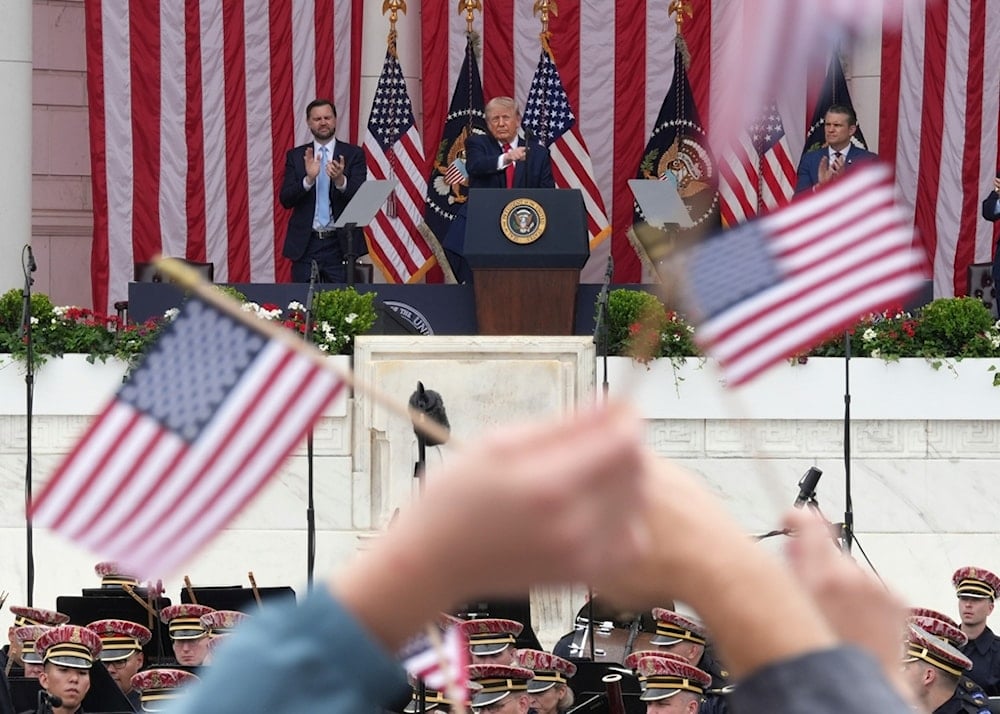
Attendees wave flags as President Donald Trump, center, Vice President JD Vance, left, and War Secretary Pete Hegseth stand on stage at the 158th National Memorial Day Observance coinciding with the nation's 250th anniversary, at the Memorial Amphitheater in Arlington National Cemetery, Monday, May 25, 2026, in Arlington, Va. (AP)
Growing acknowledgment within Western political and media circles suggests the United States is struggling to achieve its objectives in its war on Iran, with even prominent neoconservative figures warning that the war could accelerate the erosion of US global influence.
According to an analysis by Ben Norton published in ScheerPost, criticism of Washington’s strategy is no longer limited to anti-war voices, noting that several longtime advocates of aggressive US foreign policy have begun publicly expressing concern over the geopolitical consequences of the war.
Among them is veteran neoconservative commentator Robert Kagan, who warned in an article published by The Atlantic that the war on Iran could fundamentally weaken American power in the region and beyond.
“There will be no return to the status quo ante, no ultimate American triumph that will undo or overcome the harm done,” Kagan wrote.
“With control of the Strait [of Hormuz], Iran emerges as the key player in the region and one of the key players in the world. The roles of China and Russia, as Iran’s allies, are strengthened; the role of the United States, substantially diminished.”
Kagan further argued that the war had exposed “an America that is unreliable and incapable of finishing what it started,” warning that allies and adversaries alike would adjust to what he described as a visible weakening of US authority.
Growing doubts inside Western media
The analysis pointed to reporting and commentary from several major Western outlets that questioned the effectiveness of the US-led campaign against Iran.
According to the article, newspapers including The Independent and The Wall Street Journal published assessments suggesting Washington was struggling to secure decisive results despite months of aggression.
The report also referenced coverage by The New York Times and The Washington Post, citing unnamed US intelligence officials who reportedly acknowledged that Iran retained much of its missile infrastructure and could continue operating around the Strait of Hormuz despite US pressure.
The Strait of Hormuz remains one of the world’s most strategically significant maritime chokepoints, carrying a substantial share of globally traded crude oil exports.
Concerns over military and economic costs
The article additionally cited reporting by Fortune indicating concerns over the rapid consumption of US missile stockpiles during the assault.
Economist Linda Bilmes of Harvard Kennedy School was quoted as estimating that a prolonged war on Iran could ultimately cost the United States more than $1 trillion.
Despite mounting criticism, US President Donald Trump has continued insisting that Iran has suffered major military setbacks.
“They’re militarily defeated. In their own minds, maybe they don’t know that,” Trump said.
However, the analysis argued that repeated intelligence leaks and increasingly skeptical assessments appearing in US media suggest growing divisions within the American political establishment over the direction and sustainability of the military campaign.
Neoconservative figures express alarm
The article stressed the significance of criticism coming from longtime interventionist figures closely associated with previous US wars on Iraq and elsewhere.
Kagan, a co-founder of the Project for the New American Century (PNAC), was among the leading advocates of the 2003 invasion of Iraq and has long supported a more confrontational US posture toward Iran.
The analysis also cited comments from fellow PNAC co-founder Bill Kristol, who reportedly described the United States as having been “humiliated” by the war.
The report argued that opposition from such figures reflects growing concern within segments of the US foreign policy establishment that the war could produce lasting strategic consequences benefiting Iran, China, and Russia while weakening Washington’s standing across West Asia.
Public opposition in the United States
The article further noted that the war has faced substantial domestic opposition inside the United States.
It referenced polling conducted by NPR, PBS News, and Marist Poll, indicating that a majority of Americans disapproved of Trump’s handling of the war on Iran.
Additional polling by YouGov reportedly found that only a small percentage of respondents believed the United States was winning the war.
According to the analysis, the combination of military uncertainty, economic costs, and declining public support has intensified debate inside Washington over the long-term viability of continued escalation against Tehran.
Read more: GOP senator attacks Hegseth over reported Iran deal framework


