
Trump’s Iran war accelerates collapse of US-led global order: FP
 3 Min Read
Trump’s war on Iran has weakened the US-led global order, strained alliances, empowered adversaries, and triggered long-term geopolitical and economic instability worldwide.
-
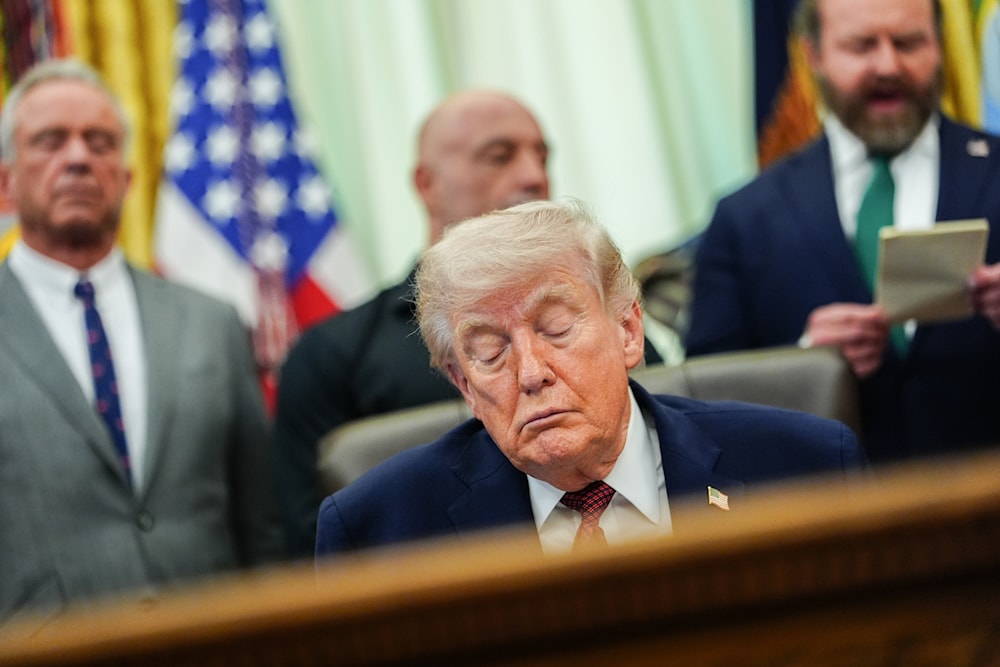
President Donald Trump closes his eyes while listening in the Oval Office of the White House on April 18, 2026, in Washington. (AP Photo/Julia Demaree Nikhinson)
The war on Iran is producing consequences that extend far beyond the battlefield, with analysts suggesting it is accelerating the erosion of the US-led international order rather than reinforcing it.
According to a Foreign Policy analysis, even with a fragile ceasefire and renewed negotiations, the immediate costs are already evident: surging energy prices, warnings of global recession from the IMF, and significant military and economic strain on the United States alongside heavy damage and civilian deaths in Iran.
The analysis contends that Washington’s decision to launch a preventive war without clear legal grounding has further weakened the rules-based system it once led. The war has helped normalize the use of force as a tool of statecraft, undermining core principles such as sovereignty, non-aggression, and freedom of navigation.
Threats against civilian infrastructure and the weaponization of critical chokepoints like the Strait of Hormuz have intensified concerns about the erosion of global stability and predictable economic rules.
Alliance strain and credibility loss
The war has deepened fractures within US alliances, particularly with European partners who were largely excluded from decision-making and opposed the war. Rising tensions have accelerated European discussions on strategic autonomy and reduced reliance on Washington for security guarantees.
Despite US rhetoric about prioritizing the Indo-Pacific, the war on Iran has forced a major redeployment of military assets away from Asia. This has strained missile defense stockpiles and reduced readiness for potential contingencies involving China, raising doubts among key regional allies about US reliability.
Rather than isolating Iran, the war has contributed to closer coordination among US adversaries. Russia and China have reportedly provided diplomatic and intelligence support to Tehran.
However, the war’s most significant outcome may be structural: a weakening of US global authority driven not only by external competition, but by Washington’s own strategic choices. Whether the war escalates again or moves toward settlement, its geopolitical effects are already reshaping alliances, markets, and global power balances.
US funds spent on ‘reckless’ Iran war could have saved 87mln lives: UN
The head of the United Nations’ humanitarian arm has issued a stark warning over the financial and human toll of the US-led aggression on Iran, arguing that the scale of military spending stands in direct contrast to a deepening global aid crisis, The Guardian reported.
Speaking at Chatham House in London on Monday, UN humanitarian chief Tom Fletcher said the vast sums allocated to the war could have instead funded life-saving operations on an unprecedented scale. He pointed out that the war is consuming roughly $2 billion per week, while the UN requires $23 billion to deliver a targeted plan aimed at assisting tens of millions of vulnerable people.
“For every day of this conflict, $2bn is being spent. My entire target for a hyper-prioritised plan to save 87 million lives is $23bn. We could have funded that in less than a fortnight of this reckless war. Now, of course, we cannot,” Fletcher said.


