
BlackRock warns European stocks at risk due to energy crisis from war
 5 Min Read
Blackrock warns that surging energy costs and higher valuations have made European equities less attractive than they appeared just a few months ago.
-
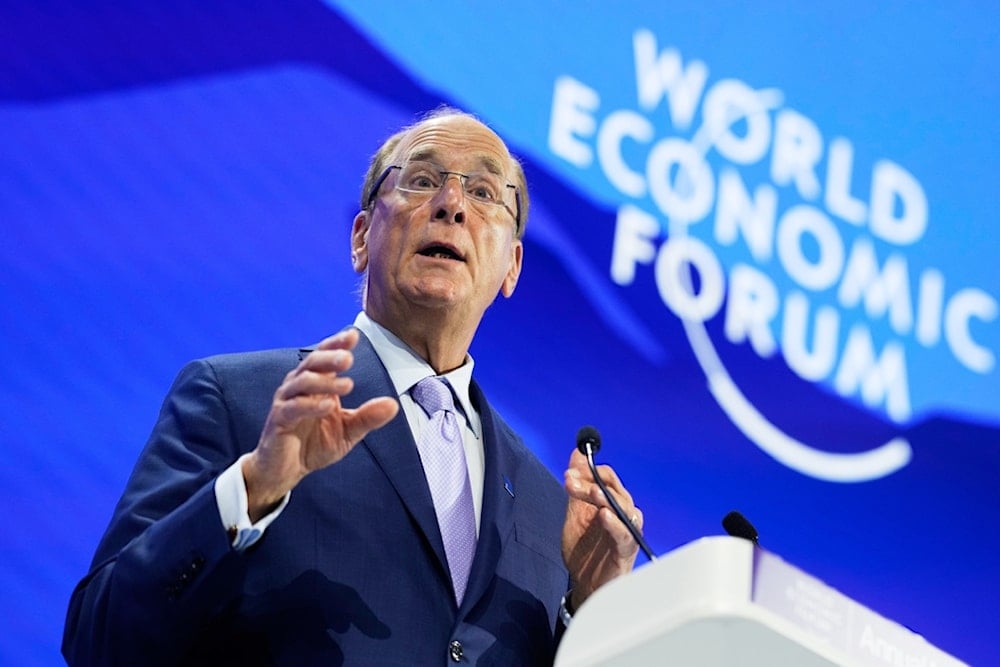
BlackRock CEO Larry Fink talks during the Annual Meeting of the World Economic Forum in Davos, Switzerland, Tuesday, Jan. 20, 2026. (AP)
Helen Jewell, international chief investment officer for fundamental equities at BlackRock, the world's largest asset manager with $13.9 trillion in assets, told the Financial Times that surging energy costs and higher valuations have made European equities less attractive than they appeared just a few months ago, as the US-Israeli war on Iran exposes the continent's vulnerability to global energy price shocks.
The economic damage from elevated oil and gas prices, combined with a narrowing valuation gap between European and American stocks following months of strong relative performance, has led BlackRock to temper its recent bullish stance on European equities.
"It is difficult to be quite as bullish on Europe as we had been," Jewell told the FT, citing the region's significant exposure to how the global energy price shock affects consumer spending across the continent.
"You can't make these big proclamations that Europe looks cheap now," Jewell added. "A year ago you had this really interesting valuation gap. The valuation gap has closed, and from an energy perspective, Europe is just a lot more exposed… so we are having to be a bit more selective about where we see opportunities."
European stocks tumbled after Iran war broke out
European equities underperformed Wall Street for years but regained popularity at the start of 2026 as investors searched for alternatives to expensive US technology stocks, the FT reports. The region's equity funds experienced record inflows during this period.
However, after a strong finish to 2025 and a solid opening two months of 2026, European stocks plunged following the outbreak of the US-Israeli war on Iran. The Stoxx Europe 600 lost nearly 12 percent from its pre-war level by its March low point. By contrast, Wall Street's S&P 500 fell only 8 percent at its worst and has since rebounded to new all-time highs.
Jewell told FT her optimism on Europe at the beginning of the year stemmed partly from expectations that returns would broaden out from strongly performing sectors such as banks and defense to other areas of the market. She noted that this broadening has since "retracted" due to the war.
Read More: Luxury stocks slide as war on Iran disrupts demand and tourism
Consumer spending under pressure from higher costs
"In Europe, broadening out was about the pockets of the market like quality growth which suffered in 2025," Jewell said. She highlighted sectors including healthcare, luxury goods and industrials that had suffered under both US President Donald Trump's sweeping tariff measures last year and the strengthening euro. These sectors were expected to rebound this year as tariff pressures eased.
But Jewell told the FT that those sectors are suffering once again, this time due to higher oil prices, rising borrowing costs and weaker consumer spending.
"We are very nervous about the consumer as a whole," she said, explaining that households are being squeezed on interest rates and inflation. "They will start to get thoughtful about what they are spending."
Read More: European market turmoil spurs shift to defensive investments: EuroNews
BlackRock turns more bullish on US stocks
"Global funds just see more interesting opportunities for companies in the US at the moment," Jewell added, partly because the United States is less exposed to a global energy supply shock. The BlackRock Investment Institute switched to a larger-than-benchmark position on US stocks this week.
Jewell, who manages portfolios focused on selecting individual stocks, said she remains positive on certain pockets of the European market, including defence, banks, and semiconductors.
However, she warned that investor positioning could become "crowded" in a few stocks within those sectors, meaning negative news for one or two sectors could trigger a sharp sell-off across the broader market.
"The market structure is fragile," Jewell said. "If something happens in one of those sectors, the entire market will hurt quite badly."
Other investors turning cautious on Europe
BlackRock is not alone in becoming more cautious on Europe since the war began, according to the Financial Times. Data from EPFR shows that flows to European equity funds have fallen sharply since the war on Iran started. Meanwhile, US stocks have already attracted more net inflows in April than in any other month so far in 2026.
Emmanuel Cau, head of European equities strategy at Barclays, told the FT: "The war is just a reminder that Europe is vulnerable, and a price taker on everything." Barclays this week recommended that clients position for US stocks to outperform Europe.
However, Cau added that there could still be reasons for optimism if the crisis eventually leads to increased investment spending by European governments. "If you want to be positive, then maybe long-term, this is going to force more investment in Europe and reinforce its strategic autonomy," he said.
Read More: Iran war will leave long-term 'scar' on Wall Street, investors warn


