Military-Industrial mouthpiece ‘The Atlantic’ admits: Iran defeated US-'Israel', became global power.
-
 Samuel Geddes
- 14 May 2026 11:46
- 9 Shares
 5 Min Read
Sections of the American foreign policy establishment are beginning to acknowledge that the US-Israeli war on Iran fundamentally altered global power balances, strengthening Tehran’s regional and international position.
-

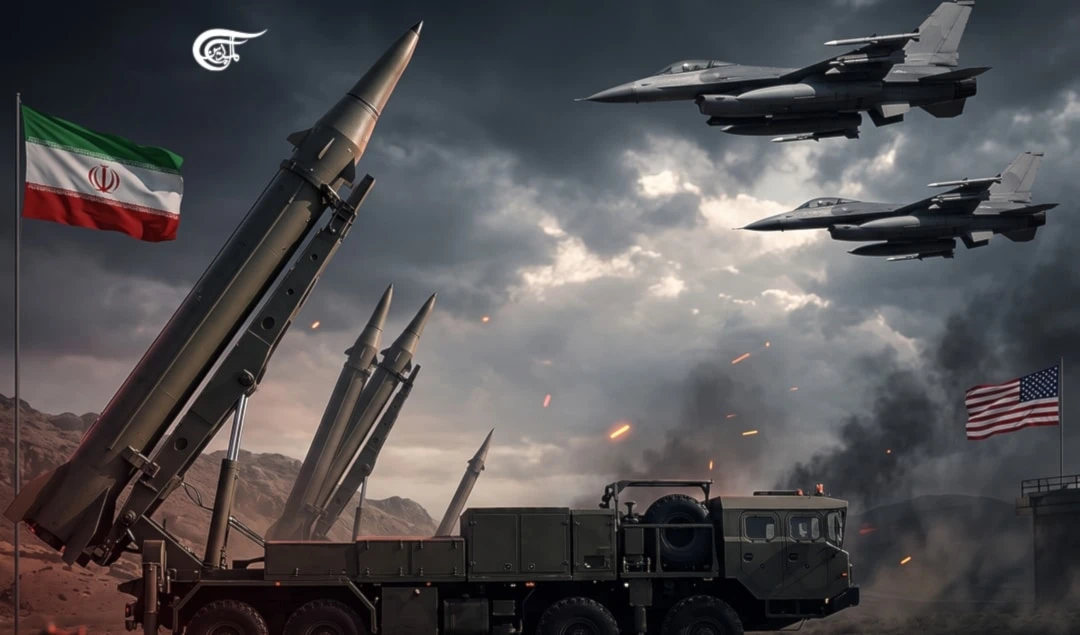
The unelected organs of power who shape policy appear to have accepted the least bad option as cutting America’s losses now and walking away while it still can. (Al Mayadeen English; Illustrated by Zeinab el-Hajj)
Like most official organizations, the output of ‘The Atlantic’ magazine can be important to read, not due to any inherent value or insight within its pages, but because it provides a window into what elite opinion in the US is. Regardless of one’s opinion of its output, it is clearly valuable to know what the class responsible for formulating American foreign policy believes without the moralizing obfuscation.
Thus, the publication of Robert Kagan’s assessment of the Trump administration’s war on Iran is one that, in retrospect, will mark a historical turning point. Kagan is an arch-neoconservative by any objective metric. A co-founder of the ‘Project for a New American Century,’ which devised the post-9/11 campaign of regime change from Afghanistan to Lebanon. He has also served US administrations, Republican and Democrat, in an advisory role on the Foreign Affairs Advisory Board.
His thesis then, that Iran has ‘checkmated’ the Trump administration, regardless of whether Washington and Tel-Aviv resume the aggression, is a stunning recognition of American failure by a personification of the Military-Industrial complex.
Still more stunning is Kagan’s- and by extension the American Deep-State class’- acceptance that this war of Trump’s own choice has catapulted Iran to the status of a world power.
“There will be no return to the status quo ante, no ultimate American triumph that will undo or overcome the harm done. The Strait of Hormuz will not be “open,” as it once was. With control of the strait, Iran emerges as the key player in the region and one of the key players in the world.”
With Washington having shown itself to be a "paper tiger" (his own words), Kagan judges that not only the GCC states but all countries dependent on freedom of navigation through Hormuz- most of the world- will line up to make their own accommodations with Tehran. This will not merely enhance the Iranians’ global stature still further but fundamentally reshape the contours of international diplomacy and geopolitics. Almost all countries will have an overriding interest in demonstrating their non-hostility to Tehran, in exchange for the safe passage of their vessels and commodities.
At a minimum, Kagan notes, this will mean the disintegration of Washington’s sanctions web, woven meticulously for more than four decades. Even American allies will not enforce secondary sanctions against a distant country at the cost of their own economic ruin. Prior to the US blockade of the Islamic Republic, multiple vessels, including those belonging to key US allies- Japan, Pakistan, India, France- were permitted passage by Tehran, doubtless due to bilateral negotiations done behind the scenes. In the face of the ongoing crisis, none other than French energy giant Total has acknowledged that paying a toll to the Iranians in exchange for access is a preferable arrangement to the status quo. That was long before the real economic shockwaves of the crisis (which remain ahead of us) hit. When they do in the weeks and months to come, paying a toll for transit will cease to be merely preferable and will become the sole rational course of action for every government and corporation with exposure to the Strait, regardless of any US objections. One could even reason that the US blockade was imposed precisely to prevent or forestall exactly this inevitability.
Concurrently, Iran’s new-found global influence will mean the almost total isolation of “Israel” from the global system and the dramatic restriction of its freedom to act. If the Global Majority knows, as has been demonstrated, that failing to punish Israeli actions in Gaza, Lebanon, or elsewhere will see retaliation in Hormuz, the collective interest in finally restraining, sanctioning, and punishing the Zionist regime rises exponentially. Again, even a prominent pro-Israeli state such as France or Germany, faced with existential retaliation against its economic model and societal living standards, will not sacrifice diplomatic and actual capital for their genocidal regional proxy.
Kagan’s instinct on the president’s most plausible course of action is that he will ultimately accept defeat now rather than resume the bombing only to accept it later at a much greater cost. To return to war now would guarantee a global generational depression unseen since the 1920s, when Tehran inevitably retaliates with saturation-bombing of the GCC’s energy infrastructure.
Kagan’s reflections suggest that even among the collective power-centers in the US-system that have for decades wanted this war, the realization has dawned and the lesson learned that American hard power has hit a wall. Even if Trump himself has yet to come to terms with this fact, those unelected organs of power who shape policy and who will ultimately decide what the administration does, appear to have accepted the least bad option as cutting America’s losses now and walking away while it still can.
If Washington shocks the world and takes the more rational path however, the dominos are already falling. A global economic shock is already well down the pipeline, the Republicans will lose the US mid-terms and from the Pacific to the North Atlantic, American allies will be taking note that their hegemonic overlord is far weaker than they believed and will act accordingly.