
Trump says Iran deal signed, 'Hormuz to fully reopen Friday'
 3 Min Read
Trump ruled out immediate sanctions relief, calling it "a behavioral thing," and signaled his administration would next turn its attention to Lebanon and Ukraine.
-
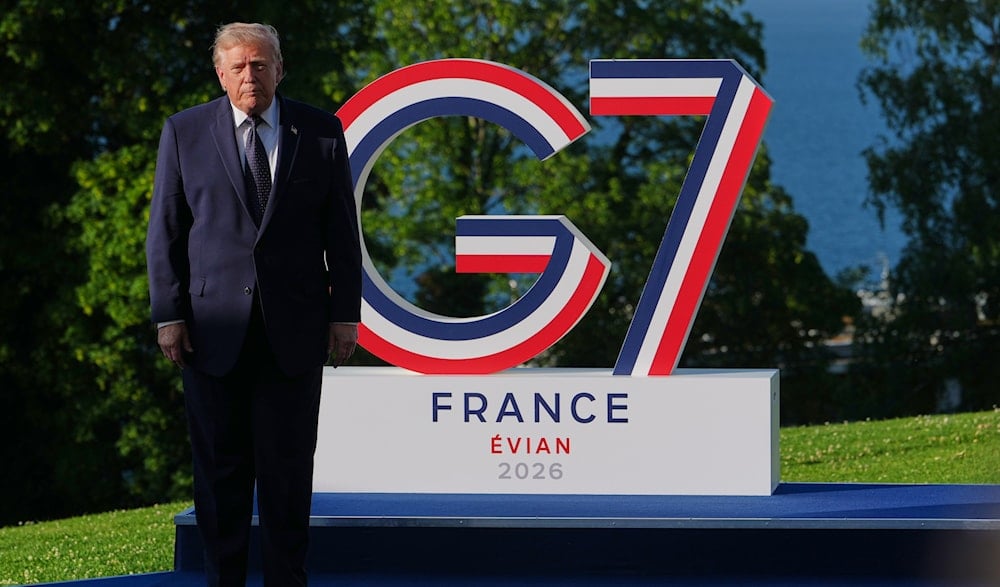
US President Donald Trump poses for a photo as her arrives to greet France's President Emmanuel Macron and first lady Brigitte Macron at the G7 summit, Monday, June 15, 2026, in Evian-les-Bains, France. (AP Photo/Julia Demaree Nikhinson)
US President Donald Trump confirmed Monday that a memorandum of understanding with Iran has been signed and that the Strait of Hormuz will be completely reopened by Friday, speaking to reporters upon his arrival in Evian, France, ahead of the G7 summit.
The MoU was signed digitally on Sunday, with Trump and Vice President JD Vance signing on behalf of the United States and Iranian Parliament Speaker Mohammad Bagher Ghalibaf signing on behalf of Iran, according to a senior US official cited by Reuters. Vance confirmed earlier Monday that no funds were released as part of the signing.
"The deal's all signed. And the Strait is already partially opened, as you know," Trump told reporters alongside French President Emmanuel Macron. "On Friday, it'll be completely open."
Signing ceremony set for Friday in Geneva
A formal signing ceremony is scheduled for Friday in Geneva, with Vance confirmed to attend. Trump said he may or may not be personally present, noting he would "probably be gone by then" given the late schedule of the G7 proceedings, but left open the possibility of involvement.
Reporter: Are you going to try to attend the signing ceremony on Friday?
— Clash Report (@clashreport) June 15, 2026
Trump: Well, it depends. JD's coming in for it — he was originally going to do it. I'll probably be gone by then.
We're going to be staying quite late, so I may be involved, I may not. pic.twitter.com/d4DJYKaeCs
The full text of the agreement is expected to be released to the public sometime after Friday's ceremony. On the question of sanctions relief for Tehran, Trump said none was included in the current agreement, framing any future relief as entirely conditional.
"It's really a behavioral thing. If they do what they're supposed to do, that starts taking effect," he said, claiming that the US would maintain "strong policing" over the implementation of the deal.
Addressing the Strait of Hormuz, Trump said passage through the waterway would be toll-free, acknowledging a dispute over the matter had been resolved.
He suggested that a small multinational naval presence in the area would not be unwelcome as a precautionary measure, while expressing confidence that the situation was under control. "I think it's going to be open and I think it's going to be free sailing," he said.
Trump on the Strait of Hormuz:
— Clash Report (@clashreport) June 15, 2026
It's toll-free. We had a little argument about that. It's toll-free, so I don't think we're going to need much help.
But I don't think it's a bad idea to have a ship or two up there — a few countries. You'd be a great country to do it.
Because… pic.twitter.com/GZjahm5zc5
Trump eyes Lebanon, Ukraine
Trump said he wanted to see if his administration could "straighten out the Lebanon thing," noting it "just seems to never end." He described Lebanon as a smaller-scale version of the broader diplomatic effort his administration has been engaged in, adding that it "should not be tough" and that a conversation with Hezbollah would be necessary.
Trump on Lebanon:
— Clash Report (@clashreport) June 15, 2026
We do want to see if we can straighten out the Lebanon thing, because it just seems to never end.
And that's a mini version of what we were doing. But it should not be tough.
Hezbollah. We have to have a little talk with them. pic.twitter.com/piheKnD7NW
On Ukraine, Trump said that with the Iran file now effectively closed, his administration would turn its focus there, expressing cautious optimism that both Moscow and Kiev were open to a settlement.
Trump also pointed to the immediate economic effects of the agreement, noting that oil prices were already falling while stock markets were rising, describing both trends as highly significant. "Oil is plummeting down, and the stock market is shooting up like a rocket," he said.


