
Trump says Iran war to 'end soon', claims victory, yet again
 4 Min Read
Diplomacy takes a back seat as Washington opts for “call us maybe” strategy, brushing off in-person talks while boasting leverage and downplaying the complexities of the escalating tensions.
-
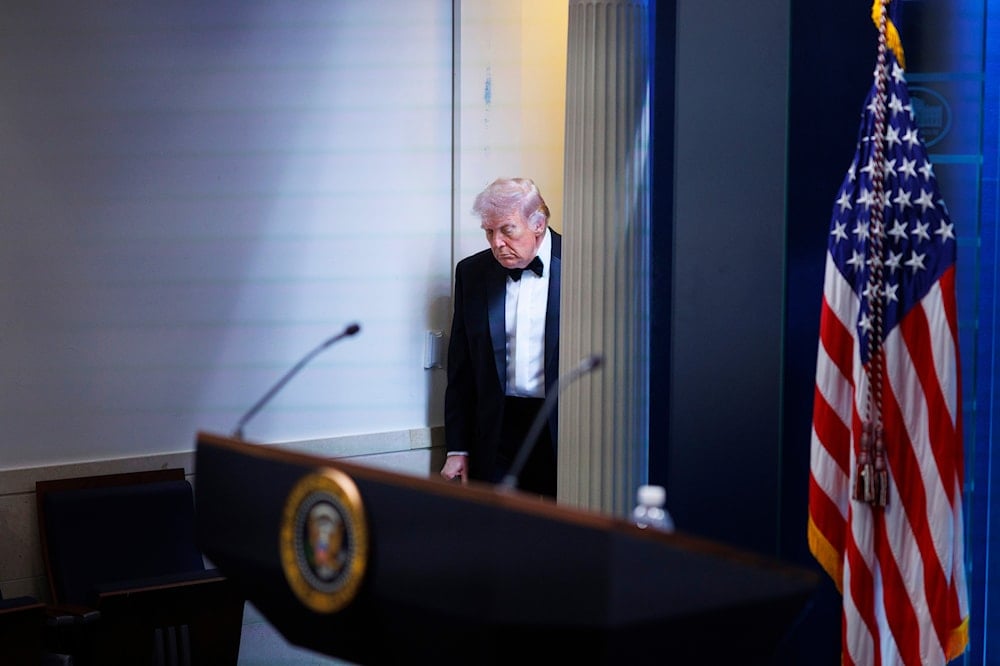
US President Donald Trump arrives at the James Brady Press Briefing Room at the White House, Saturday, April 25, 2026 (AP)
US President Donald Trump stated that American officials will not travel to Pakistan to engage in peace talks related to the war on Iran.
During a call-in interview on Fox News’ “The Sunday Briefing," he emphasized that any negotiations should take place on US terms rather than requiring long-distance travel by American representatives.
“We have all the cards. If they want to talk, they can come to us, or they can call us. You know, there is a telephone,” Trump said.
“We have nice secure lines, although I’m not sure any telephone line is secure, frankly, but we have secure lines, and if they want, we can talk, but we’re not sending people to travel 18 hours to meet,” he added.
Again, Trump says war will end soon
Trump reiterated similar remarks from the previous day, when he announced the cancellation of planned discussions in Islamabad.
“I just cancelled the trip of my representatives going is Islamabad, Pakistan, to meet with the Iranians,” Trump wrote at the time.
“Too much time wasted on traveling, too much work! Besides which, there is tremendous infighting and confusion within their ‘leadership,’” he continued. “Nobody knows who is in charge, including them. Also, we have all the cards, they have none! If they want to talk, all they have to do is call!!!”
He also repeated his claims that the war could “come to an end very soon,” alleging that the US is “going to be very victorious.”
The president’s controversial comments came after Vice President JD Vance canceled a planned trip to Islamabad the previous week, after Iranian officials said they would not attend, citing continued US violations.
Vance had been expected to participate in negotiations alongside Middle East envoy Steve Witkoff and Trump’s son-in-law, Jared Kushner.
Instead of proceeding with in-person talks, Trump extended the ceasefire with Iran indefinitely, pending a proposal from Tehran outlining terms to end the war.
The central theatre in the war
Trump claimed Washington’s expectations for any deal remain straightforward.
“Very simple. They cannot have a nuclear weapon, otherwise there’s no reason to meet,” Trump told Fox News' White House correspondent Jacqui Heinrich.
Trump alleged that the naval blockade imposed on the Strait of Hormuz is placing a significant strain on Iran’s economy, noting that the country’s resources are under pressure amid stalled diplomatic efforts.
“I think the big advantage is that we’ve taken out their navy in its entirety, which we’ve taken out their air force. Have no air force left. They have no navy left,” he said.
“Their leaders are gone. Which is, which is a good thing. They were far more radicalized than the people that we’re dealing with now, the people we’re dealing with now, some of them are very reasonable people, and others are not, and they’re not getting along,” Trump added.
Engagement with Iran
Trump said, “Some of the people we are dealing with now on Iran are very reasonable, others are not,” adding, “Hope Iran will be smart.”
He emphasized that nuclear-related conditions remain a key element in any potential agreement, claiming, “We are going to take Iran’s nuclear dust, part of negotiation.”
Iran continues to assert that its uranium enrichment activities are intended for peaceful purposes.
Read next: Iran is playing Trump, leading US to 'humiliation': Israeli media


