
Trump urges Netanyahu not to strike Iran as 'Israel' prepares response
 3 Min Read
Trump says he will tell Netanyahu not to strike Iran after Tehran's missile attack, while Israeli military leaders signal readiness for retaliation.
-
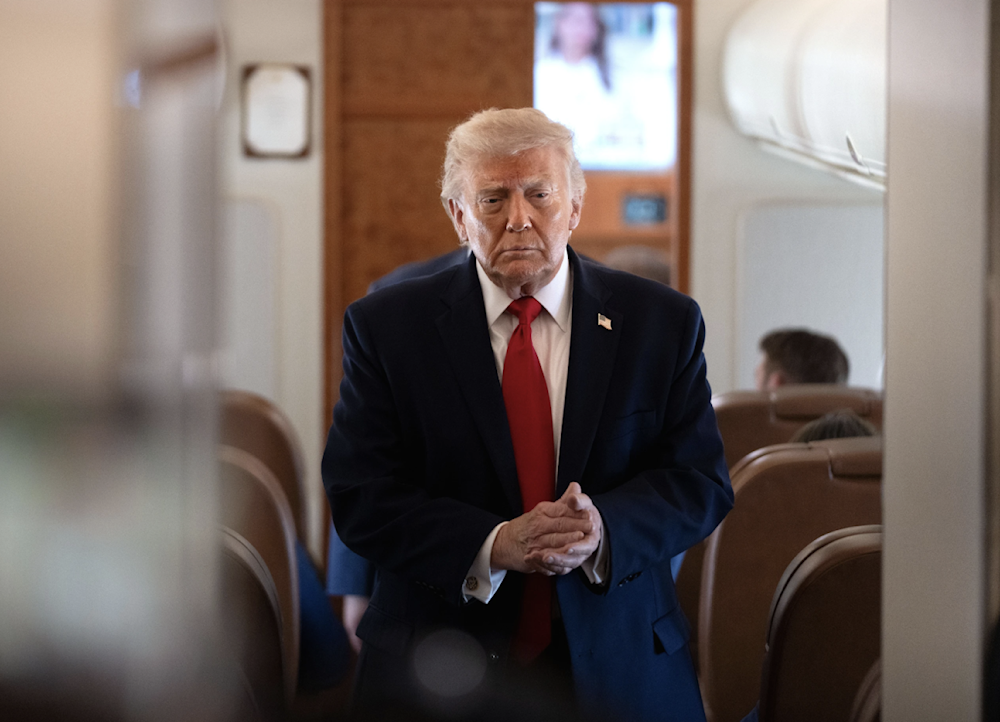
President Donald Trump arrives to speak to reporters aboard Air Force One en route from Joint Base Andrews, Md., to Eau Claire, Wis., on June 5, 2026. (AP)
United States President Donald Trump said he would urge Israeli Prime Minister Benjamin Netanyahu not to retaliate against Iran's latest missile attack, exposing an apparent divide between Washington's diplomatic strategy and the Israeli occupation's military posture.
The contradiction emerged as Trump publicly called for restraint and emphasized ongoing negotiations with Tehran, while Israeli military leaders signaled they are preparing response options and remain ready to strike.
"I am going to call Bibi right now and tell him not to retaliate. Each of them had their fun. Israel had its strike, and Iran had its strike. We don't need another one," Trump told Axios.
His remarks came after Iran launched multiple waves of missiles toward the occupied Palestinian territories in response to the Israeli attack on Beirut's southern suburb.
Trump pushes diplomacy as tensions rise
Trump sought to downplay the significance of Iran's attack and argued that further escalation could derail a potential agreement between Washington and Tehran.
"The Iranian strikes didn't hurt anybody," Trump said. "Hopefully Israel is not going to retaliate. If Bibi strikes them back, it's just gonna keep going like the last 47 years — or the last 3,000 years."
The US president stressed that negotiations with Iran remain his priority.
"We are very close to a final deal with Iran. It is going to be a good deal. I don't want it to blow up because of what is happening now," he added.
According to US officials cited by Axios, Trump personally spoke with Netanyahu following the attack and requested that any Israeli response be delayed while diplomatic efforts continue.
Israeli Channel 12 later reported that a senior US official said Trump does not expect an Israeli retaliation and asked Netanyahu to postpone any response for several days in hopes of securing an agreement with Iran.
Israeli military signals the opposite
While Trump publicly called for de-escalation, statements from the Israeli occupation's military leadership pointed in a different direction.
According to Israeli media, Chief of the General Staff Lieutenant General Eyal Zamir said the military is prepared to launch a forceful attack "as soon as the order is given."
The statements suggest that while Washington is seeking to avoid confrontation with Iran, the Israeli military establishment is actively preparing for aggressive actions.
Growing gap between Washington and Tel Aviv
The developments highlight an increasingly visible gap between the White House and the Israeli occupation government; however, previous public disagreements were revealed to be tuned to complicate opponents' decision-making.
Trump has repeatedly emphasized that he wants to secure a deal with Iran and avoid a wider regional war. His direct appeal to Netanyahu not to retaliate is one of the clearest public indications yet that Washington fears Israeli military action could undermine those efforts.
At the same time, Israeli military leaders continue to signal readiness for further escalation, while Israeli media reports indicate active planning for potential responses.


