
Tunisia arrests opposition figure Ahmed Nejib Chebbi, cites conspiracy
 4 Min Read
Ahmed Nejib Chebbi was arrested in Tunisia following his sentencing to 12 years in jail for "plotting against the state," amid a growing crackdown under Kais Saied.
-
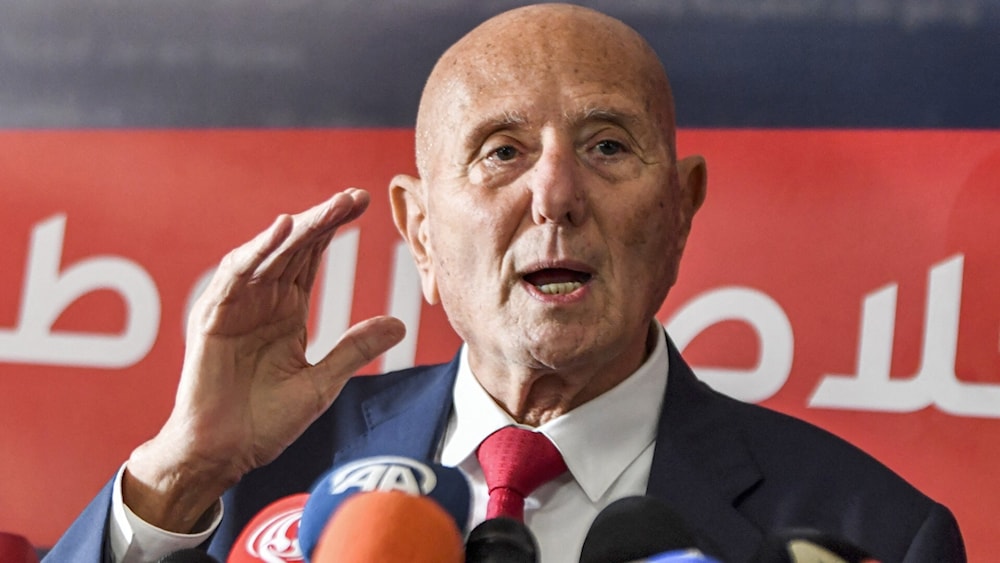
Ahmed Nejib Chebbi, political committee chief of Tunisia's Amal Party and leader of the opposition National Salvation Front, speaks during a press conference in the capital Tunis on February 15, 2023 (AFP)
Tunisian opposition veteran Ahmed Nejib Chebbi, 81, was arrested at his home on Thursday, his daughter confirmed, days after being sentenced to 12 years in prison for allegedly "plotting against the state." Rights groups have denounced the trial as politically motivated.
Chebbi, co-founder of the National Salvation Front (FSN), Tunisia's main opposition coalition, was among 40 opposition figures sentenced last Friday to prison terms ranging up to 45 years for "conspiracy against state security" and "belonging to a terrorist group," according to court documents seen by AFP.
His daughter, who is also a lawyer and a former student of President Kais Saied, confirmed the arrest in a phone call and shared on Facebook that police had taken him from their home. Chebbi’s lawyer, Amine Bouker, described Tunisia’s political climate as “frightening”, telling AFP that the arrests reflect a growing crackdown on dissent.
Saied escalates arrests against opposition
Chebbi has long been a prominent opposition figure, serving under former President Zine El Abidine Ben Ali and briefly as local development minister after Ben Ali’s fall in 2011. He also sat in the National Constituent Assembly from 2011 to 2014.
The arrest follows the detention of two other high-profile opposition figures in recent days: rights activist Ayachi Hammami on Tuesday and political figure Chaima Issa on Saturday, who received five- and twenty-year sentences respectively.
'Travesty of justice'
Human Rights Watch condemned last week’s trial as a "travesty of justice," calling it “political, unfair, and without the slightest evidence” and criticizing the "shameless instrumentalisation of the judiciary to eliminate Saied’s opponents."
Since seizing sweeping powers in 2021, President Saied has faced criticism for rolling back freedoms and prosecuting dozens of critics, often under terrorism-related charges or a 2022 law criminalizing the "spreading of false news."
Last week, the European Parliament voted to call on Tunisia to free all individuals who have been detained for exercising their right to freedom of expression, including political prisoners and human rights defenders, a move that was strongly condemned by President Kais Saied, who described the resolution as blatant interference and stated that the European Union could learn lessons from Tunisia on rights and freedoms.
Tunisia's face-off with autocracy
In the lead‑up to the October 2024 presidential election, the Tunisian authorities undertook a sweeping campaign to neutralize political challengers. More than a hundred members or supporters of the opposition Ennahda party were arrested under counter‑terrorism laws, including approved presidential candidate Ayachi Zammel, who was later sentenced to long prison terms. Judicial and electoral institutions were restructured to put them under executive control; for example, the electoral commission was re‑shaped in 2022 to be more directly linked to the presidency.
Once his 2021 power grab, in which he suspended parliament, assumed decree powers, and dissolved the judiciary‑oversight body, was firmly in place, Saied moved to suppress dissent systematically. In 2022, he dissolved the Supreme Judicial Council and dismissed dozens of judges, raising concerns over judicial independence.
By 2025, mass trials were underway: opposition figures, lawyers, businesspeople, and media professionals were being convicted of “conspiracy against state security” or terrorism‑related charges, with some sentences stretching as high as 66 years. A prominent trial that began in March 2025 targeted 40 individuals, resulting in the conviction of 37 defendants in April, with prison terms ranging from 4 to 74 years.
At the same time, the civil society space in Tunisia was under heavy assault. Authorities froze the assets of non‑governmental organizations, suspended operations of at least 14 such groups in 2025 alone, and used foreign‑funding legislation as a pretext to shut down independent watchdogs. Critics argue that the pressure on civil society aims to eliminate independent oversight and limit international scrutiny.
Saied and his supporters maintain that their campaign is focused on “purging the country of traitors and corruption.” However, human rights organizations, opposition parties, and international observers increasingly view the legal tools and judiciary as being weaponized against dissent, entrenching one-man rule and weakening democratic safeguards.


