
Turkey passing messages between US, Iran to push de-escalation, talks
 4 Min Read
Turkey says it is passing messages between Iran and the US while engaging Gulf states, as Ankara seeks to de-escalate tensions and revive negotiations amid the ongoing war.
-
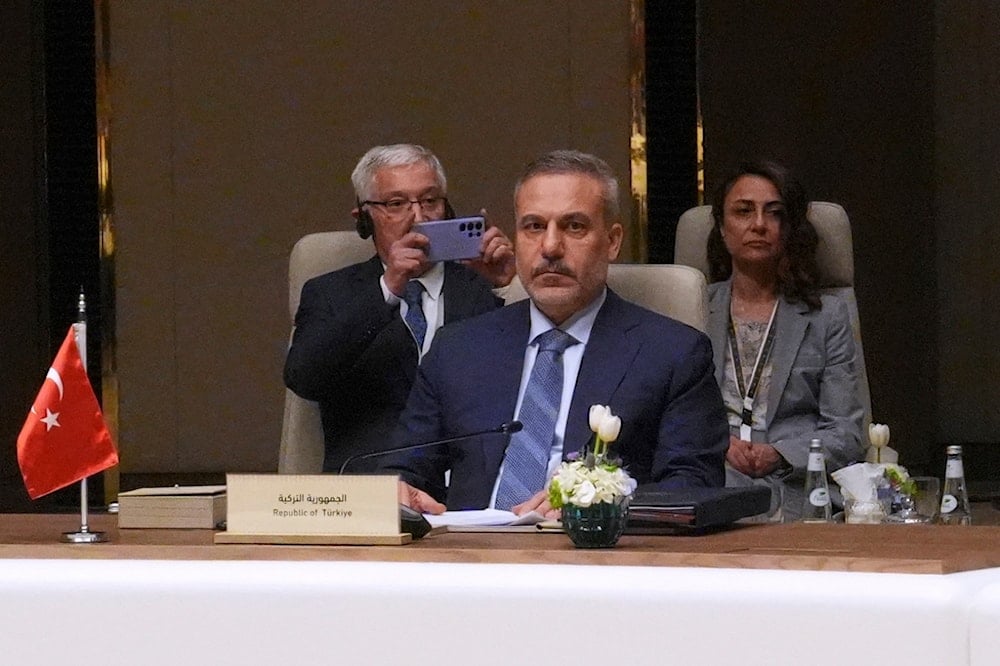
Turkey's Foreign Minister Hakan Fidan attends a consultative meeting of foreign ministers from a group of Arab and Islamic countries in the Saudi capital, Riyadh, Thursday, March 19, 2026 (AP)
Turkey is conveying messages between Iran and the United States to encourage de-escalation and direct negotiations, a senior official from President Recep Tayyip Erdogan’s ruling party said Wednesday, as cited by Reuters.
Harun Armagan, vice chair of foreign affairs for the Justice and Development Party, said Ankara is “playing a role passing messages” between the two sides, adding that similar communications are also being conveyed to Gulf countries affected by the expanding regional war sparked by the US-Israeli aggression on Iran.
Armagan did not provide details about the content of the messages but stressed Turkey’s role in promoting de-escalation and dialogue.
Turkey, a NATO member, had sought to mediate US-Iran talks before the war began nearly a month ago and has repeatedly called for an immediate halt to what it describes as "hostilities". Erdogan has said Ankara will continue working with all available resources to secure peace.
Iran denies any talks
It is worth noting that the Iranian Foreign Ministry stated before that de-escalation requests should be directed to the US, not Iran, considering that the war was initiated by courtesy of US-Israeli efforts.
"Yes, there are initiatives from some countries in the region to de-escalate tensions, and our response to all of them is clear: we are not the party that started this war, and all such requests should be directed to Washington."
Consequently, on Wednesday, Iran’s military command rejected claims by UD President Donald Trump that Washington is currently engaged in negotiations to end the war.
It warned that its adversaries’ “strategic power” has turned into a failure, saying the balance has shifted in Tehran’s favor while rejecting any agreement under current conditions.
Diplomatic outreach to Tehran, Washington, and Gulf states
Following up, Foreign Minister Hakan Fidan said Ankara has been delivering “friendly” advice to Tehran to avoid further escalation, while also maintaining contact with Washington to better understand both sides’ positions.
On Sunday, a Turkish diplomatic source said Fidan held talks with US officials, as well as Iranian Foreign Minister Abbas Araghchi, among others, to discuss possible steps toward ending the war.
'Weeks of war ahead, short-term ceasefire possible'
Turkish Foreign Minister Hakan Fidan warned last Saturday that the war could persist for another two to three weeks, pointing to Israeli obstruction as the primary obstacle standing between the region and any diplomatic resolution.
Fidan delivered the assessment to reporters following a tour of regional countries, noting that while multiple parties have floated timelines for an end to the war, the picture remains deeply uncertain.
"Some say that the Gulf war will last for another 2-3 weeks," Fidan told TRT. "Of course, the United States' position will be crucial."
He noted that "Israel" was actively working to pressure Washington and undermine ceasefire efforts, adding that observers were increasingly suggesting that initial US and Israeli positions had diverged, a split that could itself prolong the war.
Fidan was blunt on the prospects for diplomacy in the near term, stating that meaningful talks were "unlikely to take place as long as the war continues." He did not, however, rule out a short-term ceasefire aimed specifically at creating the space to assess whether conditions for negotiation exist.
"The problem is not that there are no plans to end the war," Fidan said. "The problem is that Israel does not want peace."
Read more: Iran military command to enemies: Are you negotiating with yourselves?


