
Turkey reaches out to Iran, US, EU and Egypt in push to end Iran war
 4 Min Read
Hakan Fidan held separate calls with Iranian, Egyptian, US, and EU counterparts on Sunday, seeking a path to end the war in the region.
-
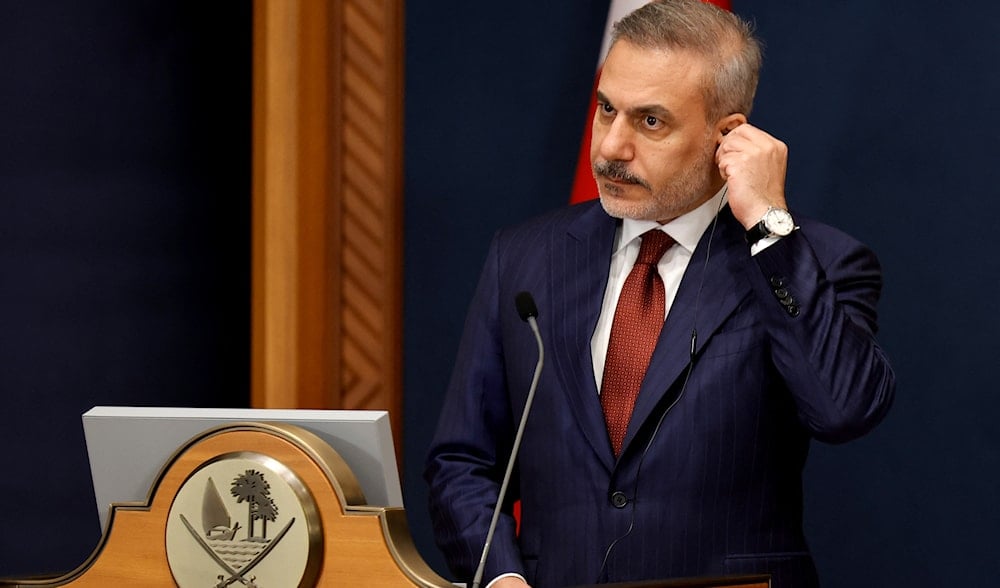
Turkey's Foreign Minister Hakan Fidan attends a joint press conference with Qatar's Prime Minister and Foreign Minister Sheikh Mohammed bin Abdulrahman Al Thani, in Doha on March 19, 2026 (AFP)
Turkish Foreign Minister Hakan Fidan has held a round of diplomatic calls with counterparts from Iran, Egypt, the United States, and the European Union, seeking to map out a path toward ending the war in the Gulf, a Turkish diplomatic source confirmed to Reuters on Sunday.
Fidan spoke separately with Iranian Foreign Minister Abbas Araghchi, Egyptian Foreign Minister Badr Abdelatty, EU foreign policy chief Kaja Kallas, and US officials, though details of what was discussed in each call were not disclosed.
The diplomatic push comes a day after Fidan warned that the war could drag on for another two to three weeks, citing Israeli obstruction as the central obstacle to any resolution.
He had been blunt about the prospects for meaningful negotiations, saying talks were unlikely to gain traction while active hostilities continued, though he did not rule out a short-term ceasefire aimed at testing whether conditions for diplomacy exist.
El-Sisi speaks with Jordan's king
As part of regional efforts aimed at de-escalation, Egyptian President Abdel Fattah el-Sisi received a phone call from Jordan's King Abdullah II ibn Al Hussein, in which they discussed developments in regional issues of mutual concern.
They affirmed the unity of the Egyptian-Jordanian stance on the need to de-escalate the current tensions and the importance of integrating Arab efforts to restore regional security and stability. In this context, the President reviewed the outcomes of his Gulf tour, reaffirming Egypt’s firm position in condemning aggression against brotherly Arab states and the necessity of respecting their sovereignty and stability.
A fragile diplomatic landscape
Tehran has made its position clear, with Iranian Parliament Speaker Mohammad Bagher Ghalibaf stating earlier in the month that Iran is "certainly not seeking a ceasefire," insisting that those responsible for the aggression must face consequences significant enough to deter any future attack.
A senior Iranian security official had also told Al Mayadeen last week that no viable scenario for ending the war currently exists, and that any eventual agreement must include the Axis of Resistance as a party.
Meanwhile, the situation on the ground continues to escalate. Iran's Khatam al-Anbiya Central Headquarters announced Sunday that the country has shifted from a defensive to an offensive military posture, with senior commanders warning of newly deployed weapons systems and pledging that operations would continue "with full force."
The IRGC Aerospace Force has separately asserted total missile dominance over the southern occupied territories.
Washington is stuck
The diplomatic pressure on Turkey to act is compounded by a growing rift between Washington and Tel Aviv. Israeli media, including Haaretz, have reported that Trump is actively seeking an off-ramp from the war, while Israeli Prime Minister Benjamin Netanyahu appears intent on prolonging it, a divergence Fidan flagged on Saturday as a factor that could extend the war further.
US credibility has also taken a hit. Israeli newspaper Israel Hayom acknowledged that Washington has yet to develop a workable strategy to counter Iran's effective control over the Strait of Hormuz, the closure of which has already driven sharp increases in global energy prices and rattled financial markets.
Fidan, for his part, has framed Turkey's role in the war as that of a consistent and credible actor. "From the very beginning, we did not adopt an ambiguous stance," he said Saturday, stressing that Ankara has opposed both the Israeli aggression and any effort to widen the war regionally.
Whether Sunday's calls translate into any concrete diplomatic framework remains to be seen. For now, Turkey is talking to everyone, in a war where almost no one is ready to stop fighting.


