
UK-held Palestinian activist risks organ failure in hunger strike
 3 Min Read
Medical and human rights monitors say a months-long hunger strike highlights deepening concerns over detainee treatment linked to Palestine-related activism in the UK.
-
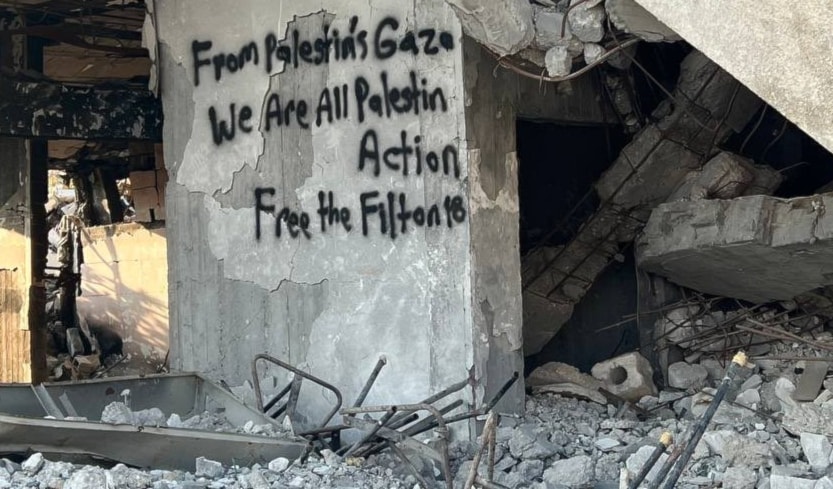
Graffiti on the wall of a building destroyed by Israeli bombs in Gaza reads: “From Palestinians in Gaza, we are all Palestine Action; Free the Filton 18” (AP)
A Palestinian activist being held on remand in a UK prison is facing worsening health complications as her hunger strike passes the 60-day mark, according to an advocacy group monitoring her condition.
Prisoners for Palestine (P4P) warned on Tuesday that detainees, including Heba Muraisi, are now at serious risk of organ failure as the protest stretches into its third month.
Muraisi told the group she has been experiencing “muscle spasms and twitches in her arm” and at times feels “like she is holding her breath and doesn’t know why, like she has to remind herself to breathe.”
In a most recent update on Heba Muraisi’s health, she describes having to remind herself to breathe, having the constant feeling of holding her breath
— Prisoners For Palestine (@Prisoners4Pal) January 5, 2026
Kamran has been hospitalised 5 times as he describes being cuffed the entire time
Three months in and silence from @DavidLammy
P4P said the symptoms may point to emerging neurological complications.
Prolonged remand, transfer sparked protests
Muraisi has been held on remand for more than a year in connection with her Palestine-related activism and has now gone 64 days without food.
She began the hunger strike on November 3, 2025, after being transferred without prior notice from HMP Bronzefield to HMP New Hall, a move that placed her hundreds of miles away from her family and support network.
Muraisi has said she will not end the strike unless she is returned to Bronzefield and granted immediate bail.
Family voices support
Her mother, Dunya, who has been unable to visit her daughter, expressed solidarity in a letter shared by P4P.
“We are here behind you, supporting you and loving you without limits,” she wrote. “No matter how long the night of waiting lasts, the sun of freedom will surely rise.”
Muraisi is one of eight activists linked to Palestine Action who have launched hunger strikes to protest being held on remand and the UK government’s decision to proscribe the direct-action group.
Another striker, Kamran Ahmed, was hospitalized for the fifth time last week. Ahmed has now spent 58 days on a hunger strike and has reported intermittent hearing loss.
Punitive treatment
P4P says the cases reflect a broader pattern of prolonged remand, punitive prison transfers, and inadequate medical care for detainees connected to Palestine activism.
The activists are being held in different UK prisons over alleged involvement in break-ins at facilities owned by Israeli arms firm Elbit Systems and at a Royal Air Force base in Oxfordshire.
Last month, seven UN human rights experts warned the UK government that the hunger strikers face the risk of organ failure and death if the protests continue.
Despite the escalating health concerns, the British government has so far declined to meet with the hunger strikers or their representatives. In response, their lawyers are now pursuing legal action over what they describe as a refusal to engage.
In July, the UK government voted to proscribe Palestine Action as a “terrorist” organization.
Founded in 2020, the group has described itself as a movement “committed to ending global participation in Israel’s genocidal and apartheid regime.”


