
UK rejects shift on Irish unity after Trump backs reunification
 3 Min Read
The UK government says its stance on Irish reunification remains unchanged after Donald Trump said he would "love" to see a united Ireland.
-
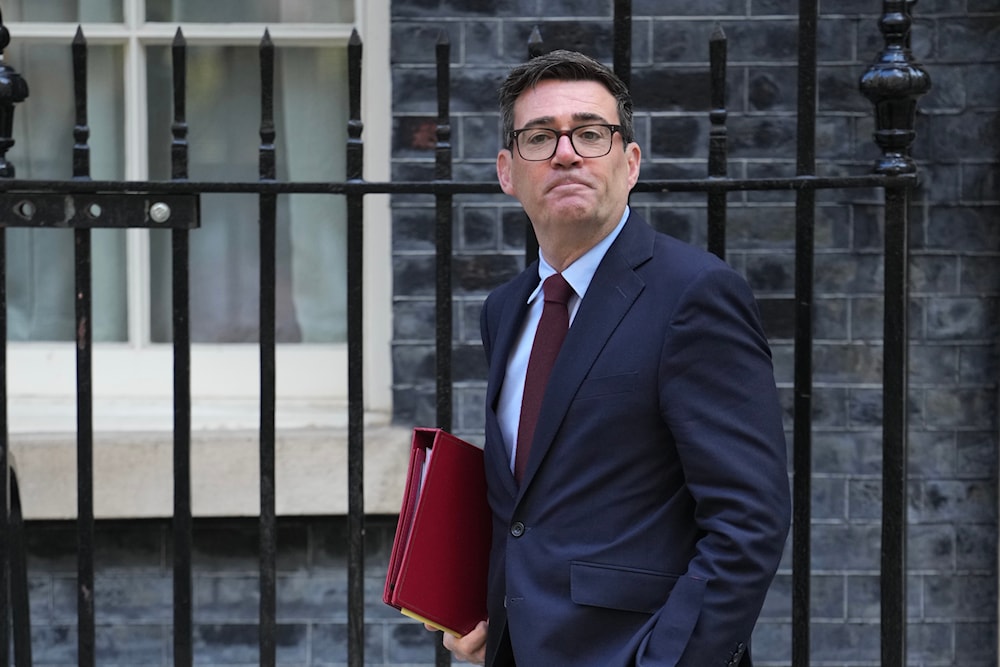
Britain's Prime Minister Andy Burnham leaves 10 Downing Street to attend the weekly Prime Ministers' Questions session in Parliament in London, Wednesday, Sept. 9, 2026 (AP)
The British government has reaffirmed that its position on Irish reunification remains unchanged after US President Donald Trump voiced support for a united Ireland during a visit to Dublin.
According to Reuters, a spokesperson for British Prime Minister Andy Burnham said on Saturday that the government continues to stand by Burnham’s earlier remarks ruling out a referendum on Northern Ireland’s constitutional status unless public support shifts significantly.
Trump told reporters following a meeting with Irish Prime Minister Micheál Martin that he would “love” to see a united Ireland, adding that reunification would eventually take place.
His comments placed renewed attention on the long-running debate over Northern Ireland’s future and the prospect of a so-called border poll on whether the territory should remain part of the United Kingdom or join the Republic of Ireland.
London says no basis for referendum
Burnham addressed the issue in parliament earlier this week after lawmakers questioned him over the possibility of holding another referendum in Northern Ireland.
“I am not aware that there is majority public support for another referendum, and until that changes, there will not be one,” Burnham said.
A spokesperson for his office told Reuters on Saturday that the prime minister’s position had not changed following Trump’s remarks.
Under the framework established by the Good Friday Agreement, a referendum on Irish unity can be held if the British government determines that majority support for reunification is likely in Northern Ireland.
Trump’s intervention comes as the question of Irish unity continues to feature prominently in political debate on both sides of the Irish border, particularly amid changing electoral dynamics in Northern Ireland.
Trump remarks come amid strains with London
Trump’s intervention also comes amid growing friction between Washington and London over several foreign policy and sovereignty-related issues.
Relations have been strained by differences over Britain’s response to the US-led war on Iran, with Trump previously criticizing London over what he viewed as insufficient support for Washington’s military campaign.
Tensions have also emerged over Palestine after the British government moved to restrict imports from illegal Israeli settlements, a measure Washington declined to follow.
More significantly, Trump has recently raised questions over Washington’s position on the Falkland Islands, another politically sensitive sovereignty issue for Britain. Earlier this year, reports also revealed discussions within the Pentagon over whether US diplomatic support for the British position on the islands could be reconsidered in response to disagreements with London over Iran.
Against that backdrop, Trump’s support for Irish reunification marks another intervention in a highly sensitive issue concerning British territorial and constitutional interests.
Read more: Farage factor fuels fears over UK breakup, Irish unity


