
Farage factor fuels fears over UK breakup, Irish unity
 5 Min Read
The growing influence of Reform UK leader Nigel Farage has sparked concern across Ireland and parts of the UK that a future Reform-led government could accelerate constitutional tensions.
-
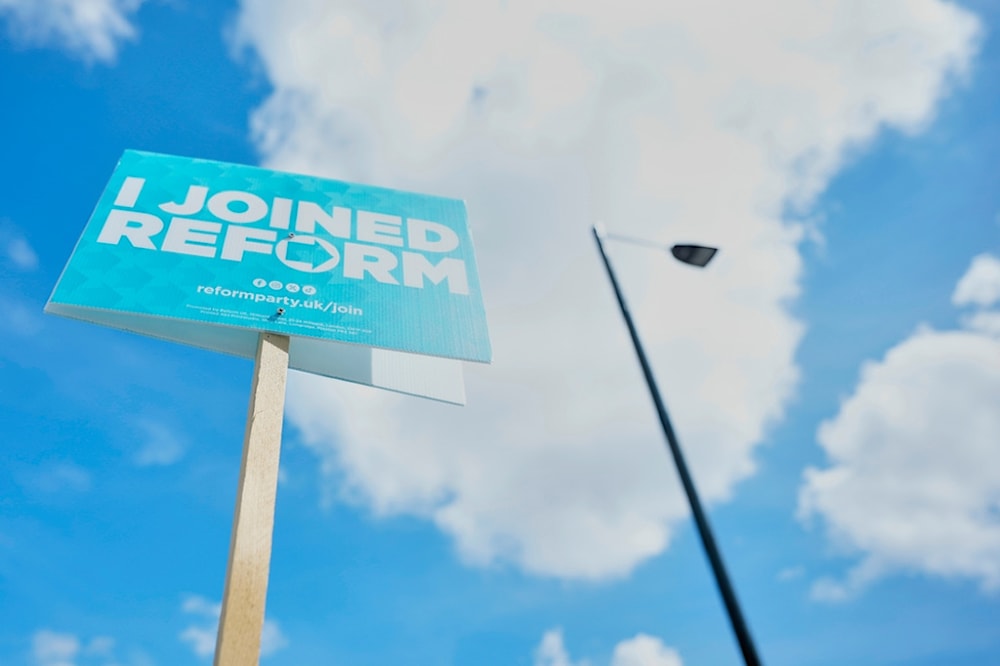
A Reform UK political sign put up by the householder to show support ahead of local council elections in London, Wednesday, May 6, 2026 (AP)
The growing influence of Reform UK leader Nigel Farage is intensifying debate across Britain and Ireland over the future of the United Kingdom, The Guardian reported, as political figures warn that a major Reform breakthrough could unsettle the constitutional balance among England, Scotland, Wales, and Northern Ireland.
Unionist and nationalist figures are increasingly assessing how a Farage-led government, or even a powerful Reform UK opposition, could reshape the political landscape after the next general election. Their concerns center on the possibility that English nationalism, tougher immigration policies, and renewed confrontation with European legal frameworks could accelerate demands for Irish unification and wider constitutional change.
Warnings from political leaders
Mark Drakeford, the former first minister of Wales and a longtime supporter of the union, warned that a Reform surge could leave little space for a careful discussion about the UK’s future. He said it was possible that “in just a handful of years’ time, people on the island of Ireland will be looking across the Irish Sea to a country where ICE-like snatch squads are arresting people off the streets."
Drakeford said British politics had shifted in ways that could make constitutional questions more urgent, warning that “there may not be time” for a measured debate if Farage enters Downing Street or significantly expands Reform UK’s presence in parliament.
“The United Kingdom is a voluntary association of four nations, and in any voluntary association there must be choices that people can make to stay in and choices that people can make to leave.”
His remarks came during a Belfast conference hosted by the Social Democratic and Labour Party, where politicians from Ireland, Northern Ireland, Scotland, and Wales discussed the danger of being “bounced” into a referendum on Irish unification without proper planning.
Ireland’s justice minister Jim O’Callaghan argued that Dublin should not wait for political developments in London to dictate the timing of constitutional change. “The future may not go down the predictable pathway of discussions and harmony,” he said.
Economic concerns and political strategy
One concern raised by Irish and Northern Irish figures is that the cost of maintaining Northern Ireland within the UK could become a target for Farage. The UK’s annual subvention to Northern Ireland is estimated at between £6bn and £20bn, a figure some believe could be turned into a Brexit-style campaign slogan.
“Wait till he sees our bill,” said SDLP leader Claire Hanna. “I think if English nationalists really dive deep into the resources that Northern Ireland requires, that could become a political football, a political problem.”
Hanna said Brexit had shown the risks of pushing through major constitutional change without sufficient preparation. “Brexit was a lesson in how not to do constitutional change, and since then British politics had changed in a structural way,” she added. “We can no longer say the Nigel Farage phenomenon is a flash in the pan, unfortunately. It’s a feature now of UK politics. So it is prudent for us to think about our own constitutional future and not be passengers in wherever politics wishes to take us.”
Calls for preparation and future planning
Sinn Féin, which has long called for a referendum on Irish unity, also warned against leaving the issue to political instability in London. Conor Murphy, a former Stormont finance minister and current Irish senator, said the British government should clarify the rules of any future border poll before a possible period of turmoil.
Murphy said Farage could exploit higher estimates of the Northern Ireland subvention. “He could say: ‘We’re going to save that by letting the Irish go and good luck to you and goodbye.’ He could do that. I’m not suggesting that he will but it’s kind of the nature of their policies. It’s Trump-like. It’s unpredictable.”
He said Sinn Féin wanted Dublin to engage with London “while there might be someone sensible in Whitehall” in order to define the framework for a referendum. “Establish the groundwork, establish the ground rules and make sure that they at least are insulated from whatever chaos might arise.”
Dublin moves toward unity blueprint
In the Republic of Ireland, Fine Gael has also begun moving more openly into the debate, saying it plans to present a blueprint for a united Ireland at its annual conference in November.
Former Taoiseach Leo Varadkar said he did not view a Farage government as the most likely outcome, but warned that such a scenario could accelerate a border poll. “An accelerator could be a UK government led by Reform that doubles down on Brexit, that takes this view that Brexit failed because it wasn’t done properly and looks for a harder separation from the EU and reopens these questions around the ECHR [European convention on human rights].”
ECHR debate adds to constitutional pressure
Farage has called for the UK to leave the European Convention on Human Rights and has also spoken of renegotiating the Good Friday Agreement, which is closely tied to the convention, as part of his push to stop small boat crossings into England.
Recent polling by Queen’s University Belfast professors Katy Hayward and David Phinnemore found that 36% of respondents in Northern Ireland supported removing the ECHR, compared with 29% across the wider UK, highlighting the complex political terrain surrounding any future constitutional confrontation.
Read more: Starmer warns successor against neglecting global crises


