
UN launches urgent probe into abuses in Sudan’s El-Obeid
 4 Min Read
UN Human Rights Council launches urgent investigation into abuses in El-Obeid, warning of imminent risk of large-scale atrocities against civilians in Sudan.
-
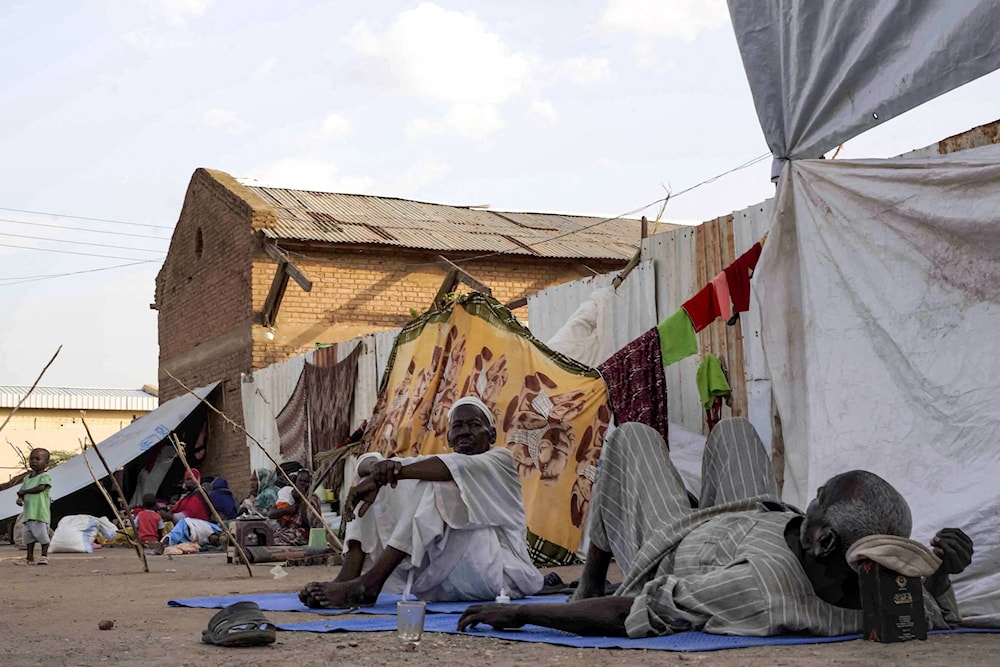
Men sit and lie outside shelters at the Hasahisa secondary school on July 10, 2023, which has been made into a make-shift camp to house people fleeing violence in war-torn Sudan (AFP)
The United Nations Human Rights Council decided on Monday to launch an urgent investigation into violations and abuses committed in the city of El-Obeid in Sudan’s North Kordofan state, warning of an imminent risk of large-scale atrocities against civilians.
The resolution was adopted unanimously by the Council’s 47 members following an emergency debate held on Friday at the request of the United Kingdom. In its statement, the Council expressed its “deep concern over the imminent risk of large-scale atrocities, in particular conflict-related sexual violence, affecting hundreds of thousands of civilians in El-Obeid and surrounding areas.”
“These horrors must not be repeated,” Britain’s Human Rights Ambassador Eleanor Sanders told the body.
Urgent probe into violations of international humanitarian law
The Council mandated the International Independent Fact-Finding Mission on Sudan to carry out an urgent investigation into violations of international humanitarian law and related international crimes.
It stressed that there is “no military solution to the crisis in Sudan,” reiterating its call for an “immediate and unconditional ceasefire,” as well as for a “credible and inclusive political transition process leading to a democratically elected national government following a civilian-led transitional period.”
The Council also condemned “airstrikes against civilians and the unlawful targeting of civilian infrastructure,” specifically pointing to “dozens of drone strikes on El-Obeid over the past two weeks, including hospitals and other health facilities, which have resulted in civilian casualties and disrupted access to essential services.”
In addition, it called on “all parties to the conflict to ensure the protection of civilians,” particularly those forced to flee their homes, while condemning the “widespread use of rape and other forms of sexual and gender-based violence as a method of warfare.”
The city of El-Obeid
El-Obeid has a population of around 500,000 and is also hosting approximately 100,000 people displaced by violence in other parts of the country.
The city has been under siege for months by the Rapid Support Forces (RSF), which have been fighting the Sudanese army since April 2023.
Over the past three weeks, the United Nations, NGOs, and various governments have issued warnings about a potential imminent assault on El-Obeid, similar to last year’s offensive that led to the capture of El-Fasher in western Sudan’s Darfur region, where the RSF has been accused of committing atrocities.
UK placed UAE ties over preventing atrocities in El-Fasher
It is worth noting that the British government has been accused of deliberately suppressing intelligence and obstructing international action during the genocidal assault on El-Fasher in Sudan, where an estimated 60,000 civilians were killed, according to testimony presented to a parliamentary committee.
The Foreign, Commonwealth & Development Office (FCDO) reportedly received repeated alerts describing the situation as potentially one of the largest mass casualty events of the 21st century. These warnings came ahead of the UAE-backed RSF’s assault on El-Fasher after the extended siege.
Nathaniel Raymond, executive director of the Humanitarian Research Lab (HRL) at the Yale School of Public Health, told the International Development Committee that his team provided UK officials with real-time intelligence for more than two years. He said the data consistently indicated that the siege would result in large-scale civilian killings.
He stated that officials “prioritised HMG’s [His Majesty’s Government’s] economic, security, and diplomatic relationships with the UAE above preventing the intentional starvation, forced displacement, and the genocidal slaughter of tens of thousands of civilians living in El Fasher and its surrounding communities,” in written testimony to MPs.
Raymond also described meetings in which Foreign Office officials discussed limits on public warnings from civil society groups. NGOs were reportedly cautioned against repeatedly issuing alerts about the fall of El-Fasher to avoid diminishing credibility.
What's the cost of choosing the cheaper option when lives are at stake?
— Al Mayadeen English (@MayadeenEnglish) November 9, 2025
A #UK watchdog review reveals that officials rejected robust civilian protection plans for #Sudan's El Fasher despite warnings of potential mass atrocities.
Budget constraints were cited as one reason for… pic.twitter.com/wOIFSfsu1h


