
Inside UNRWA's secret mission to save Palestinian refugee archives
 5 Min Read
UNRWA carried out a months-long operation to rescue and digitize historic Palestinian refugee archives from Gaza and eastern al-Quds amid Israeli aggression.
-
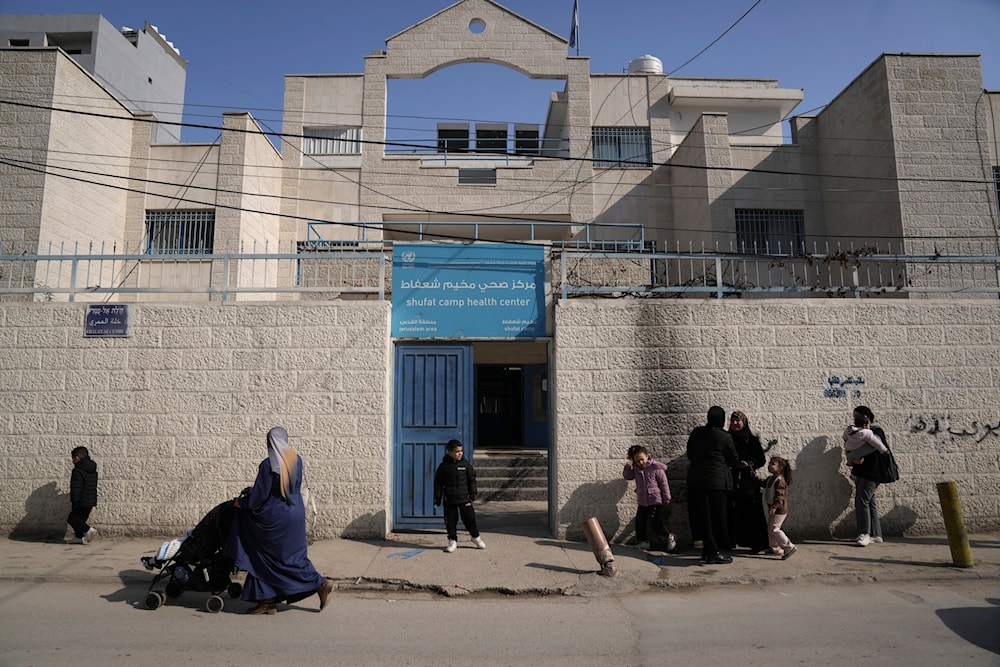
Palestinians gather outside of a health clinic run by the United Nations agency for Palestinian refugees, known as UNRWA, in the Shuafat refugee camp in occupied al-Quds, on January 27, 2025 (AP)
An investigative report by The Guardian on Thursday revealed a months-long operation carried out by the United Nations Relief and Works Agency for Palestine Refugees (UNRWA) that successfully rescued and transferred millions of historical Palestinian records from Gaza and occupied al-Quds to Jordan amid the ongoing war on Gaza and mounting pressure from Israeli authorities.
The operation, which unfolded over nearly 10 months, involved the evacuation of sensitive archives documenting decades of Palestinian refugee history, including original registration cards, birth certificates, marriage records, and testimonies related to the displacement of Palestinians during the 1948 Nakba, according to Jason Burke, The Guardian's International Security Correspondent.
Senior UNRWA officials said that the mission required coordination across multiple countries and included dangerous trips through active war zones, covert document transfers, and emergency digitization efforts.
Stored in paper, under bombardment
At the outset of the Israeli war on Gaza in October 2023, many of UNRWA’s most valuable archives remained stored in paper form inside the agency’s compound in Gaza City.
The documents included refugee registration records belonging to Palestinians expelled during the occupation of Palestine in 1948. Officials feared the archives could be permanently destroyed during Israeli bombardment or military incursions. "Their destruction would have been catastrophic … If there is ever a just and durable solution to this conflict, then this is the only evidence people can use to show there were once Palestinians living in a particular place," said Roger Hearn, a senior UNRWA official who oversaw the operation.
Jean-Pierre Filiu, a professor of Middle East Studies at Sciences Po in Paris, described the records as "crucial to the Palestinian experience," adding that "there are testimonies of how people were forced to flee in 1948, where they came from, where their property was, what was destroyed."
Covert rescue operation conducted under bombardment
Following Israeli evacuation orders in Gaza City, international UNRWA staff departed the area rapidly, leaving the archives temporarily behind. “There was a real risk that the Israelis would move in and destroy them, or they would just be destroyed in a fire or an explosion,” said Sam Rose, acting director of UNRWA affairs in Gaza.
Amid ongoing Israeli airstrikes and shelling, a small group of UNRWA employees reportedly returned to the Gaza City compound using rented pickup trucks to transport the archives southward toward Rafah.
The documents were later transferred through Egypt in what officials described as a highly sensitive operation. UNRWA personnel carrying international passports reportedly moved portions of the archives discreetly across border crossings. "If anyone was stopped at the border, they just said they were carrying paperwork," Rose said.
The archives were eventually transported to Jordan through a humanitarian effort involving Jordanian military aircraft delivering aid to Gaza.
Officials stated that the final shipment left Gaza only weeks before Israeli forces seized Rafah in May 2024, effectively cutting off the last viable exit route.
Eastern al-Quds archives also removed
A separate collection of archives housed at UNRWA’s compound in occupied eastern al-Quds also became the focus of urgent evacuation efforts.
According to officials, cited by The Guardian, the compound faced increasing pressure amid Israeli accusations against UNRWA and escalating campaigns targeting the agency. The facility reportedly became the site of protests and arson attacks during 2024. “In East Jerusalem, we had months of warnings that we would lose access [to our offices],” Rose said.
Efforts to secure diplomatic protection for the archives reportedly failed, prompting UNRWA staff to secretly transfer the remaining records over several months to Jordan. In January 2025, Israeli legislation banning UNRWA operations in occupied Palestine entered into effect.
Massive digitization effort underway in Jordan
In Amman, UNRWA launched a large-scale project to digitize the rescued archives with support primarily funded by Luxembourg.
More than 50 staff members reportedly worked to scan millions of records by hand, including original refugee registration cards and historical administrative documents. "Now [the archives] are out of Palestine, but at least they are protected," Filiu said.
UNRWA officials said nearly 30 million documents have already been digitized. The agency hopes the archive project will eventually allow Palestinian refugees to access detailed family records and trace ancestral origins across historic Palestine. The records are also expected to contribute to historical research surrounding the displacement of approximately 750,000 Palestinians during the 1948 Nakba.
Dr. Anne Irfan, a historian specializing in the modern Middle East at University College London, said the archives hold exceptional national significance for Palestinians. "The Palestinians are a stateless people and without a fully unified national archive … so the UNRWA archive has a particular significance for them," Irfan said.
She added that the digitized materials could provide valuable insight into the history of Palestinian displacement, the role of the United Nations, and broader political developments in the region over the past eight decades.


