
UNSC condemns settler violence, urges Gaza ceasefire commitment
 4 Min Read
UN Security Council debates Gaza ceasefire, Israeli settler violence, and the future of the "two-state solution" amid rising tensions in occupied Palestine.
-
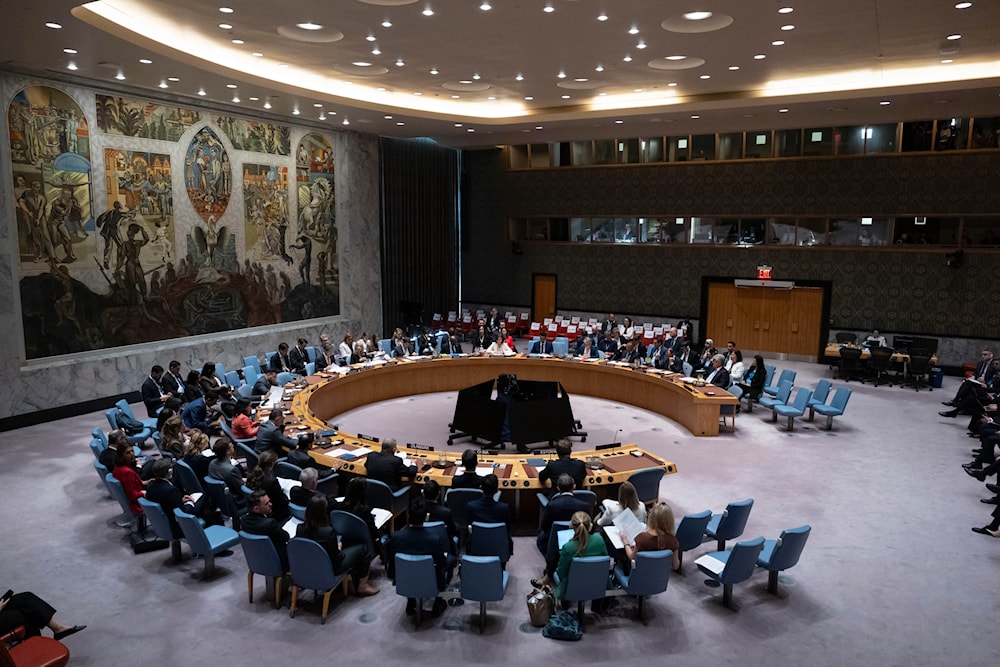
A general view shows a Security Council meeting at United Nations Headquarters, Monday, Sept. 22, 2025 (AP)
The United Nations Security Council convened a session on Tuesday to discuss developments in the Middle East, with a particular focus on the situation in the occupied Palestinian territories.
During the meeting, Russia’s UN Ambassador, Vasily Nebenzya, condemned settler attacks and crimes against Palestinians, describing them as efforts to displace residents and deprive them of their livelihoods. He emphasized that "the future of Gaza should be part of a Palestinian state along with the West Bank."
China’s representative to the Security Council, Fu Cong, stressed that "the Palestinian issue must not be marginalized in any form" and called for a ceasefire in Gaza. He additionally warned that settler violence is escalating, all while undermining the "two-state solution", urging an immediate halt to all Israeli settlement activities.
The US representative, Dorothy Shea, said she expects that violence in the West Bank would end, reiterating Washington’s opposition to its "annexation"., without saying how.
France’s UN Ambassador, Gérôme Bonafe, highlighted the need for all parties to respect the Gaza ceasefire, release all detainees, and adhere to US President Donald Trump’s peace plan. He also warned that escalating violence in the West Bank and al-Quds is undermining prospects for peace.
"We seek lasting security for both Palestinians and Israelis and stability in the Middle East," Bonafe said, calling for the protection of Palestinians from settler attacks and accountability for perpetrators.
Gaza, West Bank test of international system's legitimacy: Algeria
Algeria’s ambassador, Ammar Benjamai, described the situation in Gaza and the West Bank as a test of the international system’s legitimacy. He accused "Israel" of planning to demolish nearly 100 homes in the West Bank and receiving protection rather than accountability for its actions.
Benjamai called for protection for Gaza, noting that despite the ceasefire, Israeli forces continue committing violations, and criticized the Security Council for shielding Israeli actions against Palestinians and UNRWA, having failed to impose sanctions.
The Algerian envoy also accused "Israel" of continuing attacks in Lebanon, Syria, and Palestine, while pointing out that "everyone accepted the ceasefire except Israel."
West Bank, Gaza, suffer under the yoke of Israeli occupation
Despite the international condemnations and the ceasefire in place, Gaza continues to face sustained Israeli aggression, all while the West Bank sees daily raids, arrests, demolitions, and Israeli settler attacks.
The Palestinian Ministry of Health in Gaza said on December 16 that hospitals received the bodies of two people recovered from the rubble, along with six injured individuals, over 24 hours. The Ministry added that a number of victims remain trapped under debris and on roads, as ambulance and civil defense teams continue to face difficulties reaching them.
Since the ceasefire took effect on October 11, 2025, Palestinian health authorities have reported 393 martyrs and 1,074 injured, while the cumulative toll of the Israeli aggression has climbed to 70,667 martyrs and 171,151 injured since October 7, 2023.
IOF kill teenager in West Bank, settlers destroy olive trees
Meanwhile, on December 15, Israeli occupation forces killed a Palestinian teenager during a raid on the town of Tuqu‘, southeast of Beit Lahm, in the occupied West Bank, after Israeli troops entered the town, deployed in its center, and opened fire with live ammunition, fatally shooting 17-year-old Ammar Yasser Sabah in the chest.
In a separate incident on the same day, Israeli settlers set fire to olive trees in Burqa village, east of Ramallah, with local sources reporting that the attackers targeted the al-Hadab area in western Burqa, igniting several trees in the process.
Despite the rain, the trees ignited, suggesting that highly flammable materials were used and that the flames could have threatened nearby homes.


