
US, 'Israel' sign deal for permanent US embassy in occupied al-Quds
 4 Min Read
The US and "Israel" sign an agreement allocating land for a permanent US Embassy compound in occupied al-Quds, advancing Trump's 2017 embassy move.
-
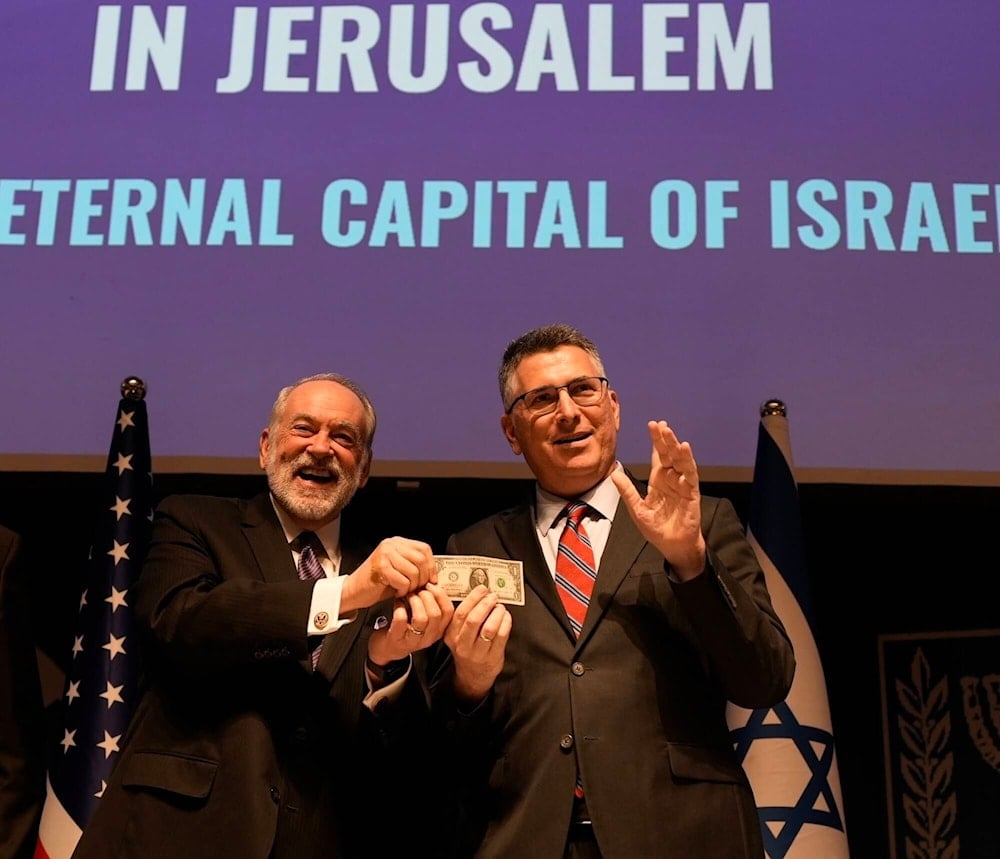
The US Ambassador to "Israel", Mike Huckabee, hands Israeli Foreign Minister Gideon Sa'ar the symbolic payment of one dollar for the lease of the land intended for the future permanent US embassy in occupied al-Quds on July 1, 2026. (Social media/X platform)
The United States and "Israel" signed a formal agreement on Wednesday allocating land for the construction of a new, permanent US Embassy compound in occupied al-Quds, marking the latest step in a diplomatic process initiated more than eight years ago.
Israeli Foreign Minister Gideon Sa'ar and US Ambassador to "Israel" Mike Huckabee inked the deal during a ceremony at the Foreign Ministry, which was also attended by occupied al-Quds Mayor Moshe Lion. The agreement activates the transfer of the embassy from its current premises to a newly built, permanent facility in the occupied city.
The pact formalizes a recent Israeli cabinet decision to designate the Allenby compound for the project. Officials on both sides cast the development as a solidification of US President Donald Trump’s December 2017 directive, which recognized occupied al-Quds as the Israeli capital and ordered the embassy’s relocation from Tel Aviv.
Israeli officials praise decision
“This is another milestone in the unshakeable alliance between "Israel" and the United States,” Sa'ar said at the signing. He added that the move builds upon Trump’s original decision and cements it “for generations to come.”
Sa'ar characterized the agreement as more than a land transfer, calling it “a recognition of history and a declaration of our shared future.”
The foreign minister also underscored "Israel’s" strategic value to Washington, describing it as America’s most important strategic asset in West Asia.
Mayor Lion hailed the signing as the moment Trump’s 2017 decision “officially [turned] from paper to stone,” reiterating that al-Quds “was and will always be our eternal capital.” He thanked Trump, Ambassador Huckabee, and Sa'ar for advancing the project.
Ambassador Huckabee, speaking at the ceremony, described the day as another historic moment in bilateral relations, confirming that the United States would construct a new, “impressive” embassy compound to support what he called the United States' and "Israel's" “vital and irreplaceable partnership.”
The new permanent compound will eventually replace the current embassy facility, which opened in 2018 following Trump’s initial relocation order. No timeline for the construction or completion of the new site was immediately released.
World condemnds Trump's decision to move US embassy to al-Quds
US President Donald Trump's December 6, 2017, decision to recognize al-Quds as the Israeli capital and relocate the US embassy drew immediate international backlash.
Palestinian President Mahmoud Abbas condemned the move on December 6, 2017, calling it an abdication of America's role as a peace mediator and warning it would destroy hopes for a two-state solution.
Additionally, European allies swiftly rejected the decision. Then-British Prime Minister Theresa May stated on December 6, 2017, that the move was "unhelpful" to peace efforts, while French President Emmanuel Macron and then-German Chancellor Angela Merkel both insisted al-Quds' status must be settled through direct negotiations.
Arab nations expressed deep concern. Saudi Arabia stated on December 6, 2017, warning of "dangerous consequences," and Jordan declared the recognition "legally null" as it undermined the city's final status.
The United Nations also weighed in, with Secretary-General António Guterres reiterating on December 6, 2017, that there was "no alternative" to the two-state solution and that all sides must respect international law.
On December 18, 2017, the US vetoed a UN Security Council resolution, supported by the 14 other members, that would have required Trump to rescind his declaration, further deepening its diplomatic isolation on the issue.


