
US attacks on Iran's Asaluyeh facilities emit 1.5 mln tonnes of CO2
 3 Min Read
Iran's Environment Department chief Shina Ansari says US attacks on energy facilities in Asaluyeh released greenhouse gases equivalent to 1.5 million tonnes of carbon dioxide.
-
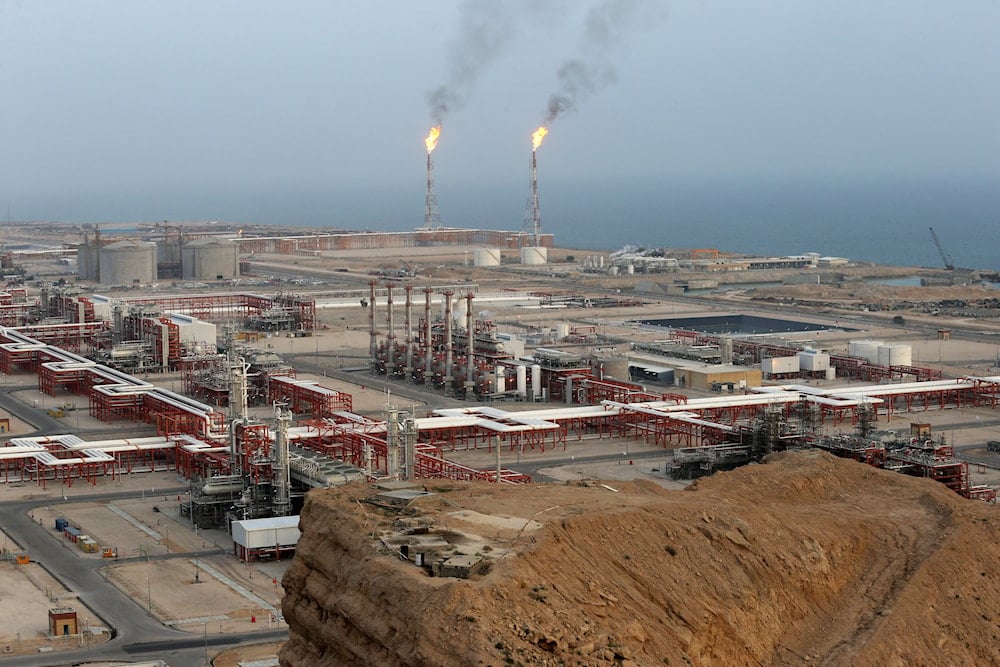
A natural gas refinery is visible at the South Pars gas field on the northern coast of the Persian Gulf, in Asaluyeh, Iran on March 16, 2019 (AP)
US attacks on energy facilities in Iran's Asaluyeh released greenhouse gases equivalent to 1.5 million tonnes of carbon dioxide, according to Iranian Department of Environment chief Shina Ansari.
The figure covers emissions resulting from attacks on fuel storage sites and other infrastructure in the southern Iranian petrochemical hub, Ansari said. She added that the amount of carbon dioxide involved would equal the annual absorption capacity of 66 million mature trees.
"Several days of attacks on fuel storage and infrastructure facilities in Asaluyeh led to emissions equal to 1.5 million tonnes of carbon dioxide. Such amount of gas is absorbed annually by 66 million mature trees," Ansari said, according to Iranian state television.
The United States and "Israel" launched war on Iran on February 28, prompting Iran to retaliate by targeting US assets in the region. US and Israeli forces later struck the South Pars gas field and the Asaluyeh industrial zone in March.
War on Iran generates 5 million tonnes of emissions in first two weeks
A March 22, 2026 analysis by The Guardian estimates that the US-Israeli war on Iran generated about 5 million tonnes of carbon dioxide equivalent (tCO2e) during its first 14 days, exceeding the combined annual emissions of 84 of the world's lowest-emitting countries.
The destruction of civilian infrastructure accounted for the largest share. Around 20,000 civilian buildings were damaged, according to reports from the Iranian Red Crescent, with the resulting emissions estimated at 2.4 million tCO2e.
Military fuel consumption was the second-largest source, with aircraft, naval vessels, and military vehicles consuming an estimated 150 million to 270 million liters of fuel during the first two weeks, producing about 529,000 tCO2e. Destroyed military equipment added another 172,000 tCO2e, while missiles, drones, and interceptors contributed about 55,000 tCO2e.
Strikes on fossil fuel facilities further increased emissions. Attacks and subsequent fires are estimated to have burned between 2.5 million and 5.9 million barrels of oil, releasing approximately 1.88 million tCO2e.
Overall, the analysis puts emissions from the first 14 days at 5,055,016 tCO2e. If maintained at the same rate over a full year, that would amount to about 131 million tonnes of CO2 equivalent, roughly comparable to the annual emissions of Kuwait.


