
5m tonnes of CO2 emitted in just 14 days of US war on Iran: Analysis
 4 Min Read
The US-Israeli war on Iran generated emissions equal to 84 countries in just two weeks, highlighting the severe climate cost of modern warfare.
-
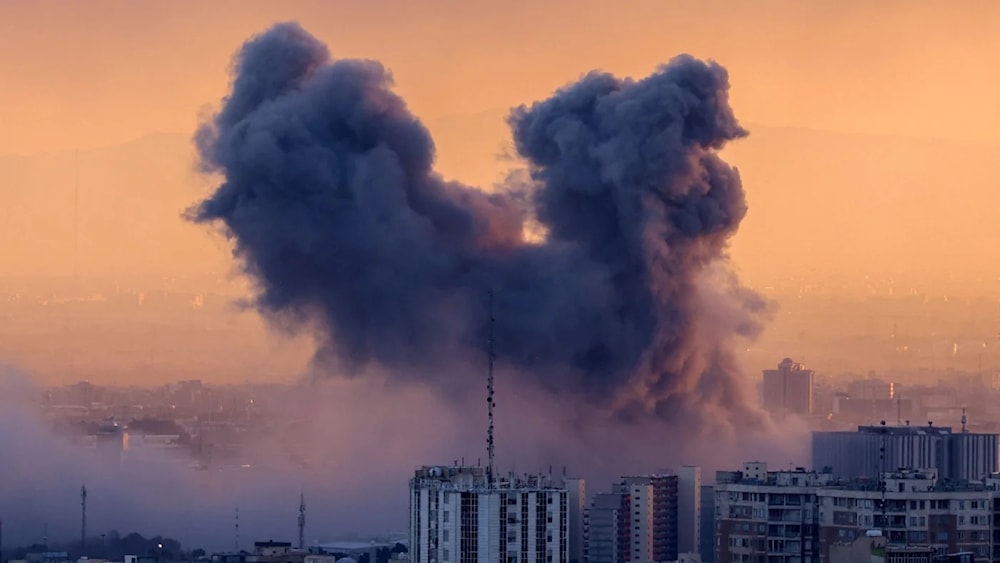
A plume of smoke rises after a strike on the Iranian capital Tehran, on March 3, 2026. (AFP)
The climate impact of the US-Israeli war on Iran is rapidly escalating, with a new analysis estimating that the war generated more greenhouse gas emissions in its first 14 days than those produced by 84 countries combined.
According to an analytical report by The Guardian, while warplanes, drones, and missiles continue to devastate infrastructure and civilian areas across the region, West Asia is increasingly being transformed into a large-scale environmental sacrifice zone. The analysis found that the war produced approximately 5 million tonnes of carbon dioxide equivalent (tCO2e) within just two weeks.
The largest contributor to emissions stems from the destruction of civilian infrastructure. According to reports from the Iranian Red Crescent, around 20,000 civilian buildings have been damaged during the war. This destruction is estimated to have generated 2.4 million tonnes of CO2 equivalent, making it the single biggest source of emissions so far.
Military operations and fuel consumption
Fuel consumption from military operations represents the second-largest source of emissions. US heavy bombers have reportedly flown from as far as western England to conduct strikes on Iran.
The analysis estimates that between 150 million and 270 million litres of fuel were consumed by aircraft, naval vessels, and military vehicles during the first 14 days, producing approximately 529,000 tCO2e.
Destroyed military equipment and munitions
The loss of military hardware has also contributed to emissions. In the first two weeks, the US reportedly lost four aircraft, while Iran lost 28 aircraft, 21 naval vessels, and around 300 missile launchers.
The destruction of this equipment is estimated to account for 172,000 tCO2e in embodied carbon emissions. Meanwhile, the extensive use of munitions, including missiles, drones, and interceptors, has added a further 55,000 tCO2e to the total.
Oil fires and fossil fuel infrastructure damage
Strikes on fossil fuel infrastructure have significantly intensified the environmental toll. One of the most notable incidents occurred when “Israel” bombed major fuel storage depots near Tehran, igniting massive fires.
The attacks, along with retaliatory strikes, are estimated to have burned between 2.5 million and 5.9 million barrels of oil, releasing approximately 1.88 million tonnes of CO2 equivalent. These incidents highlight the broader climate risks associated with targeting fossil fuel infrastructure during military conflicts.
Total emissions and global comparisons
In total, emissions from the first 14 days of the war reached 5,055,016 tCO2e. On an annualized basis, this equates to 131 million tonnes of CO2 equivalent, comparable to the emissions of a mid-sized fossil fuel-dependent economy such as Kuwait.
This figure is also equivalent to the combined emissions of the world’s 84 lowest-emitting countries, underscoring the scale of the environmental impact.
Patrick Bigger, research director at the Climate and Community Institute and co-author of the analysis, warned: “Every missile strike is another downpayment on a hotter, more unstable planet, and none of it makes anyone safer.”
He added: “Every refinery fire and tanker strike is a reminder that fossil-fuelled geopolitics is incompatible with a livable planet. This war shows, yet again, that the fastest way to supercharge the climate crisis is to let fossil fuel interests dictate foreign policy.”
Fred Otu-Larbi, the study’s lead author from the University of Energy and Natural Resources in Ghana, also cautioned that emissions are likely to rise further:
Strain on the global carbon budget
The climate cost of the US-Israeli war on Iran comes at a critical time for the global carbon budget. Climate scientists estimate that humanity can emit approximately 130 billion tonnes of CO2 while maintaining a 50% chance of limiting global warming to 1.5°C.
At the current global emissions rate of around 40 billion tonnes per year, this budget could be exhausted by 2028.
Beyond immediate emissions, the war may trigger longer-term increases in fossil fuel production. Disruptions to supply historically lead to expanded drilling and infrastructure development.
Bigger warned: “Historically, every US-driven energy shock has been followed by a surge in new drilling, new LNG terminals, and new fossil-fuel infrastructure. This war risks hard-wiring another generation of carbon dependence.”


