
US-backed Gaza 'humanitarian zone' plan raises displacement concerns
 5 Min Read
The pilot plan has raised concerns that it could entrench displacement, restrict Palestinian movement, and fragment governance under continued Israeli military control.
-
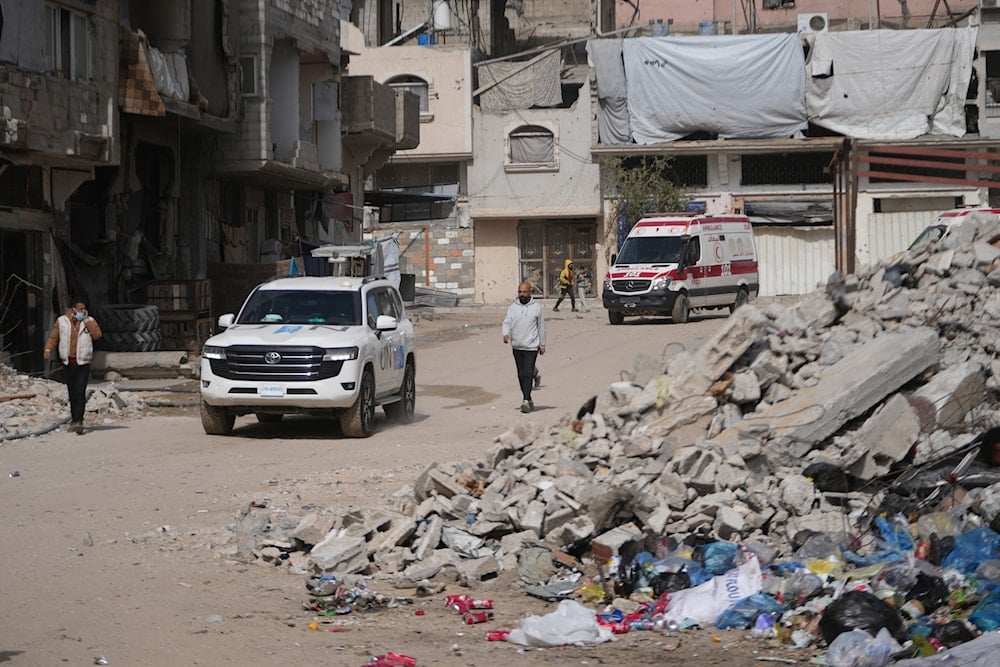
UN vehicles escort ambulances and a bus carrying Palestinian patients in Khan Younis as they travel to the Rafah crossing to leave the Gaza Strip for medical treatment abroad, Thursday, Mar, 19, 2026 (AP)
A US-backed body formed under President Donald Trump’s Gaza ceasefire framework is weighing a pilot “humanitarian zone” in southern Gaza, a proposal likely to deepen Palestinian concerns that Washington and “Israel” are seeking to repackage displacement, security control, and political engineering as post-war relief.
A "Board of Peace" official told AFP that the project could be established in Rafah, where tens of thousands of screened Palestinian civilians would be housed under the supervision of a Palestinian technocratic committee and protected by multinational troops.
The plan comes as Israeli occupation forces continue to control more than 60 percent of Gaza despite the ceasefire that entered into effect last October, raising fears that a limited zone in the south could serve as a managed enclave while the occupation maintains its grip over the rest of the Strip.
Screening and foreign oversight
Under the proposal, the National Committee for the Administration of Gaza, or NCAG, would manage screening and access control, while the International Stabilization Force, a multinational force operating under the Board of Peace, would handle security.
Movement in and out "will remain free for all unarmed civilians," the board official told AFP on condition of anonymity.
But the idea of vetting Palestinians before allowing them into a designated zone is likely to be viewed by Palestinians as a political-security mechanism aimed at separating civilians deemed acceptable from those accused of links to the Resistance.
Such a mechanism would therefore fit into a broader pattern of attempts to impose external control over Gaza’s future, weaken the Resistance, and create alternative administrative structures under foreign supervision rather than genuine Palestinian sovereignty.
"There's one pilot project we're looking at particularly, that maybe you can get the NCAG a starting point, you can enable tens of thousands to come if they wish voluntarily to this area, and you start giving them a space where they exercise effective governance and they're the administration," the official said.
Rafah as a testing ground
The official said the "Board of Peace" was “looking at Rafah” for the project, though no construction has begun and the exact location has not been finalized.
Rafah was extensively destroyed during the Israeli war on Gaza and remains largely under Israeli military control. That makes the choice of location especially sensitive, as Palestinians and aid officials have repeatedly warned against plans that could turn devastated areas into controlled camps rather than enabling displaced families to return freely to their homes across the Strip.
The International Stabilization Force would serve as a "kind of buffer" between Palestinians and the Israeli military, according to the official.
"A screening mechanism will ensure that armed individuals and militants cannot enter these safe humanitarian zones," he added.
"This function will not be performed by the IDF (Israeli occupation force), which will have no contact with the civilian population and no role in separating these areas from the rest of Gaza."
Asked about the proposal, the Israeli military told AFP, "The matter is known and is currently under review."
Governance without sovereignty
The "Board of Peace" was formally established earlier this year under the US-backed ceasefire plan endorsed by the UN Security Council. Its declared role is to oversee Gaza’s transition away from Hamas rule, restore civilian administration, and support basic services.
Hamas announced on Monday the dissolution of the body that had governed Gaza for nearly two decades, a move presented as clearing the way for the Palestinian technocratic committee.
However, the continued inability of the NCAG to enter Gaza, combined with the ongoing Israeli military presence across large parts of the territory, has kept the ceasefire framework stalled.
From Hamas’ perspective, the Rafah pilot zone would likely be seen not as a neutral humanitarian initiative, but as an attempt to create fragmented areas of limited self-administration under foreign security control, while delaying full Israeli withdrawal and sidelining the Resistance.
Under Trump’s plan, the International Stabilization Force is supposed to deploy in Gaza as Israeli forces withdraw. The "Board of Peace" official said four countries were "really engaged" with the force: Morocco, Kosovo, Albania, and Kazakhstan. He added that an ISF support site near Kerem Shalom, on the Israeli side of the Gaza border, was "close to complete."
Warnings of fragmentation
The proposal has already raised serious concerns among diplomats and humanitarian officials working in Gaza. Speaking anonymously to AFP, they warned that concentrating civilians in demarcated zones subject to access controls could violate international humanitarian law, restrict Palestinian movement, and normalize displacement.
For Palestinians, the fear is that such zones could become a substitute for reconstruction, return, and full sovereignty, while giving “Israel” more room to operate militarily elsewhere in Gaza.
Muhammad Shehada, a visiting fellow with the European Council on Foreign Relations, said the plan could "accommodate a miniscule symbolic amount of Palestinians" in temporary structures to give "a facade of progress" in parts of Gaza.
He warned that the mechanism could allow the Israeli military greater freedom of action across the rest of the Strip and reduce the NCAG to an authority governing fragmented territory rather than Gaza as a whole.
The proposal therefore places the US-backed ceasefire framework under renewed scrutiny, with critics warning that humanitarian language is being used to advance a political-security arrangement that could entrench Gaza’s division and preserve Israeli control under a different name.
Read more: Gaza bloodshed ongoing as Israeli attacks claim more Palestinian lives


