
US blockade on Iran hinders Pakistani diplomatic push
 4 Min Read
Pakistan is intensifying diplomatic efforts to salvage the Iran–US talks, as Tehran rejects negotiations under US maritime blockade conditions.
-
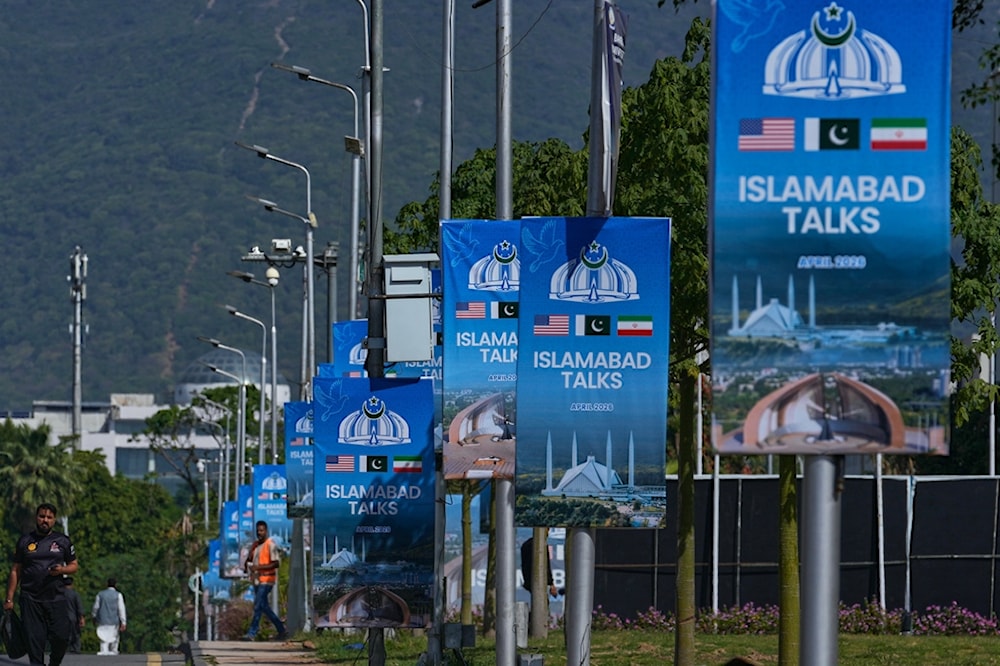
Workers walk past billboards near the Serena Hotel ahead of a potential second round of negotiations between the United States and Iran, in Islamabad, Pakistan, on April 20, 2026. (AP)
Intensive diplomatic efforts by Pakistan are underway to salvage a potential second round of negotiations between Iran and the United States, amid mounting uncertainty over whether talks will take place in the coming hours or days, according to informed sources in Islamabad.
Al Mayadeen's correspondent in the Pakistani capital reported that there are, so far, no concrete indicators suggesting an imminent new round of negotiations, despite sustained contacts by Pakistani authorities with both Washington and Tehran aimed at securing a viable framework for dialogue.
The sources noted that Islamabad is seeking to ensure that any upcoming session is not merely procedural, but rather “constructive” and capable of laying the groundwork for a possible agreement. However, informed sources indicated that the Iranian side is currently refusing to participate in talks following a major US escalation, including the targeting of an Iranian commercial vessel.
No signs of imminent breakthrough
Al Mayadeen’s correspondent in Islamabad confirmed that recent communications between Iranian and Pakistani leadership over the past 24 hours have not produced any indication that a second round of negotiations is imminent.
In parallel, the Associated Press reported that Pakistan has intensified its diplomatic outreach since Sunday, engaging both Washington and Tehran in an effort to restart negotiations by Tuesday.
Iran: No plans for new talks under current conditions
Iranian state media, citing official sources, confirmed that Tehran is not currently planning to participate in any new round of talks with Washington.
The development comes as US President Donald Trump dispatched a negotiating delegation to Islamabad on Monday evening, claiming it would present a “reasonable agreement” to Tehran. However, this coincided with heightened tensions after a US destroyer allegedly targeted and detained the Iranian cargo vessel Toska in the Gulf of Oman, an incident Tehran said was “armed piracy”, warning of an imminent response.
Earlier, the Islamic Revolution Guard Corps's Navy (IRGC-N) announced it had reasserted control over the Strait of Hormuz, linking the move to what it described as violations of ceasefire commitments and the continuation of a maritime blockade on Iranian ports and shipping routes.
Maritime blockade remains key obstacle
Iranian sources cited by Fars and Tasnim news agencies said the overall atmosphere “cannot be described as very positive,” stressing that the lifting of the US maritime blockade on Iranian ports remains a precondition for any negotiations.
The official IRNA news agency further reported that Trump’s “maximum pressure approach” and contradictory positions, alongside the continued maritime restrictions, are effectively blocking prospects for meaningful dialogue.
Foreign Ministry spokesperson Esmail Baghaei described the US blockade as “not merely a violation of the ceasefire mediated by Pakistan, but a criminal act and collective punishment amounting to a war crime and a crime against humanity.”
Strategic chokepoints and nuclear dispute deepen rift
With the temporary two-week truce nearing its expiration in three days, key disputes remain unresolved, most notably the status of the Strait of Hormuz. Tehran insists that any unauthorized passage through the waterway would be considered cooperation with a hostile party and that offending vessels would be targeted.
On the other hand, US President Trump has reportedly pushed for opening the strait by force while maintaining the blockade on Iranian ports.
The nuclear file also remains highly contested. Trump has claimed that Tehran agreed to transfer 440 kilograms of enriched uranium, a claim Iran’s Foreign Ministry has categorically denied, stating that its uranium stockpile “will not be transferred anywhere” and that such a proposal was never raised in negotiations.
Read more: John Bolton: Trump in 'panic mode' after Iran downs US aircraft


