
US chokes Cuba, then offers seized Venezuela oil as 'humanitarian' aid
 3 Min Read
Washington announced a partial easing of its ban on Venezuelan oil exports to Cuba, but the Cuban state remains locked out of the arrangement.
-
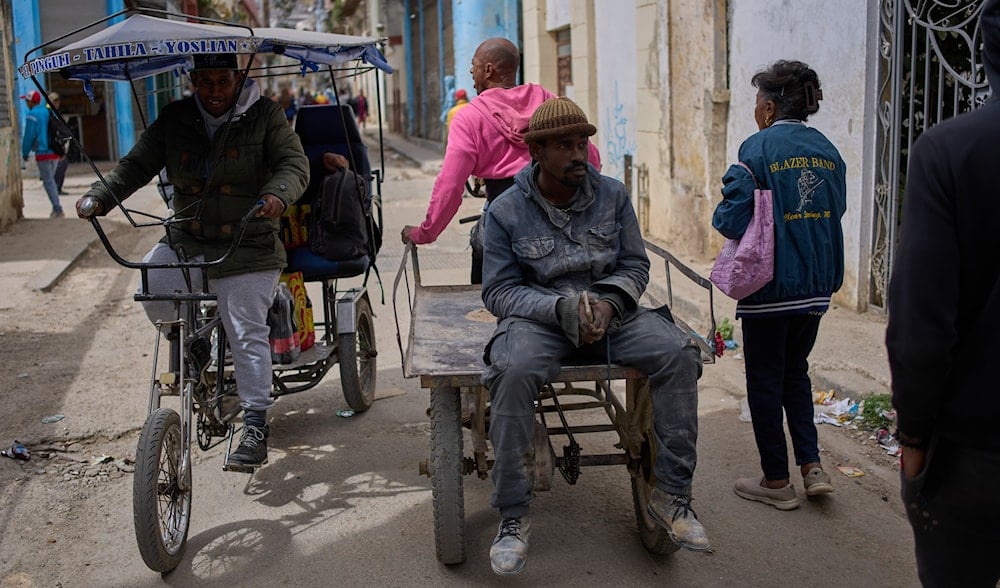
People traverse a street in Havana, Tuesday, Feb. 24, 2026 (AP)
Washington has softened a sweeping ban on Venezuelan oil exports to Cuba, announcing a partial carve-out that allows Venezuelan crude to reach the island through US-approved channels.
The Treasury Department's Office of Foreign Assets Control (OFAC) announced Wednesday it would apply a "favorable licensing policy" toward specific license applications seeking to route Venezuelan-origin oil to Cuba for "commercial and humanitarian use."
The announcement came as Secretary of State Marco Rubio, a Cuban-American who has spent his political career pursuing regime change in Havana, sat in closed-door talks with Caribbean Community (CARICOM) leaders in Saint Kitts and Nevis, where the humanitarian fallout from Washington's own pressure campaign had become the unavoidable subject of the summit.
The mechanics
What Washington announced is narrower than the headline suggests. The favorable licensing policy applies only to transactions that bypass the Cuban state, directing oil toward private businesses and individuals unaffiliated with the government.
The Commerce Department simultaneously clarified that its existing License Exception SCP, "Support for the Cuban People," already permits gas and petroleum exports to Cuba's private sector without requiring separate OFAC authorization.
Cuba's energy infrastructure, its national grid, distribution networks, and import terminals, is state-operated. A permission that excludes the entities that actually run the power sector cannot address the crisis on the scale it demands.
Following January's aggression on Caracas, Washington assumed control of Venezuela's oil export proceeds, channelling payments into US-controlled Treasury accounts. The crude being discussed is effectively seized Venezuelan oil, to be routed through a handful of US-licensed traders, on Washington's terms, through Washington's intermediaries, as an act of "humanitarian" concern.
Decades of blockade, sharpened to a crisis
Cuba's energy collapse did not unravel overnight. The US embargo, first imposed in the early 1960s, has for decades restricted the island's access to capital, medicine, and fuel. Cuba had relied on Venezuela for roughly half its fuel needs, an arrangement that collapsed when US forces raided Caracas on January 3, abducting President Nicolas Maduro and severing Havana's principal energy lifeline.
An executive order signed by Trump on January 29 then designated Cuba "an unusual and extraordinary threat," warning that countries exporting oil to the island could face punitive tariffs.
The results have been swift and severe, with blackouts stretching up to 20 hours, shuttered schools, gutted public transport, and hospitals running on rationed fuel. The UN Secretary-General had warned earlier this month that essential services could collapse if oil supplies were not restored.
CARICOM's warning
It was this trajectory that brought the Cuba question to a head in Saint Kitts and Nevis. Jamaican Prime Minister Andrew Holness warned that further deterioration in Cuba would ripple across the Caribbean, triggering migration flows and regional instability. "Humanitarian suffering serves no one," he said. "A prolonged crisis in Cuba will not remain confined to Cuba."
Rubio has publicly softened his regime-change rhetoric since taking office, and Trump has held off on measures pushed by hardliners such as blocking remittances. But the administration has also been reported to be actively seeking Cuban insiders who might help dislodge the government by year's end.


