
US delivers F-35s minus advanced radars due to production delays
 4 Min Read
The US technical delays mount questions about Block 4 readiness and combat capability.
-
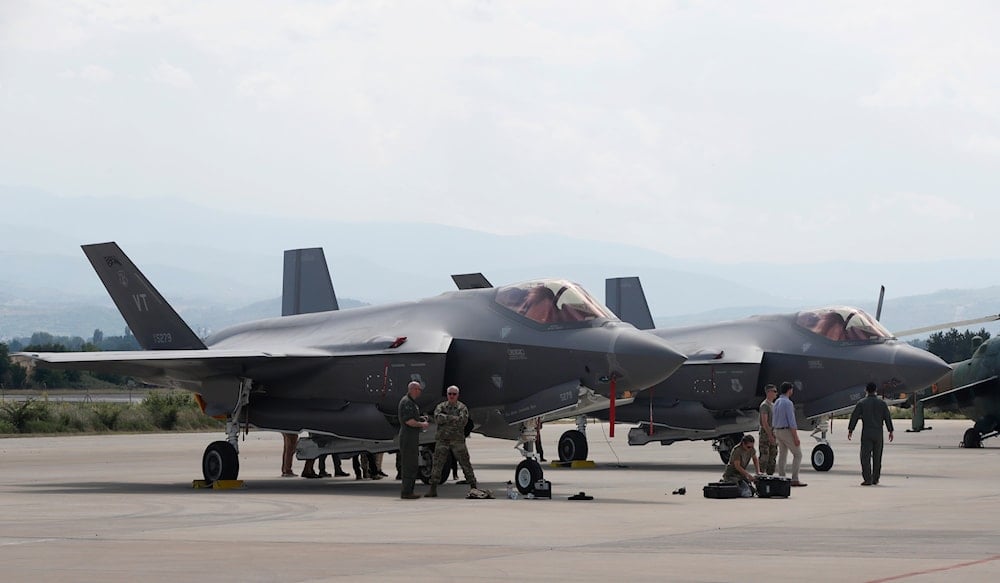
US military personnel work near F-35 fighter jets of the Vermont Air National Guard, parked in the military base at Skopje Airport, North Macedonia, on June 17, 2022. (AP)
The United States has begun delivering new fifth-generation F-35 fighter jets without installed radars, as delays in the rollout of the upgraded AN/APG-85 system continue to disrupt the program.
According to reports by Avionics International, the new F-35s, which were expected to begin arriving with the advanced AN/APG-85 radar starting in 2025, are instead being supplied without any radar systems at all. The delay stems from technical and supply chain challenges affecting the new radar’s production and integration.
Mounting incompatibility forces interim solution
The legacy AN/APG-81 radar, currently installed on export aircraft and previously mounted on domestic variants, uses a different mounting system from the newer AN/APG-85. Since June 2025, newly delivered F-35s have been manufactured with updated mounting structures designed specifically for the AN/APG-85, rendering them incompatible with the older radar. As a result, aircraft are being delivered without radars installed. To compensate for the missing equipment and maintain proper weight distribution, ballast has been added to the nose section of the aircraft.
Despite the absence of a radar, officials maintain that the fighter can still operate and fly as a functional aircraft. In such cases, radar-less jets would rely on operating in coordination with fully equipped F-35s capable of sharing targeting and situational awareness data through the platform’s integrated network systems.
While the F-35’s extensive information-sharing infrastructure theoretically enables radar-less aircraft to function in a networked environment, the arrangement would likely prove problematic in high-intensity combat scenarios. The workaround is largely viewed as a peacetime solution rather than a viable long-term operational model.
Read more: How Saudi F-35s would not erode Israeli air superiority: Report
Crown jewel of the Block IV upgrade missing
The AN/APG-85 radar was originally scheduled for delivery beginning with Lot 17 production aircraft in 2025. However, integration has since been postponed to Lot 20. Earlier uncertainty surrounding the transition raised questions about potential production delays, but manufacturers appear to have opted for continued airframe deliveries without radars to avoid halting production altogether. In response to the mounting challenges, Lockheed Martin has reportedly proposed developing a redesigned fuselage capable of accommodating both the legacy AN/APG-81 and the newer AN/APG-85 radars.
While such a solution could provide greater flexibility, it would require additional certification processes and production adjustments, extending timelines further.
Mounting issues
The radar issue adds to ongoing concerns surrounding the F-35 program, which has faced scrutiny over maintenance costs, software delays, and low readiness rates. Reports indicate that only around half of the fleet is mission-capable at any given time.
The US Air Force’s Lot 17 production batch was designed to be a turning point for the F-35 program, marking the debut of the Block 4 upgrade package, for which the next-generation AN/APG-85 radar would be essential. Originally scheduled for delivery in late 2025 and early 2026, Lot 17 was intended to deliver the full suite of hardware and software required for Block 4, featuring a complete modernization of the F-35's hardware suite; a massive package that adds around seventy new capabilities, including advanced missile carriage, drone control, and enhanced electronic warfare systems.
Why it matters
The AN/APG-85 radar is the critical enabler of these upgrades, using Gallium Nitride technology to deliver the range, power, and data processing speed required for Block 4 missions.
The radar is essential because the legacy AN/APG-81 cannot support the full scope of Block 4 operations. The APG-85 demands a redesigned fuselage and engine upgrades to deliver sufficient power and cooling. Its data throughput is designed to manage advanced weapons and electronic warfare systems that require instantaneous processing, and it is capable of countering modern air and surface threats, including advanced Chinese and Russian systems.
Read more: US admits F-35 program failure after decades and trillions spent


