
US escalates regime change threats against Cuba amid pressure campaign
 4 Min Read
Trump and Marco Rubio intensified threats against Cuba, raising the prospect of military intervention as Washington expands sanctions and pressure on Havana.
-
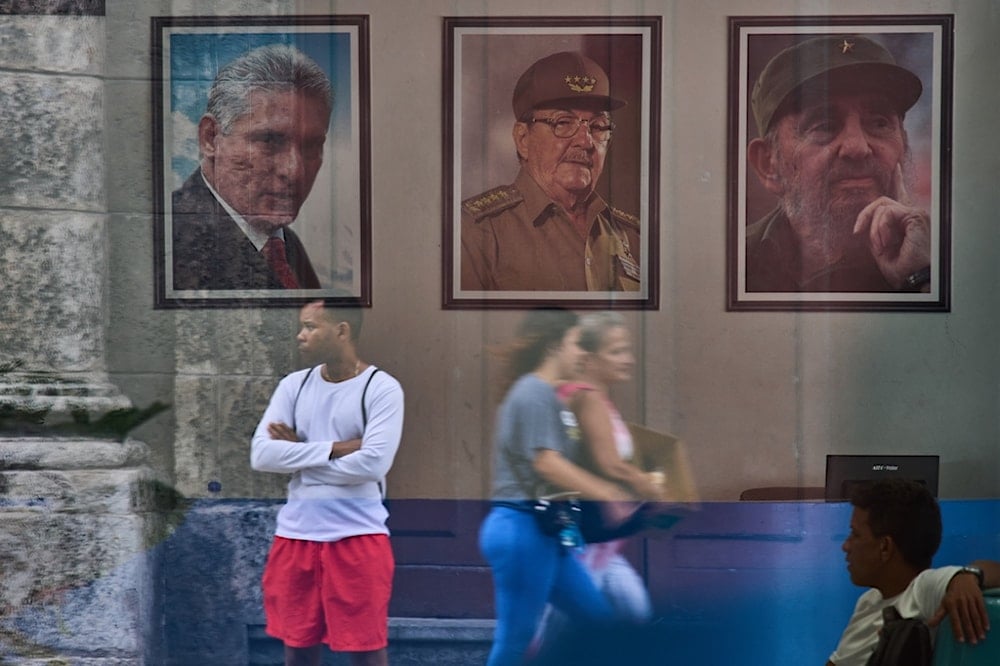
Framed images of Cuba's President Miguel Diaz-Canel, Raul Castro, and Fidel Castro, adorn a state building wall in Havana, Cuba, May 20, 2026. (AP Photo/Ramon Espinosa)
The Trump administration has increasingly intensified hostile rhetoric targeting Cuba, openly raising the possibility of military action against the island as Washington expands its pressure campaign against Havana’s government.
Speaking at the White House, US President Donald Trump suggested he could become the US president who finally acts on decades of interventionist ambitions toward Cuba.
“Other presidents have looked at this for 50, 60 years, doing something,” Trump told reporters overnight Thursday. “And, it looks like I’ll be the one that does it ... So, I would be happy to do it."
The remarks marked one of the clearest public signals yet that the Trump administration is escalating discussions around regime change in Cuba following months of mounting sanctions and diplomatic pressure.
Rubio casts doubt on diplomacy with Havana
Rubio said Washington still officially prefers a negotiated outcome but claimed the chances of reaching an agreement with Cuba’s current leadership were “not high.”
The top US diplomat, who has long advocated hardline policies against Havana, described Cuba as a national security threat due to its ties with China, Russia, and regional governments opposed to Washington’s agenda in Latin America.
“The president always has the option to do whatever it takes to support and protect the national interest,” Rubio said when asked whether military force remained under consideration.
Rubio rejected suggestions that Washington was pursuing “nation-building,” despite repeated references to changing Cuba’s political direction and forcing strategic realignment.
Read more: Cuba slams 'collective punishment', US narrative on economic crisis
Charges against Raúl Castro deepen tensions
The renewed threats came one day after US federal prosecutors announced criminal charges against former Cuban leader Raúl Castro over the 1996 downing of an aircraft flown by Miami-based anti-government exiles, Brothers to the Rescue.
Brothers to the Rescue have been known to invade Cuban airspace and drop propaganda leaflets above cities on multiple occasions prior to the Cuban air force's actions against them.
Declassified communications from US aviation officials showed that they were aware of a potential retaliation by the Cubans if the group kept up its provocations.
Cuban President Miguel Díaz-Canel condemned the indictment as a political maneuver aimed at justifying possible military aggression against the island.
The move has fueled comparisons to Washington’s earlier campaign against Venezuelan President Nicolás Maduro, whose kidnapping by US forces earlier this year followed years of sanctions, diplomatic isolation, and criminal indictments.
US expands sanctions and military signaling
Washington has increased economic and military pressure on Cuba in recent months, including expanded sanctions targeting state-linked institutions and intensified restrictions affecting fuel and trade flows.
The arrival of the USS Nimitz carrier group in the Caribbean coincided with the announcement of charges against Castro, though US Southern Command described the deployment as part of ongoing regional exercises.
The Trump administration has also targeted Grupo de Administración Empresarial S.A. (GAESA), a major Cuban business network, while US Secretary of State Marco Rubio announced the detention of a relative of one of the company’s executives inside the United States.
China rejects US pressure campaign
China criticized Washington’s actions against Cuba, with Chinese Foreign Ministry spokesperson Guo Jiakun reiterating Beijing’s support for Cuban sovereignty.
“China firmly supports Cuba in safeguarding its national sovereignty and national dignity and opposes external interference,” Guo said Thursday.
The statement came as tensions surrounding Cuba increasingly intersect with broader geopolitical rivalry between Washington, Beijing, and Moscow across Latin America and the Caribbean.
Read more: Hondurasgate leaks expose US-Israeli influence network


