
After sanctions strategy fails, US military aggression to target Cuba?
 4 Min Read
Reports say the Trump administration is considering military intervention options in Cuba after sanctions and a fuel blockade failed to break Havana's reslience.
-
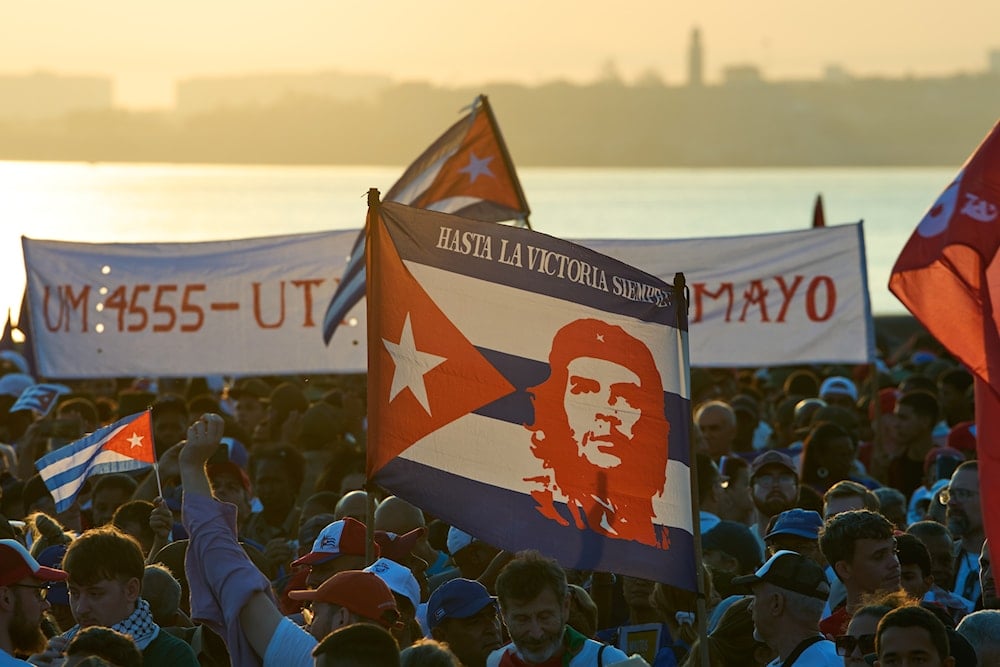
Cubans attend a march marking International Workers' Day at Jose Marti Anti-Imperialist Square in Havana, Cuba, on May 1, 2026. (AP)
The United States is reportedly exploring a range of military aggression scenarios in Cuba after concluding that its sanctions-based strategy and fuel blockade have failed to force political change on the island, according to Politico, citing sources familiar with internal deliberations.
The report claims that the Trump administration has begun considering options that go beyond limited operations, including scenarios ranging from targeted airstrikes intended to compel concessions to a large-scale ground invasion aimed at regime change.
A US official cited in the report said the initial assumption in Washington was that sustained economic pressure, combined with broader regional military outcomes, would force Havana into negotiations. However, the official added that developments in other theatres have complicated that calculation, with Cuba proving more resilient than anticipated.
According to the report, the US Southern Command has initiated an operational planning cycle in recent weeks, effectively preparing contingency frameworks for a possible military campaign in the Caribbean.
The Pentagon has not confirmed any specific operational decisions, though previous reporting has indicated that defense planners have been directed to maintain readiness for a range of scenarios in the region amid heightened tensions between Washington and Havana.
Earlier assessments have suggested that such planning remains preliminary and contingent on presidential authorization.
Read more: Cuba vows self-defense amid US regime-change schemes
Tightened sanctions, blockade amount to collective punishment
The reported shift comes amid an intensified US sanctions campaign targeting the Cuban government, the Cuban people, and energy imports. The measures are part of a broader strategy that has included restrictions on oil shipments and financial channels linked to Havana.
In this context, Cuban President Miguel Díaz-Canel Bermúdez affirmed that no official within the leadership of the Communist Party, the state, government, or military institutions holds assets or property under US jurisdiction, rejecting Washington’s “anti-Cuban rhetoric of hatred.”
In a post on X, Díaz-Canel accused the United States of escalating its “total economic war” against the island through sanctions and executive measures targeting foreign companies that sell fuel to Cuba or invest in the country.
En la dirección de nuestro Partido, Estado, Gobierno y sus instituciones militares, nadie tiene activo o propiedad que proteger bajo jurisdicción estadounidense.
— Miguel Díaz-Canel Bermúdez (@DiazCanelB) May 19, 2026
El gobierno de EE.UU lo sabe de sobra, tanto es así que ni siquiera hay evidencia que presentar. La retórica…
The statement described the US embargo as “immoral, illegal, and criminal,” arguing that measures restricting access to fuel, food, medicine, and basic goods amount to collective punishment against the Cuban people.
He further called on international organizations to condemn the sanctions regime, describing it as an act of “genocide” against the population.
The sanctions regime has coincided with a deepening energy crisis on the island, including widespread fuel shortages and prolonged electricity disruptions affecting transportation, healthcare, and food production.
US officials have argued that the pressure is aimed at forcing political and economic reforms, while Cuban authorities maintain that the crisis is the direct result of Washington’s blockade policies and sanctions that directly target the Cuban people.
Diplomatic contacts, intelligence engagement
The report also comes against the backdrop of continued high-level engagement between US and Cuban officials.
CIA Director John Ratcliffe recently visited Havana, leading a delegation that met with representatives of the Cuban Interior Ministry, according to Cuban government statements and media reports. The visit has been interpreted by observers as part of parallel diplomatic and intelligence tracks.
The potential for escalation follows months of increasingly confrontational rhetoric and policy measures, including tariffs on countries supplying oil to Cuba and expanded sanctions targeting its political and military leadership.
Recent developments have also sparked warnings from Cuban officials about the risks of direct conflict, while human rights organizations and some US lawmakers have raised concerns that continued pressure could exacerbate a humanitarian crisis and destabilize the region.
At the same time, reports suggest that internal US deliberations remain divided, with some officials cautioning against military escalation while others argue that sanctions alone have failed to produce strategic outcomes.
Read more: Cuba restores electricity after nationwide blackout


