
US intel: Iran government not near collapse despite war
 5 Min Read
US intelligence assessments say Iran’s leadership remains firmly in control despite nearly two weeks of intense US-Israeli strikes.
-
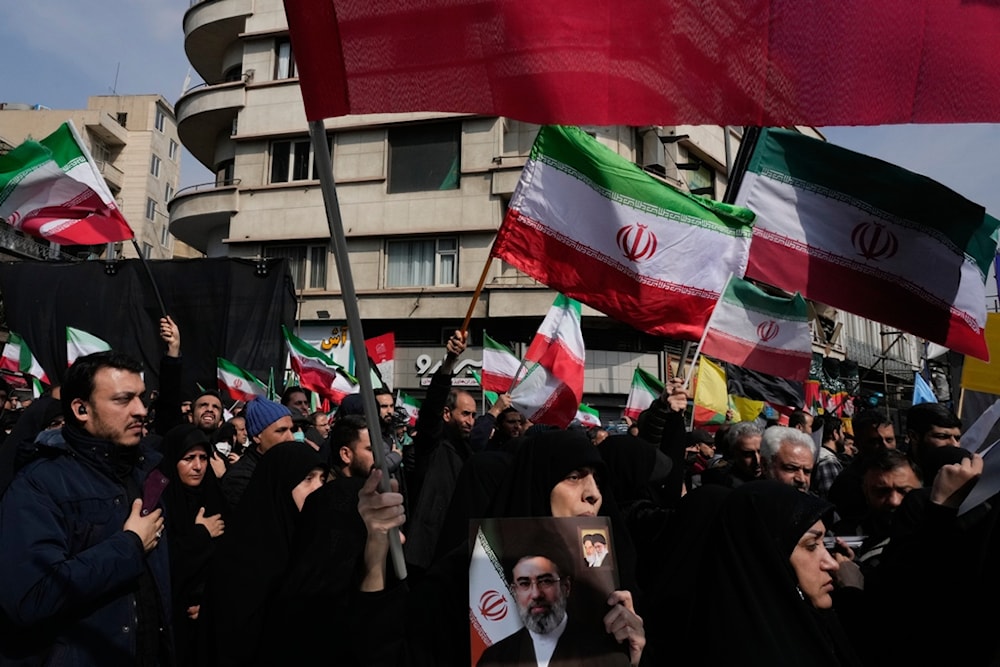
Mourners wave Iranian flags during the funeral procession for Iranian military officials and civilians killed as one of them holds a poster of Sayyed Mojtaba Khamenei, son, in Tehran, Iran, Wednesday, March 11, 2026. (AP)
US intelligence agencies assess that Iran’s government is not at risk of collapse, despite nearly two weeks of sustained US-Israeli military attacks across the country, according to officials familiar with the findings.
Multiple intelligence reports indicate that Iran’s leadership structure remains intact and retains control over the country, sources told Reuters.
A “multitude” of intelligence assessments have produced “consistent analysis that the regime is not in danger” and continues to maintain authority over the Iranian public, one source said.
The latest intelligence review was reportedly completed within the past few days as the war between Iran and the US-Israeli alliance continues to escalate.
Leadership cohesion after assassination of Sayyed Ali Khamenei
The assessments suggest that Iran’s political system has remained cohesive even after the assassination of Sayyed Ali Khamenei, who was killed during the initial wave of US-Israeli strikes on February 28.
Following his death, Iran’s Assembly of Experts, a body of senior Shiite clerics, named his son Sayyed Mojtaba Khamenei as the country’s new supreme leader.
Despite the killing of senior officials and commanders in the Islamic Revolution Guard Corps (IRGC) during the bombing campaign, US intelligence sources believe that Iran’s military and political institutions remain functional and continue to exercise control.
Even Israeli officials have privately acknowledged uncertainty about whether the ongoing military campaign could lead to the collapse of Iran’s governing system, a senior Israeli official told Reuters.
The intelligence agencies involved, including the Central Intelligence Agency (CIA) and the Office of the Director of National Intelligence, declined to comment on the assessments.
War objectives remain unclear
Since launching the war, the United States and "Israel" have targeted a wide range of Iranian infrastructure, including air defense systems, nuclear facilities, and senior members of Iran’s political and military leadership.
However, Washington’s stated objectives for the war have appeared to shift over time.
When announcing the start of the war, US President Donald Trump called on the Iranian population to “take over your government.”
Later, senior US officials attempted to downplay the suggestion that the campaign aimed at regime change.
The absence of a clearly defined end goal has raised questions in Washington about how the war could be concluded if Iran’s leadership remains firmly entrenched.
Analysts say that a collapse of the Iranian government would likely require a large-scale ground invasion, which could enable opposition groups inside the country to mobilize safely against the state.
The Trump administration has not ruled out the possibility of deploying US ground forces to Iran, though no such plan has been publicly announced.
Kurdish armed groups unlikely to challenge Iran’s military
US intelligence has also assessed that Iranian Kurdish armed groups are unlikely to significantly challenge Iran’s security forces.
Some Kurdish militias based in Iraqi Kurdistan had reportedly explored possible coordination with the United States about launching attacks inside Iran’s western regions.
Leaders of these groups have claimed that “tens of thousands of young people” could potentially mobilize against the Iranian government if they received US support.
However, recent intelligence assessments conclude that these militias lack the numbers and military capabilities necessary to sustain a major confrontation with Iranian security forces.
Some of the groups have reportedly requested weapons and armored vehicles from Washington, though US officials have not approved such assistance.
President Trump has also reportedly ruled out allowing Kurdish forces to launch cross-border operations into Iran after the Kurds refused to follow his plans.
US-Israeli War continues to expand across West Asia
The intelligence findings emerge as the confrontation between Iran and the US-Israeli alliance that started the aggression continues to intensify across West Asia.
Iran has launched multiple waves of drone and missile attacks targeting Israeli-occupied territories and US military installations across the region, describing the strikes as retaliatory responses to the ongoing aggression against the country.
The fighting has already resulted in significant casualties, including reports that around 150 US troops have been wounded during the first ten days of the war.
At the same time, the conflict has triggered major disruptions to global energy markets, particularly through tensions surrounding the Strait of Hormuz, a critical shipping route for global oil supplies.
The economic consequences of the war have begun to reverberate globally, with rising energy prices and growing political pressure inside the United States over the risks and costs of a prolonged conflict with Iran.


