
US launches strikes on Iran; Tehran readies missile, drone response
 4 Min Read
The renewed US aggression has prompted Tehran to condemn the attack as direct aggression and prepare missile and drone retaliation against US military bases.
-
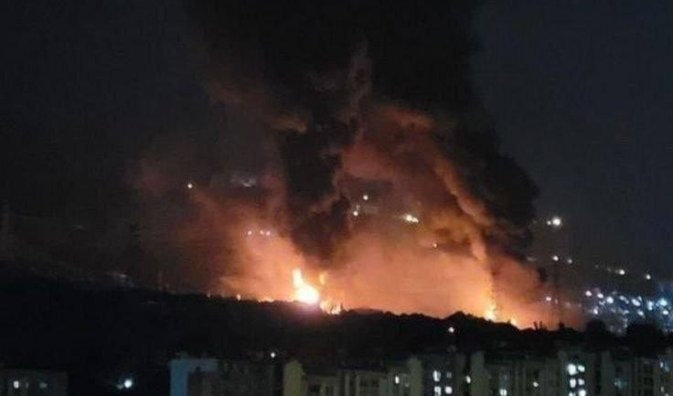
US strike on Sirik city, near Bandar Abbas, Iran (Social media)
The United States has launched additional strikes against Iran, expanding its military aggression against the Islamic Republic as explosions were reported across several areas in southern Iran and Tehran prepares a missile and drone response targeting US military bases.
The US military said its forces had begun carrying out additional strikes against Iran, while US Central Command claimed that Tehran was responsible for what it described as the latest “unjustified aggression” against commercial vessels and civilian crews in the Strait of Hormuz. Washington’s allegations came as the fragile ceasefire framework continued to unravel under renewed US military and economic pressure.
At the direction of the Commander in Chief, U.S. Central Command forces have started conducting additional strikes against Iran to further degrade their ability to threaten freedom of navigation in the Strait of Hormuz. The United States is holding Iran accountable for recent…
— U.S. Central Command (@CENTCOM) July 8, 2026
Iranian media reported explosions in several southern areas following the US attack. Mehr News Agency said an explosion was heard in Bandar Abbas, while Mizan reported blasts in the areas of Sirik and Bandar Abbas. Mehr later said Iranian air defenses were engaging hostile targets near Bandar Abbas.
Nour News also reported that an explosion was heard in Chabahar, while Mehr said blasts were heard in Konarak and Chabahar in southern Iran. Later, IRNA reported that around ten explosions were heard in Chabahar and Konarak.
Nour News, citing an informed source, later said the US aggression on Bushehr caused no damage to the nuclear power plant, countering any suggestion that the strike had affected Iran’s nuclear energy infrastructure.
Iranian state television also reported that shrapnel from US projectiles hit Imam Ali Hospital in Chabahar, southern Iran, underscoring the civilian risks of Washington’s expanded strikes.
🚨 BREAKING ⚡
— Muhammad Fahad (@myrules_fahad) July 8, 2026
US strike on a military site in Sirik city, near Bandar Abbas, Iran.
Explosions reported as tensions escalate.#Breaking #Iran #BandarAbbas #Sirik #USStrikes #MiddleEast pic.twitter.com/OPXF1Q0RkF
Tehran vows retaliation
The new US escalation followed an earlier wave of American strikes that CENTCOM claimed targeted more than 80 sites, including Iranian air defense systems, command and control networks, coastal radar sites, anti-ship missile capabilities, and more than 60 Islamic Revolution Guard Corps boats in and near the Strait of Hormuz. Washington claimed the strikes were intended to degrade Iran’s ability to affect maritime traffic through the strategic waterway.
Tehran, however, has framed the attacks as a blatant act of aggression and a violation of the understandings reached under the ceasefire memorandum. Iran’s top joint military command, Khatam al-Anbiya Central Headquarters, vowed a “crushing response” and warned that the Islamic Republic would not allow Washington to interfere in the management of the Strait of Hormuz.
According to Nour News, citing a military source, Iranian missile units and drone forces are set to begin large-scale operations within minutes to target US military bases.
Nour News, citing a military source, also reported that the Iranian Armed Forces’ response to the US aggression would be “painful” and would make the aggressor “regret it".
Washington escalates pressure
The escalation also comes after Washington revoked a temporary license that had allowed Iran to sell oil, further intensifying pressure on Tehran and undermining one of the few tangible components of the ceasefire framework. Reuters reported that the license was withdrawn after three tankers were hit by projectiles in the Strait of Hormuz, a move that added economic coercion to the direct military campaign against Iran.
Iran has repeatedly stressed that security in the Strait of Hormuz must be managed by regional states and not imposed by the United States, whose military presence has long been viewed by Tehran as the primary source of instability in the Gulf. The latest strikes, launched under the pretext of protecting navigation, mark a renewed attempt by Washington to dictate the terms of passage through one of the world’s most strategic maritime corridors.
The confrontation risks pushing the fragile ceasefire closer to collapse, especially as US President Donald Trump has openly threatened further attacks on Iran. Earlier today, Trump said Washington could hit Iran again, while Tehran declared that it would no longer distinguish between US forces and allied positions in the region if aggression continued.
Read more: Iran warns US Gulf allies to 'watch their oil wells' amid tensions


