
US pushes NATO to scale back overseas missions, report says
 5 Min Read
The Trump administration is pressing NATO to scale back overseas missions in Iraq and Kosovo, limit Ukraine and Indo-Pacific participation at its summit, and refocus the alliance strictly on core Euro-Atlantic defense priorities.
-
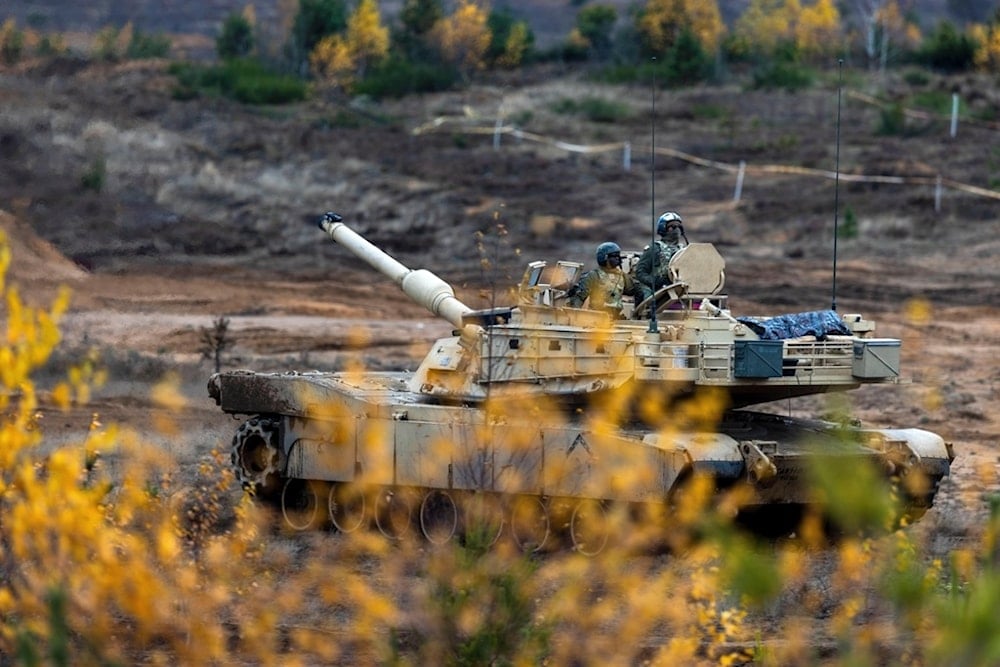
US soldiers ride on an M1A2 Abrams battle tank during a combined arms live fire military exercise 'Strong Griffon 2025' at a training range in Pabrade, north of the capital Vilnius, Lithuania on October 29, 2025. (AP Photo/Mindaugas Kulbis)
The United States is pressing NATO to scale back several of its overseas activities, including ending the alliance’s mission in Iraq and limiting participation by Ukraine and Indo-Pacific partners at the upcoming summit in Ankara, according to four NATO diplomats cited by Politico.
The push is part of a broader effort by President Donald Trump’s administration to narrow NATO’s mandate and refocus it strictly on collective defense within the Euro-Atlantic area. Diplomats speaking on condition of anonymity described the internal initiative as a “return to factory settings,” signaling a rollback of NATO’s post-Cold War expansion into crisis management and global partnership initiatives.
Under this approach, so-called “out-of-area” missions would be reduced or eliminated. Deputy US Defense Secretary Elbridge Colby outlined the administration’s priorities last week, telling defense ministers: “Not every mission can be the top priority. Not every capability can be gold-plated.” He added that Washington remains committed to European security but stressed that “The measure of seriousness is whether European forces can fight, sustain, and prevail in the scenarios that matter most for the defense of the alliance.”
Iraq mission under scrutiny
NATO’s advisory and training mission in Iraq, launched in 2018 during Trump’s first term and expanded after 2021 at Baghdad’s request, is among the operations under review. Two diplomats said Washington has asked allies to wind it down as early as September.
The proposal coincides with a separate US plan to withdraw approximately 2,500 American troops from Iraq under a 2024 agreement with Baghdad. A US official described the move as part of Trump’s “commitment to ending forever wars,” while emphasizing that coordination with the Iraqi government remains ongoing.
Security analysts have raised concerns about potential regional repercussions. Tamer Badawi of the Center for Applied Research in Partnership with the Orient said that although the NATO presence is not “crucial” to Iraq’s security framework, ending it alongside a US troop withdrawal could empower militia factions and prove “destabilizing” for the Kurdistan Regional Government.
Within NATO, the proposal has triggered resistance. One diplomat said, “It’s not the moment to get out of Iraq … the government wants us there.” Another noted that while “the majority” of allies favor reducing the mission over time, they prefer a phased adjustment rather than a rapid termination.
The debate unfolds against the backdrop of the 2003 US-led invasion of Iraq and years of subsequent occupation, which reshaped regional power dynamics and continues to shape discussions over foreign military presence in the country.
Kosovo concerns
Washington has also indicated interest in reducing the NATO-led Kosovo Force (KFOR), deployed since 1999 and currently comprising roughly 4,500 troops.
European officials warn that a premature drawdown could heighten tensions between Kosovo and Serbia. Engjellushe Morina of the European Council on Foreign Relations described the mission as “indispensable” for regional stability, cautioning that a withdrawal could embolden separatist elements in northern Kosovo and potentially spark repercussions in Bosnia’s Republika Srpska. A senior NATO diplomat acknowledged that “things in the western Balkans can escalate quickly.”
A NATO official said there is “no timeline associated with NATO Mission Iraq ... or with KFOR,” adding that such deployments undergo regular review and adjustments as circumstances evolve. Any decision to end either mission would require unanimous approval from all 32 member states.
Kosovo declared independence in 2008, a move recognized by the United States and most European Union countries but rejected by Serbia, with backing from Russia and China. The territory’s status remains contested, and ethnic tensions continue in northern municipalities.
Summit participation and partnerships
According to the diplomats, Washington is also pressing allies not to grant Ukraine or NATO’s four Indo-Pacific partners, Australia, Japan, South Korea, and New Zealand, formal roles in core sessions at July’s summit in Ankara. They could still attend side events, but not the main decision-making meetings.
Former NATO spokesperson Oana Lungescu said excluding partner states “would send a signal that perhaps the focus is much more on core NATO issues.” The alliance has not yet confirmed final participation arrangements.
Alliance officials have also decided not to organize the traditional public forum alongside the summit, opting instead for a defense industry gathering. While NATO representatives cited budget constraints and internal restructuring under Secretary General Mark Rutte, some diplomats believe the move may reflect broader US pressure to curtail spending on international initiatives. One diplomat warned that reducing outreach efforts is “very harmful” at a time when NATO seeks public support for increased defense spending.
Since returning to the office, Trump has scaled back US deployments in Europe and transferred additional command responsibilities to European allies. The current initiative reflects his administration’s stated preference for concentrating on what it calls “core national security” priorities, emphasizing deterrence and warfighting readiness over global engagement.
Although no formal decisions have been taken, the internal debate underscores growing tensions within NATO over its future trajectory — whether it will continue operating as a globally engaged security actor or narrow its mandate to territorial defense.
Read more: US urges Europe for 'NATO 3.0', lead its own defense effort


