
US pushes to revive Syria-'Israel' talks after Iran war
 4 Min Read
The United States is seeking broader regional arrangements, including a proposed Syrian role regarding Hezbollah, according to Israeli media.
-
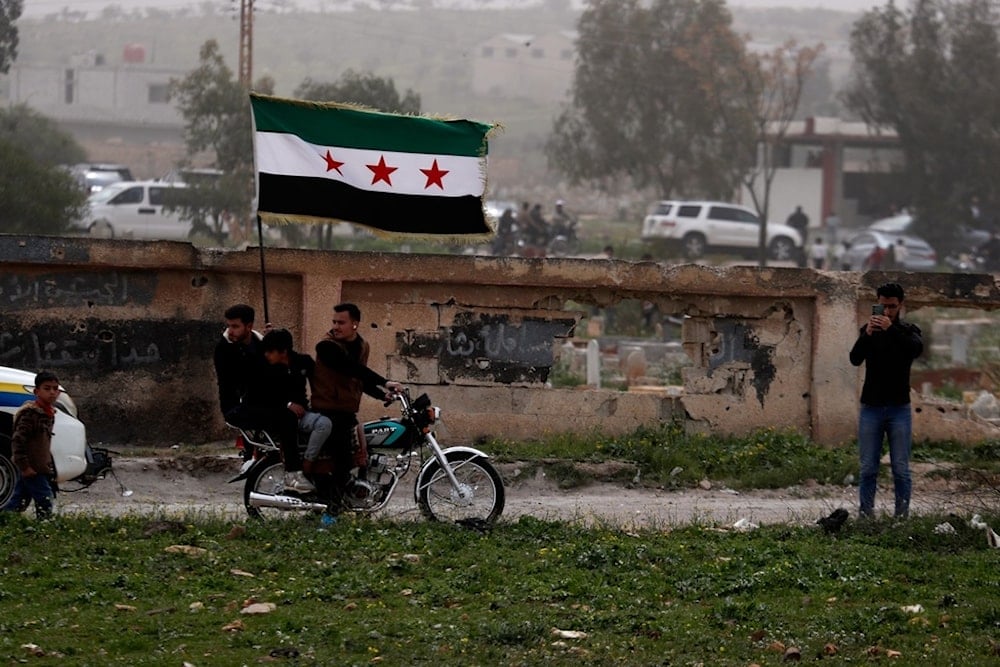
Demonstrators carry the Syrian flag during a rally marking the 15th anniversary of the outbreak of the foreign-backed war on Syria in Daraa, southern Syria, Wednesday, March 18, 2026 (AP)
The United States is pressing to restart talks between Syria and "Israel" for the first time since the end of the US-Israeli war on Iran, according to Israeli public broadcaster KAN, in what appears to be a broader effort by Washington to recover politically what it failed to achieve through months of military aggression against Iran and the wider Axis.
KAN reported on Thursday that the renewed contacts would come after "months of deadlock" and are expected to proceed on a parallel track with the ongoing negotiations between "Israel" and the Lebanese government.
According to the broadcaster, US President Donald Trump is also attempting to enlist Syria's transitional government in efforts to "weaken Hezbollah", although neither Syrian transitional President Ahmad al-Sharaa, "Israel", nor Lebanon has expressed support for such a proposal.
Trump proposes Syria as a substitute for 'Israel'
The latest reports follow Trump's remarks earlier this week suggesting that Syria could assume responsibility for confronting Hezbollah if "Israel" proved unable to carry out its attacks without inflicting widespread civilian casualties.
Speaking at the G7 summit, Trump criticized the latest Israeli aggression on Beirut's Southern Suburb, saying he had warned Israeli Prime Minister Benjamin Netanyahu that the attack had gone too far.
"I saw that attack; I saw where that bomb went. That was a vicious... that was too much. You can do too much also," Trump said.
While reaffirming Washington's unwavering support for the occupation, Trump argued that Netanyahu "has to be more responsible with respect to Lebanon" before openly proposing that Damascus take over efforts against the Lebanese Resistance.
"If Israel can't do the job (against Hezbollah) without killing everyone else, then he (Sharaa) will do the job. Syria will do the job," Trump said while praising al-Sharaa.
Trump's remarks marked one of the clearest public indications yet that Washington is seeking to transform Syria's new leadership into a political and security instrument for advancing long-standing US and Israeli objectives against Hezbollah.
Rather than abandoning efforts to weaken the Resistance after the war on Iran, the proposal suggests an attempt to outsource that mission to regional actors while reducing the political costs of continued direct Israeli aggression.
Israeli concerns over Washington's new approach
The latest KAN report follows claims by Israeli Channel 12 that Israeli officials are deeply concerned about Trump's proposal involving Syria.
According to the outlet, the Israeli security establishment views allowing Damascus to assume responsibility for confronting Hezbollah as the "worst possible" scenario. One Israeli security source reportedly likened the proposal to "throwing a match into a barrel of explosives," warning it could dramatically alter the balance along "Israel's" northern frontier.
Channel 12 also reported that Trump's comments did not come as a surprise to Israeli officials, saying similar proposals had previously been raised during discussions between Trump and Israeli Prime Minister Benjamin Netanyahu.
The broadcaster added that Israeli officials now view accelerating negotiations with Lebanon as a way to preempt any Syrian role in addressing Hezbollah, underscoring the extent to which the Lebanese and Syrian tracks have become intertwined in Washington's broader regional strategy.
Israeli media have also pointed to growing tensions between Trump and Netanyahu following the war on Iran, reporting that the US president chose to pursue a negotiated settlement after Iran refused to capitulate and the closure of the Strait of Hormuz rattled global markets. According to Yedioth Ahronoth, Trump later concluded that Netanyahu's vision for the region no longer aligned with his own, contributing to increasingly public disagreements over Lebanon and the broader regional approach.
Normalization linked to a broader campaign against the Axis
The reported US push comes months after Washington, Damascus, and "Israel" announced strategic understandings aimed at promoting "security and stability" following a trilateral meeting in Paris earlier this year.
According to Axios, the Trump administration has been encouraging Syria and "Israel" to reach an agreement that would stabilize their shared border as a first step toward diplomatic normalization.
The initiative has drawn scrutiny as it comes despite "Israel's" continued occupation of the Syrian Golan Heights and additional Syrian territory, suggesting Washington is prioritizing normalization before the restoration of occupied land while seeking to integrate Damascus into a US-backed regional order aimed at isolating the Axis of Resistance.
Read more: Ghalibaf says US lifted Iran sanctions, ensured Lebanon ceasefire


