
US Republicans intensify Islamophobic rhetoric ahead of midterms
 3 Min Read
Attacks on Muslim candidates are escalating as Republican politicians invoke terrorism and “Sharia law,” while researchers warn of a broader electoral strategy.
-
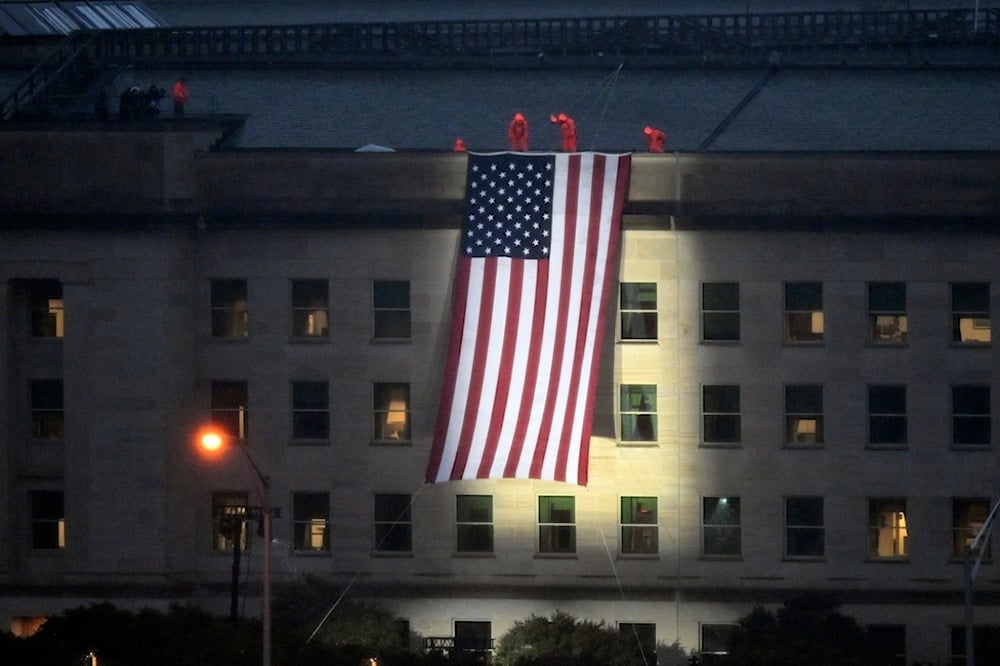
Service members unfurl a flag on the 25th anniversary of the portion of the Pentagon's west side that was struck by an airliner, on Friday, Sept. 11, 2026, in Arlington, Virginia. (AP Photo/John McDonnell)
Republican politicians and political figures in the United States are intensifying anti-Muslim rhetoric ahead of the 2026 midterm elections, targeting Muslim candidates with accusations tied to terrorism and alleged foreign influence.
The rhetoric has increasingly focused on Muslim candidates seeking national office, reflecting a broader Republican effort to turn religious identity and political positions on Palestine into electoral issues.
Among the targets is Muslim Democratic Senate candidate Abdul El-Sayed, whose campaign has faced attacks centered on his religious identity and political positions.
Republican figures have invoked terrorism and “Sharia law” while discussing Muslim political candidates, reviving narratives that have repeatedly been used in US politics to portray Muslims as security threats.
The attacks come as the number of Muslim candidates seeking elected office in the United States grows, challenging longstanding political assumptions about who can occupy positions of national power.
Rather than remaining confined to fringe political circles, anti-Muslim rhetoric is increasingly appearing in mainstream electoral debates and campaign messaging.
Read more: Trump says $5,000 payouts affordable if GOP wins Congress
Islamophobic rhetoric spreads ahead of midterms
The escalation reflects a wider political environment in which Republican politicians have increasingly linked Muslim identity with national security concerns.
References to terrorism and “Sharia law” echo narratives that became deeply embedded in US politics following the September 11 attacks. Those narratives helped establish a framework in which Muslim communities were frequently discussed through the lens of surveillance, counterterrorism, and national security.
Civil rights advocates and researchers have warned that the revival of such rhetoric risks reinforcing discrimination against Muslim Americans while mobilizing voters around fear of a religious minority.
The political calculations are particularly significant as the 2026 midterms approach, with control of Congress again at stake and candidates seeking to distinguish themselves in increasingly polarized races.
Palestine becomes a political pressure point
Muslim candidates and other politicians supporting Palestinian rights have faced heightened scrutiny over their positions as the US continues to provide extensive political and military support for “Israel”.
For Republicans seeking to portray Muslim candidates as outside the US political mainstream, support for Palestine can become another avenue for questioning their patriotism or political legitimacy.
The issue has gained greater prominence amid continued international criticism of Israeli and US hostilities in the region.
This has placed Muslim candidates in a difficult political environment: their religious identity can become a target while their positions on Palestine are used to reinforce claims that they represent foreign rather than domestic interests.
After September 11, successive US administrations expanded surveillance, counterterrorism programs, and security policies affecting Muslim communities. Although political debates have shifted since then, the association between Islam and national security threats remains influential in parts of US political discourse.
The renewed campaign rhetoric demonstrates how those narratives can be repurposed during elections.
For Muslim Americans seeking political office, the challenge is therefore not limited to individual campaign attacks. Their candidacies are unfolding within a political system where Islamophobia has repeatedly been used to define Muslims as a security, cultural, or ideological threat.
Read more: US facing setbacks as pressure fails against Iran, Yemen | Exclusive


