
US seeks to plunder, fragment Iran: Brig. Gen. Mohebbi
 5 Min Read
IRGC spokesperson Hossein Mohebbi says US policies seek to plunder Iran, fragment the country, and expand Washington’s military presence.
-
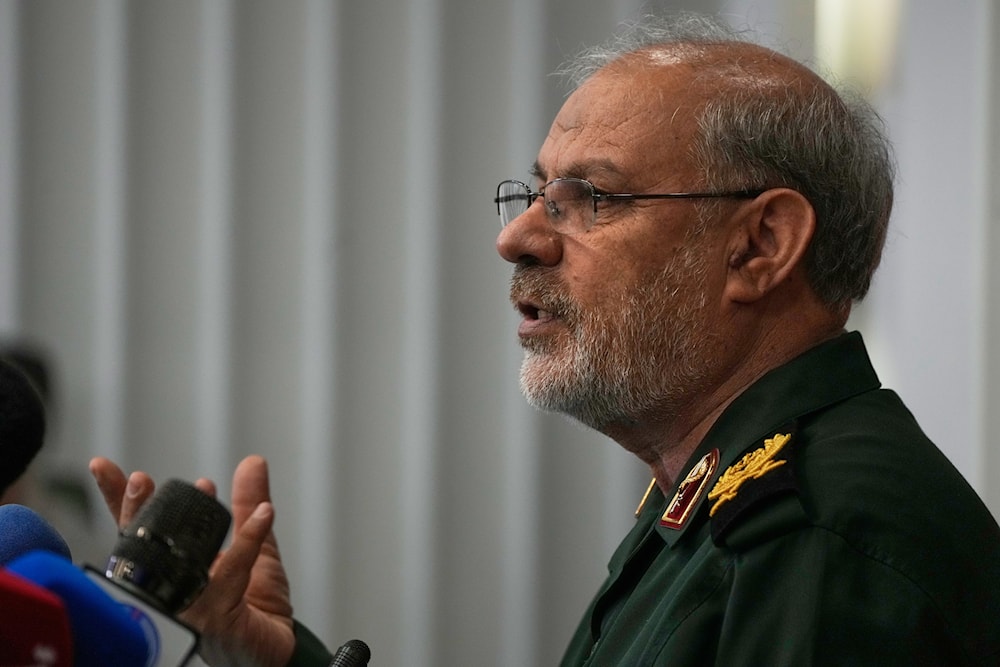
Iran's Revolutionary Guard spokesman Gen. Hossein Mohebbi speaks during a news conference in Tehran, Iran, Tuesday, Sept. 29, 2026. (AP)
Washington seeks to plunder and rob the Iranian people, fragment Iran, and return it to a country colonized by them, the spokesperson for Iran's Islamic Revolution Guard Corps, Brigadier General Hossein Mohebbi, said on Tuesday.
In a letter addressed to the US public, Mohebbi said Americans do not know the facts and objectives of the American administration toward Iran and the peoples of the region, and that the American administration levels accusations against other countries at random to dominate them and plunder their wealth.
He said, "The lie of the century is that Iran wants to produce a nuclear weapon," and asked why the American administration killed the only person who was prohibiting the production of nuclear weapons.
Mohebbi questions US military spending and bases abroad
Mohebbi's letter addressed American bases stationed in countries around the world, asking what justification exists for their budget. He said the United States spends approximately 1,100 billion dollars annually on military armament, while Iran's annual armament cost amounts to 1 percent of American military spending.
American people live in a region that is among the best lands and possesses abundant water sources, energy and valuable mines, Mohebbi emphasized, and said, "To the American people we say: the people who have all these riches, why do they have a large number of poor people? Are American policies not wrong?"
He said that although the military budget of some countries is not comparable to America's, they have nonetheless managed to defeat the United States, questioning where the weapons that are manufactured go and where all these profits go, saying, "I ask the American people why your science crushes peoples."
Mohebbi proceeded to ask the American people why their president does not dare to go to many countries, and what they have harvested from destruction other than rising debts.
He then questioned why America has been attacking different countries for 70 years yet remains silent about the "war of extermination" in Gaza. He asked what the American people have gained from all the operations Washington has carried out against other countries, and asked whether the time has not come for the American leadership to change its policy.
Iran continues to arm itself in the face of aggression
He said Iran continues to arm itself, manufacture weapons and develop its military capabilities, and that Iran will add new weapons to its arsenal in the event of any potential aggression against the country.
"We addressed the American people, not the American government, to reveal the facts before them," Mohebbi noted, adding that the American government may stand in the way of anything that would clarify the facts to the American people and the world.
He said Iran's message to neighboring countries is that American bases have brought them insecurity and instability. He said most American bases in the region have been destroyed and can no longer be used again, and that the countries hosting these bases have realized this.
"Certainly the enemy is considering other scenarios, and we are not unaware of those scenarios, and we have prepared ourselves for them," Mohebbi asserted, asserting that American bases in the region have not only failed to strengthen security but have become harmful to it, as they have been unable even to defend themselves.
Trump rejects Iran's Strait of Hormuz plan, mulls renewed war
This closely follows US President Donald Trump's rejection of a proposal from Tehran for a seven-day reopening of the Strait of Hormuz and is considering new strikes after the US midterm elections, the Wall Street Journal reported on September 26, citing US officials.
According to the WSJ, Trump doubts that Iran will accept the conditions set by Washington and has told his aides that further strikes are likely. The report also said the United States informed Iran and mediators involved in the talks that Trump does not plan to lift the naval blockade of the Strait of Hormuz.
Iranian Foreign Minister Abbas Araghchi said Tehran delivered a seven-day plan to the United States through Qatar that would pave the way for reopening the Strait of Hormuz, stressing that maritime traffic cannot return to normal under economic pressure.
Speaking to reporters outside the United Nations headquarters in New York, Araghchi accused Washington of resorting to threats and assassinations against Iran, saying that more than 5,000 Iranians were killed during the US-Israeli aggression against the country.
Tehran has also outlined conditions for restoring maritime traffic through the strategic passage. Iran has demanded that Washington fulfill seven conditions before the reopening of the strait, including ending all military and hostile actions, including those in Lebanon; releasing frozen Iranian assets; lifting the naval and oil blockade; removing economic and political sanctions; withdrawing US naval and air forces from near Iran; providing compensation for war-related damages; and ending US threats and insults. "When the United States accepts our conditions, the seven-day plan to open the strait begins," Araghchi said.


