
US shares responsibility for any Israeli aggression on Iran: Baghaei
 4 Min Read
Iran says the US bears direct responsibility for any Israeli military action against the Islamic Republic, warning of consequences from further escalation.
-
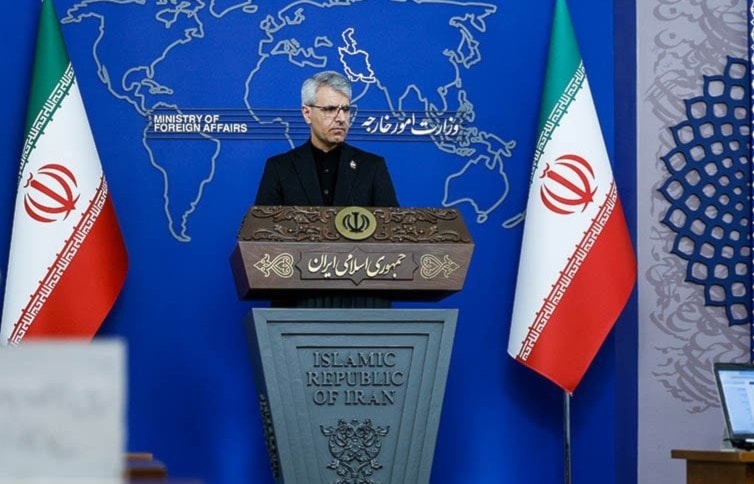
Iranian Foreign Minsitry spokersperson Esmail Baghaei during a weekly press conference, in Tehran, Iran, June 1, 2026. (Fars News Agency)
Washington shares direct responsibility for any Israeli aggression against the Islamic Republic and its potential consequences, Iran’s Foreign Ministry spokesperson stated on Monday.
In a series of statements, spokesperson Esmaeil Baghaei dismissed the notion of "Israel" acting independently in any attack, emphasizing the deep operational coordination between the two allies.
“It is not possible for the Israeli occupation to launch an attack against Iran without coordination with the United States,” Baghaei said.
He further pointed to official US positions that he argued reveal direct American backing for "Israel’s" military posture. “One should not overlook the fact that the US State Department justified the attack on Iran as support for the Zionist regime,” Baghaei stated.
The Iranian spokesperson also cited the role of US military command structures in the region as evidence of direct involvement, emphasizing that “CENTCOM has also explicitly acknowledged its coordination with the Zionist regime."
Baghaei concluded by placing the onus for any further deterioration of regional stability squarely on Washington. “The United States’ responsibility for the aggression of the Zionist regime is evident, and responsibility for the consequences of any escalation also lies with the United States,” he said.
This comes amid sharp escalation in the region, triggered by an Israeli aggression on Beirut's southern subrub, prompting Iran to act on previous warnings that targeting the suburb will lead to retaliation. Meanwhile, Trump attempted to remove the United States from Israeli actions in the region.
Trump attempts to remove US from Israeli actions
Axios reported on June 7 that Trump planned to call Israeli Prime Minister Benjamin Netanyahu and urge him not to strike back.
"I am going to call Bibi right now and tell him not to retaliate. Each of them had their fun. Israel had its strike, and Iran had its strike. We don't need another one," Trump told Axios.
Trump is racing to stop the escalations from killing his hopes of a lasting deal with Iran, according to Axios. Trump later reinforced that position in remarks to Israeli media, saying, "I think Israel has responded enough. There doesn't need to be any more."
A US official told Axios, "We are not part of this," but it is unclear whether Trump will order the US military not to assist "Israel" in strikes on Iran, especially when it comes to air refueling and other kinds of military coordination.
Netanyahu will have to accept any deal US, Iran reach: Trump
US President Donald Trump has asserted that Israeli Prime Minister Benjamin Netanyahu will have no option but to accept any agreement reached between Washington and Tehran, claiming the United States remains firmly in control of the negotiations.
In a telephone interview with the Financial Times, Trump said Netanyahu would ultimately have to abide by the outcome of the talks.
"He won't have any choice," Trump said. "I call the shots. I call all the shots. He [Netanyahu] doesn't call the shots."
The remarks came shortly after Iran launched a barrage of ballistic missiles toward the occupied Palestinian territories in response to continued Israeli aggression on Lebanon, including a strike on Beirut's southern suburbs.
Despite the latest hostilities, Trump insisted the missile attack would not affect ongoing US-Iran talks. "It's not going to have any impact on the deal," he said, adding that the talks would proceed regardless of the recent exchange of fire.
Trump noted that while negotiations remain active, he was less certain than in previous weeks that an agreement was imminent. "I think the deal is going on," he said, adding, "We'll see what happens." The US president reiterated that the success or failure of the negotiations would be determined by the substance of the agreement itself rather than recent military developments.


