
US strikes vessel in Caribbean killing three, death toll reaches 180
 3 Min Read
A new US aggression in the Caribbean leaves three dead as scrutiny intensifies over Washington’s expanding anti-drug campaign and its legal implications.
-
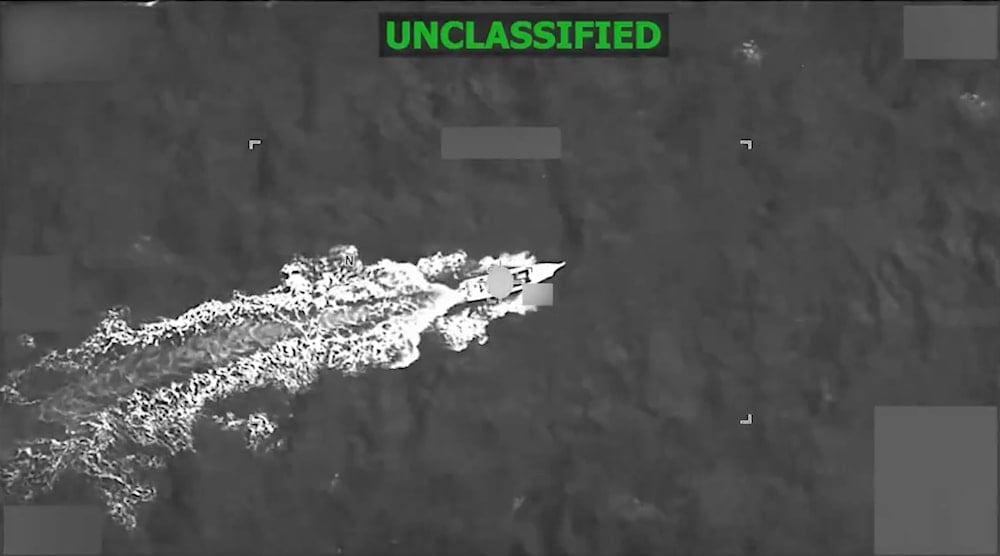
Screenshot from a video showing the moments before a US strike on a vessel in the Caribbean on April 19, 2026 (@Southcom/X)
The United States military announced the killing of three individuals in a strike targeting an alleged drug-trafficking vessel in the Caribbean, marking the latest escalation in Washington’s expanding operations across the region.
According to the United States Southern Command, the strike was carried out on Sunday against what it described as a vessel “operated by Designated Terrorist Organizations.”
SOUTHCOM alleged that “intelligence confirmed the vessel was transiting along known narco-trafficking routes in the Caribbean and was engaged in narco-trafficking operations,” adding that “three male narco-terrorists were killed during this action.”
On April 19, at the direction of #SOUTHCOM commander Gen. Francis L. Donovan, Joint Task Force Southern Spear conducted a lethal kinetic strike on a vessel operated by Designated Terrorist Organizations. Intelligence confirmed the vessel was transiting along known… pic.twitter.com/yMtPhXBdNn
— U.S. Southern Command (@Southcom) April 20, 2026
Washington frames operations as war
US President Donald Trump's administration has framed these operations within the context of a broader confrontation, asserting that the United States is effectively “at war” with what it labels as “narco-terrorists” in Latin America.
Despite repeated claims by US officials, the administration has not presented definitive public evidence demonstrating that the targeted vessels were actively engaged in drug trafficking.
This lack of transparency has fueled skepticism and intensified scrutiny over the criteria used to authorize strikes, particularly in cases where those targeted are not independently verified as combatants.
Three major US rights groups filed a lawsuit against the Trump administration in December of last year, stating that there is a total lack of legal justification for the US strikes in the Caribbean.
Lawmakers also raised questions about the validity of strikes, stating that the decision to use lethal force may run contrary to international law, as well as US statutes prohibiting murder or assassination.
The latest strike brings the number of reported fatalities from these operations to at least 180, based on available data. US military officials have acknowledged conducting at least six such strikes in April alone, indicating a sharp increase in operational tempo.
The growing frequency of these attacks reflects a sustained escalation, with Washington relying on military force as a primary tool in its anti-drug campaign across Caribbean waters.
Read more: Intel reports put to question US claims on Venezuela, drug-trafficking
International legal experts and human rights organizations have also raised serious concerns regarding the legality of the strikes. Critics argue that the operations likely constitute extrajudicial killings, as they appear to target individuals who do not pose an immediate threat to the United States.
The absence of due process, combined with the classification of suspects as “narco-terrorists,” has further complicated legal assessments, raising broader questions about the use of military force in law enforcement contexts.


