
US Supreme Court blocks Trump National Guard deployment in Illinois
 4 Min Read
The Supreme Court refused to allow US President Donald Trump to deploy the National Guard to Illinois, finding that the federal government failed to show it had legal authority to do so over the state’s objection.
-
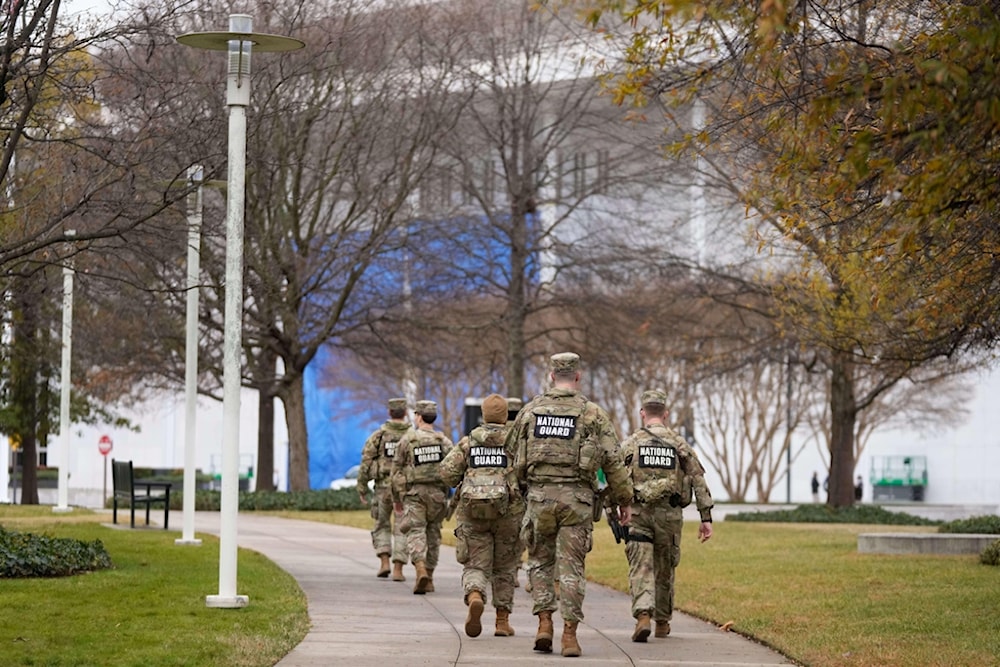
National Guard soldiers walk toward the Kennedy Center as work is done on the signage on the exterior of the Kennedy Center on December 19, 2025, in Washington. (AP)
On Wednesday, Axios reported that the Supreme Court of the United States has rejected an effort by Donald Trump to deploy National Guard troops to Illinois, leaving intact a lower-court ruling that blocks the move while litigation proceeds.
In a 6-3 decision issued on Tuesday, the conservative-majority court declined to lift a temporary injunction preventing the administration from federalizing the Guard for operations around Chicago. In an unsigned order, the justices said, "At this preliminary stage, the government has failed to identify a source of authority that would allow the military to execute the laws in Illinois." Justices Samuel Alito, Neil Gorsuch, and Clarence Thomas dissented.
Beyond the immediate dispute, the case centers on long-standing limits governing the domestic use of military force in the United States. The National Guard typically operates under the authority of state governors, while federal law, including the Posse Comitatus Act, sharply restricts the use of military forces in civilian law enforcement. Presidents can override state control only under narrowly defined conditions, most notably through the Insurrection Act of 1807, which allows federal troop deployments during insurrection or when civil authorities are unable or unwilling to enforce federal law.
Courts reviewing Trump’s deployment efforts have repeatedly found that those conditions were not met. In the Illinois case, judges noted that the administration did not formally invoke the Insurrection Act and failed to demonstrate that local authorities were incapable of maintaining order. That absence of a clear statutory basis has become a central weakness in the administration’s legal defense.
Federal power dispute
The ruling represents a setback for the Trump administration’s immigration and public-order agenda, particularly as Democratic-led states challenge federal efforts to deploy troops for domestic law enforcement functions tied to immigration enforcement and protest control.
Reacting to the decision, White House spokesperson Abigail Jackson said in an email that Trump remains committed to enforcing immigration law and "protect federal personnel from violent rioters." She added that he "activated the National Guard to protect federal law enforcement officers, and to ensure rioters did not destroy federal buildings and property," stressing that "Nothing in today’s ruling detracts from that core agenda."
Illinois officials welcomed the outcome. Governor JB Pritzker wrote on X that the decision was "a big win for Illinois and American democracy," adding, "I am glad the Supreme Court has ruled that Donald Trump did not have the authority to deploy the federalized guard in Illinois."
Attorney General Kwame Raoul said, "The extremely limited circumstances under which the federal government can call up the militia over a state's objection do not exist in Illinois, and I am pleased that the streets of Illinois will remain free of armed National Guard members as our litigation continues in the courts."
National Guard showdown
The Illinois case is one of several legal challenges confronting Trump’s broader push to deploy the National Guard in Democratic-run jurisdictions. Federal judges previously halted Guard deployments linked to anti-ICE protests in California, ruling that troops were unlawfully assigned to law enforcement roles. A planned deployment to Oregon was also temporarily blocked following a lawsuit by the state.
In Washington, DC, where the president exercises greater authority, a judge ruled an August troop deployment unlawful, a decision now under appeal as Guard forces remain in the capital on an interim basis.
By contrast, some Republican state leaders have embraced Trump’s approach. Louisiana Governor Jeff Landry said federal troops would deploy to New Orleans through February following a state request, while Tennessee Governor Bill Lee joined Trump at the White House for a memorandum focused on Memphis, an action later frozen by a state judge.
Together, these disputes have turned the National Guard into a central battleground in a widening legal struggle over presidential power, state sovereignty, and the historically sensitive question of using military forces to police civilians inside the United States.
Read more: Illinois governor calls Trump’s Chicago deployment plot an 'invasion'


