
US threats against al-Maliki will boost his standing in Iraq: Report
 5 Min Read
In a country where sovereignty remains the defining political principle, Washington's intervention may prove its own undoing.
-
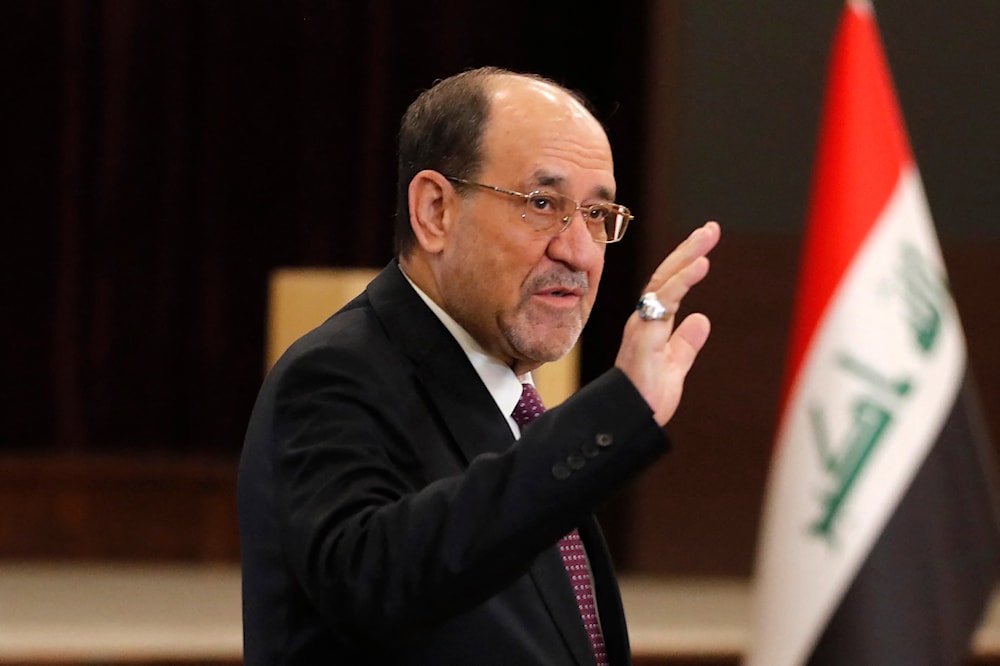
Former Iraqi Prime Minister Nouri al-Maliki leaves after casting his ballot at a polling station in Baghdad on November 11, 2025, during Iraq's parliamentary elections. (Photo by AHMAD AL-RUBAYE / AFP)
On January 27, US President Donald Trump warned on Truth Social that if Iraq's former Prime Minister Nouri al-Maliki returns to office, "the United States of America will no longer help Iraq and, if we are not there to help, Iraq has ZERO chance of Success, Prosperity, or Freedom." Unironically, the warning came from a country that has long positioned itself as an advocate for free and fair elections in Iraq, unfettered by external pressures.
The threat came after Iraq's Coordination Framework nominated al-Maliki for the premiership following prolonged political deadlock. A parliamentary session scheduled for Tuesday to elect a president, who would then appoint the prime minister, was canceled due to a lack of quorum, leaving the political process in limbo.
Yet, Responsible Statecraft posits that Trump's public intervention, widely perceived in Iraq as blatant interference in domestic politics, may achieve the opposite of its intended effect: strengthening rather than weakening al-Maliki's position by effectively casting him as a defender of Iraqi sovereignty against external pressure.
Iraqi rejection of US interference
Al-Maliki swiftly rejected Washington's warnings, describing them as "blatant American interference" that "constitutes an encroachment on the Coordination Framework's decision to select its candidate for the post of prime minister" and represents "an infringement on Iraq's sovereignty."
He stressed that his nomination reflects internal political consensus, vowing to continue "until we reach the end in a way that serves the interests of our people." He also rejected coercive diplomacy, saying "the language of dialogue between states is the only political option in dealing with one another, not resorting to the language of dictates and threats."
Former Prime Minister Adel Abdul Mahdi echoed this stance, emphasizing that "Iraqis are free to choose their government, just as they were in 2003," underscoring Iraq's right to sovereign decision-making without foreign dictates.
In sharper language, Abu Alaa al-Walae, secretary-general of Kataib Sayyed al-Shuhada, accused Trump of attempting to eliminate political opponents through pressure, saying Washington had "assassinated the leaders of victory physically" in the past and now seeks to "assassinate Nouri al-Maliki politically."
The backlash reflects broader resistance within Iraq to continued US influence more than two decades after the 2003 invasion that reshaped the country's political system.
Why external pressure often backfires
In Iraqi politics, sovereignty remains a defining issue. Any perceived attempt to manipulate political outcomes from abroad risks triggering a nationalist backlash that can strengthen the very figures Washington seeks to marginalize.
By publicly warning Iraqis against their own political choices, Trump's intervention shifts the political debate away from governance and accountability toward questions of national independence and external interference.
As Responsible Statecraft noted, history shows that such overt foreign pressure, particularly when delivered as threats, tends to lend renewed legitimacy to leaders positioned as defenders of Iraqi autonomy. Rather than weakening al-Maliki's standing, such interventions can harden political positions and narrow the space for internal compromise, potentially turning a divisive figure into a symbol of resistance.
A pattern of US intervention in Iraq
This is not the first time Trump has sought to impose outcomes in Iraq through displays of power. In January 2020, he ordered a drone strike that killed Iranian General Qassem Soleimani and, crucially, Abu Mahdi al-Muhandis, the deputy commander of Iraq's Popular Mobilization Forces and a revered figure in the fight against ISIS.
While General Soleimani's martyrdom produced ripples across the region, the assassination of Muhandis resonated deeply within Iraq, triggering attacks on the US embassy and intensifying support for the very armed factions that Trump now demands Baghdad dismantle.
Economic leverage, structural constraints
Washington's campaign to shape Iraq's current government formation extends beyond public threats. Over the past two months, US officials have reportedly warned Iraqi leaders that including certain political factions associated with the resistance in the next government could trigger financial sanctions, including potential restrictions on Iraq's access to oil revenues.
Iraq maintains its oil income in a Central Bank account at the Federal Reserve Bank of New York, an arrangement that grants Washington considerable economic leverage over Baghdad.
According to sources familiar with the matter cited by Reuters, US Chargé d'Affaires Joshua Harris delivered warnings to senior Iraqi officials, including Prime Minister Mohammed Shia al-Sudani and political leaders Ammar al-Hakim, Hadi al-Amiri, and Masrour Barzani, that the inclusion of 58 MPs identified by Washington would lead to the suspension of diplomatic engagement and halting of dollar transfers. This economic chokehold reflects the structural constraints Iraq continues to navigate two decades after the invasion.
By attempting to prevent al-Maliki's return through open threats, Trump may inadvertently enhance his appeal, transforming internal political debate into a test of Iraq's capacity to assert autonomy in the face of foreign pressure. As Responsible Statecraft observed, in a country where sovereignty remains the defining political principle, Washington's intervention may prove its own undoing.


