
US war on Iran loses support inside Washington: Foreign Policy
 6 Min Read
Foreign Policy examines growing divisions in Washington over war on Iran, as officials debate escalation, diplomacy, and US national interests.
-
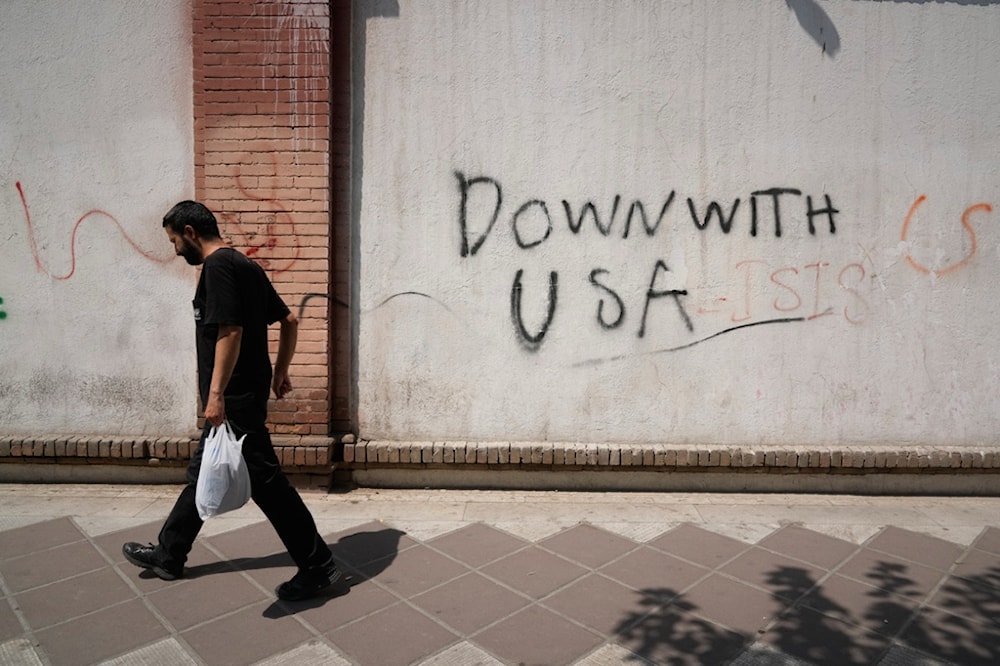
A man walks past anti-US graffiti on the wall of the British Embassy in Tehran, Iran, Monday, July 27, 2026. (AP Photo/Vahid Salemi)
A growing divide inside Washington over the future of US policy toward Iran has exposed questions about whether a wider confrontation serves American interests, according to an analysis published by Foreign Policy.
The report examined how recent disagreements within the US administration have pushed long-standing debates over Iran policy into the mainstream of American foreign-policy discussions, particularly after Vice President JD Vance argued that some figures within the Israeli government had sought to shape US public opinion against a potential agreement that could end the war.
According to Foreign Policy, the dispute reflects a broader reassessment in Washington over the costs, objectives, and consequences of continued escalation with Tehran.
Internal US debate over Iran strategy
The Foreign Policy analysis said US policy toward Iran is increasingly moving beyond the traditional debate over how pressure should be applied, with policymakers now questioning whether Washington should bear the costs of a prolonged confrontation.
The report raised questions over whether a maximum-pressure strategy without a defined political outcome strengthens US security or risks drawing Washington into an open-ended crisis.
Foreign Policy noted that these concerns are no longer limited to anti-war voices outside government or disagreements between political parties. Instead, they have emerged within the governing coalition itself, where some officials argue that US foreign policy should prioritize American interests rather than the objectives of other actors.
The analysis said this position challenges a long-standing assumption in Washington that separating US interests from those of "Israel" carries significant political risks.
Vance remarks reflect broader reassessment of military options
According to Foreign Policy, the debate over Iran is shaped by the consequences of two decades of US wars and military interventions, as well as growing domestic pressure over economic and political costs.
The report argued that some US policymakers increasingly recognize that the consequences of a major war against Iran could outweigh potential gains, while also making it more difficult for Washington to disengage once hostilities expand.
Foreign Policy said Vance’s support for diplomacy over escalation, including regarding security in the Strait of Hormuz, represents a broader acknowledgment of the limitations of military power in resolving complex regional disputes.
The analysis stated that a shift from viewing pressure as a pathway toward war to seeing it as leverage aimed at reaching agreements, even if "negotiations are pursued from a position of strength."
A decline of support
The Foreign Policy analysis also highlighted a decline in support for "regime change as a central US objective toward Iran."
It argued that previous US interventions in Iraq, Afghanistan, and Libya demonstrated that removing governments does not necessarily lead to stability and can instead create prolonged security and political challenges.
According to Foreign Policy, some strategic circles in Washington increasingly view government change as a potential driver of further instability rather than a solution to regional challenges.
The report said opposition to an expanded war on Iran follows a similar logic, focusing instead on limiting escalation, managing tensions, and preventing a wider regional confrontation.
Strait of Hormuz crisis raises economic concerns
Foreign Policy emphasized that any war on Iran would extend beyond the battlefield, affecting energy markets, international shipping, US military deployments, and the global economy.
The analysis pointed to disruptions in traffic through the Strait of Hormuz during recent escalations as an example of how a confrontation with Tehran could generate consequences far beyond the immediate war zone.
According to the report, these risks have contributed to growing skepticism among parts of the US establishment over relying on military force as the primary response to Iran.
Debate changes over US support for 'Israel'
The Foreign Policy analysis also linked the debate over Iran to shifting discussions around US support for "Israel".
It noted that while support for "Israel" has historically maintained broad bipartisan backing in Washington, that consensus has weakened in recent years.
Foreign Policy cited a House vote on an amendment seeking to block $3.3 billion in annual US security assistance to "Israel". Although the measure was defeated 314-104, with 103 House Democrats voting in favor, the report argued that the vote reflected a changing political environment in which such policies face greater scrutiny.
The analysis said these developments are connected to changing public attitudes and a younger generation of politicians that increasingly evaluates foreign commitments through the lens of US interests and domestic consequences.
Iran policy debate shifts toward national interest
Foreign Policy said the central issue is not whether Washington will continue competing with Tehran, but how that competition aligns with US strategic priorities.
The report argued that critics of a more aggressive approach believe American policy should avoid pulling the country into wars that primarily advance the interests of other actors rather than Washington’s own objectives.
However, Foreign Policy also cautioned that the emerging debate does not represent a complete transformation of US policy toward Iran.
The analysis noted that Tehran will remain a major national-security concern for Washington, with economic pressure, intelligence operations, and security measures continuing to shape US strategy.
It added that the argument for limiting military action is not entirely new, pointing to former President Barack Obama’s defense of diplomacy and the 2015 nuclear agreement with Iran.
Iran debate reflects changing Washington priorities
According to Foreign Policy, the most significant change is where opposition to war is now appearing within Washington’s political landscape.
The report argued that skepticism toward military escalation has entered parts of a governing coalition previously associated with maximum pressure policies, with some decision-makers viewing war as the most costly option rather than the preferred solution.
Foreign Policy concluded that the debate over Iran reflects a gradual shift in how Washington approaches confrontation with Tehran.
The analysis said US policy remains divided between two competing approaches: one that emphasizes sustained pressure and the possibility of military action, and another that prioritizes limiting escalation, reducing costs, and using diplomacy to manage tensions.
The report argued that this divide is no longer a marginal disagreement but an increasingly central dispute shaping the future of US policy toward Iran.


