
US war on Iran takes center stage at BRICS foreign ministers summit
 4 Min Read
Foreign ministers from BRICS nations have convened in New Delhi as the US war on Iran dominates the two-day gathering.
-
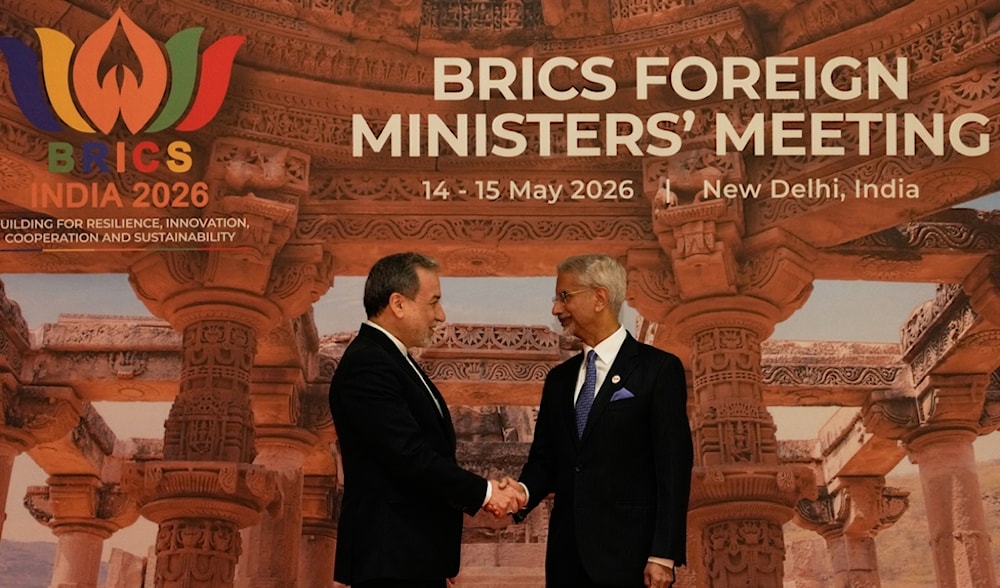
India's Foreign Minister S.Jaishankar, right, shakes hands with Iranian Foreign Minister Abbas Araghchi as he arrives for a two-day BRICS nations meeting in New Delhi, India, Thursday, May 14, 2026. (AP Photo/Manish Swarup)
Foreign ministers from the BRICS group of nations have gathered in New Delhi for a two-day meeting opening Thursday, a preparatory gathering ahead of the 18th BRICS leaders' summit India will host in September, with the US-Israeli war on Iran and its cascading energy crisis set to overshadow the bloc's formal agenda of multilateral reform and Global South cooperation.
India, holding the BRICS chairmanship for 2026, is hosting the high-level gathering at Bharat Mandapam convention centre, chaired by External Affairs Minister Subrahmanyam Jaishankar. Delegations will also call on Prime Minister Narendra Modi during their visit.
The meeting brings together representatives from all eleven BRICS member states: Brazil, Russia, India, China, South Africa, Iran, Egypt, Ethiopia, Indonesia, and the United Arab Emirates.
A bloc divided by war
The sharpest divisions have emerged between Iran and the UAE, whereby the latter has aligned with the US-Israeli aggression on the former, hosted US and Israeli military assets on its territory, and repeatedly carried out attacks on Iranian infrastructure in coordination with Tel Aviv and Washington.
Indian Foreign Ministry spokesman Randhir Jaiswal acknowledged as far back as March that the direct involvement of BRICS members in the war had made it "difficult to forge a consensus," though a ministry official subsequently told Reuters that New Delhi remained hopeful a joint declaration could be achieved.
An earlier April meeting of BRICS deputy foreign ministers and special envoys on West Asia ended without a joint statement, after the UAE blocked consensus language on the US-Israeli aggression against Iran. A chair's summary was issued instead, a precedent that looms over this week's ministerial gathering.
Who is attending
Iranian Foreign Minister Abbas Araghchi arrived in New Delhi on Wednesday evening, his first visit to India since the outbreak of the war on February 28.
Russian Foreign Minister Sergey Lavrov also arrived on Wednesday and held preliminary bilateral talks with Jaishankar, with both sides describing political cooperation as "valuable in an uncertain and volatile global environment."
South Africa's Ronald Lamola and Brazil's Mauro Vieira are also attending, along with Indonesia's Foreign Minister Sugiono.
Thailand's Deputy Prime Minister and Foreign Minister Sihasak Phuangketkeow, Malaysia's Foreign Minister Dato' Seri Mohamad bin Haji Hasan, Cuba's Foreign Minister Bruno Rodriguez Parrilla, and Vietnam's Deputy Foreign Minister Nguyen Minh Hang also arrived on Wednesday as part of the partner country delegations.
China, the bloc's most consequential absent voice, is represented not by Foreign Minister Wang Yi, who remained in Beijing for US President Donald Trump's state visit, but by its ambassador to India, Xu Feihong. The UAE sent Minister of State Khalifa Shaheen Al Marar rather than its foreign minister.
Iran's pitch to BRICS
Ahead of the summit, Iran's Deputy Foreign Minister Kazem Gharibabadi framed Tehran's participation in BRICS as a "strategic choice to strengthen genuine multilateralism," arguing the grouping could serve as a platform for independent trade frameworks, deeper financial ties among member states, and reduced dependence on US-imposed "discriminatory and unilateral mechanisms."
He presented Iran's energy resources, transport networks, and geographic position as direct contributions to the bloc's agenda on regional connectivity and economic resilience.
Sessions are scheduled to run throughout Thursday, concluding with a dinner hosted by Jaishankar, before a final session on Friday morning.


