US warned countries over Sayyed Khamenei funeral attendance: Tasnim
 6 Min Read
According to Tasnim News Agency, US Secretary of State Marco Rubio reportedly instructed embassies to pressure governments against attending Sayyed Khamenei's funeral ceremonies.
-
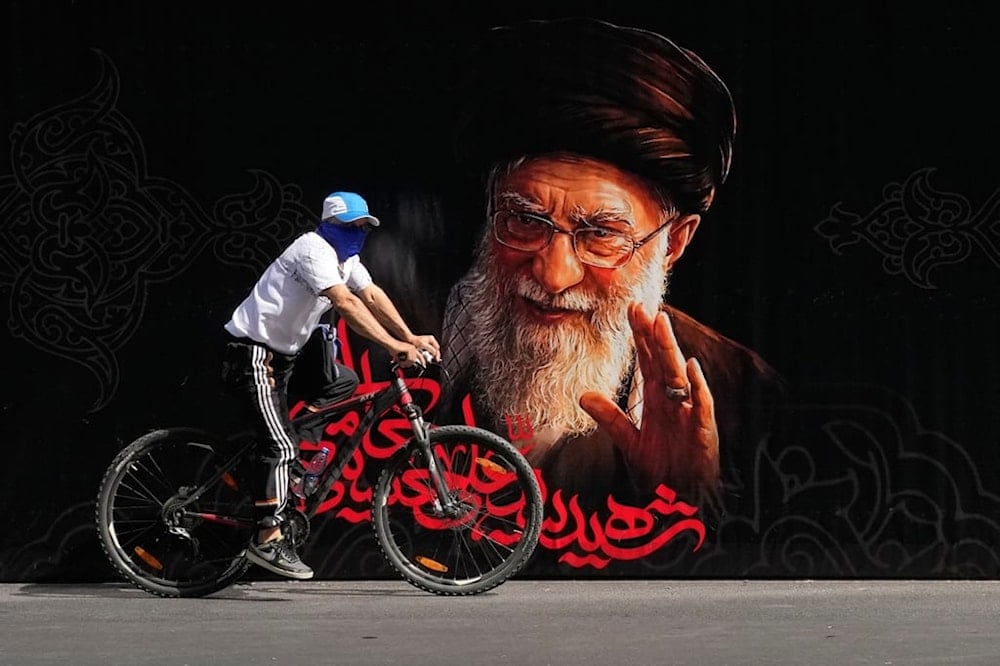
A man rides a bicycle past a portrait of Martyred Iranian Leader Ayatollah Sayyed Ali Khamenei ahead of his days-long funeral ceremonies in Tehran, Iran, Friday, July 3, 2026. (AP Photo/Vahid Salemi)
The United States has launched a broad diplomatic campaign in recent days aimed at discouraging countries from participating in memorial ceremonies for the martyred Leader Sayyed Ali Khamenei,
Tasnim News Agency reported, citing a senior source.
According to the report, US Secretary of State Marco Rubio instructed all American embassies and missions to use available resources to persuade host country officials not to attend the funeral ceremonies. He also directed diplomatic missions to inform governments that participation would be considered an “unfriendly act” from Washington’s perspective.
The agency added that, according to Arab diplomats, Rubio has personally raised the issue with his counterparts in at least five Arab countries.
Tasnim further reported that US ambassadors in African states were warned that participation in the ceremonies could lead to reductions in American aid to those countries.
According to the same source, a major North African country reportedly reduced its level of participation in the ceremonies due to concerns over potential repercussions in its relations with the United States.
The report also claimed that 13 countries, including three from Eastern Europe, five African states, two Gulf countries, and two East Asian countries, have withdrawn from participation in the funeral ceremonies.
Tasnim added that some of the countries that reportedly stepped back under US pressure have sought to justify their absence through diplomatic channels or intermediaries.
Iran begins weeklong funeral ceremonies for Sayyed Ali Khamenei
Iran has begun a weeklong series of funeral ceremonies for Leader Sayyed Ali Khamenei, with millions of mourners expected to participate across five cities in Iran and Iraq. The processions are taking place amid a period of national mourning, with authorities framing the events as a collective expression of resilience, continuity, and political cohesion following years of war and sustained economic pressure.
Media reporting, including CNN, has described the ceremonies as highly symbolic, noting that they reflect both the political and religious legacy of Sayyed Ali Khamenei and the enduring influence attributed to his leadership. CNN stated that “the scale of the spectacle is designed to send a message to the world and to the Islamic Republic’s enemies: The regime not only survived an existential war, but will stubbornly immortalize its slain leader as a symbol of its resilience.”
National messaging of continuity and endurance
Iranian officials say the gatherings reflect a unified national response to loss, emphasizing institutional stability and social cohesion rather than disruption. State messaging has consistently framed Sayyed Ali Khamenei as a figure whose leadership defined decades of continuity under sustained external pressure.
The ceremonies are being presented domestically as a demonstration of endurance, portraying the state as having withstood war and sanctions while maintaining internal alignment around its core institutions and identity.
Sina Toossi, a senior nonresident fellow at the Center for International Policy, told CNN that Sayyed Ali Khamenei is being placed within a religious-historical narrative, saying, “Khamenei is now being framed as a martyred religious authority, akin to revered Shia saints who were martyred, whose worldview was vindicated by the manner of his death.”
International delegations gather in Tehran
The body of Sayyed Ali Khamenei was transferred to the Grand Mosalla of Tehran, where it is lying in state ahead of the official funeral procession scheduled to begin on Saturday. Delegations from across the region and beyond have begun arriving to pay their final respects.
Iranian state officials, senior commanders from the Islamic Revolution Guard Corps (IRGC) and the Iranian Army, and members of the Expediency Discernment Council were among those present at the Grand Mosalla. Senior military officials emphasized the strategic and ideological legacy of the martyred leader, linking recent developments to the frameworks he established.
Media and political delegations have also arrived, including representatives from regional and international outlets and organizations. Delegations from Hezbollah, Palestinian scholarly groups, Iraqi political and tribal figures, and Afghan representatives are also attending, alongside scholars and community leaders from diverse countries.
Large-scale coordination and logistical mobilization
The first public ceremony was scheduled for 6:00 am local time on Saturday at Tehran’s Imam Khomeini Musalla, where the coffin will be placed on display for public viewing. Authorities have implemented extensive logistical measures, including crowd-control systems and cooling infrastructure such as thousands of overhead water sprinklers to manage expected heat conditions.
Nationwide coordination measures include temporary airport closures in Tehran, public holidays in key cities along the procession route, and major traffic restrictions in the capital. More than 700 parking zones have been designated, while private vehicles are restricted from central areas.
State-linked reporting cited by CNN indicates extensive preparations to accommodate mass participation. The Basij volunteer force has reportedly organized large-scale food distribution efforts, including the production of tens of millions of bread portions supported by mobile bakeries deployed in Tehran.
Emergency services have also been mobilized, including thousands of ambulances, helicopters, drones, and rescue personnel. Hospitals, emergency supplies, and educational facilities have been placed on standby across multiple cities, while public spaces such as mosques, sports halls, and parks are being converted into temporary accommodation areas.
Authorities have also encouraged citizens to host visiting mourners in their homes, particularly in Tehran, Mashhad, and Qom, as part of broader nationwide participation efforts.
Transnational dimension of the ceremonies
Part of the funeral route extends beyond Iran into Iraq, including Najaf and Karbala, two of the most significant religious sites in Shia Islam. Officials have also said that this cross-border element reflects Sayyed Ali Khamenei’s broader religious and social influence across the region.
Sina Toossi told CNN that the planned processions in Iraq highlight the transnational dimension of the ceremonies, noting that his religious following extended into communities in Iraq, Pakistan, Bahrain, and beyond.
Political messaging and regional implications
Iranian officials have stated that the ceremonies were both a national moment of mourning and a reaffirmation of political continuity. Senior officials characterized the funeral as one of the most significant events in recent history, with expectations of participation ranging from several million to as many as 15 million people.
Ali Akbar Pourjamshidian, a Revolution Guards commander overseeing the organizing committee, said the ceremonies are intended to project the Islamic Republic’s “power to the international community,” combining domestic unity with external messaging.
Iranian military officials have warned against any disruption during the mourning period, while Foreign Minister Abbas Araghchi stated that Iran would respond decisively to any threats against its leadership following recent remarks attributed to Israeli officials.