
Vance reconsiders 2028 presidential bid after midterm defeat: CNN
 5 Min Read
The US war on Iran and mounting divisions within the Republican Party are complicating JD Vance's anticipated path to the 2028 presidential election, as allies say the vice president has yet to decide whether to run.
-
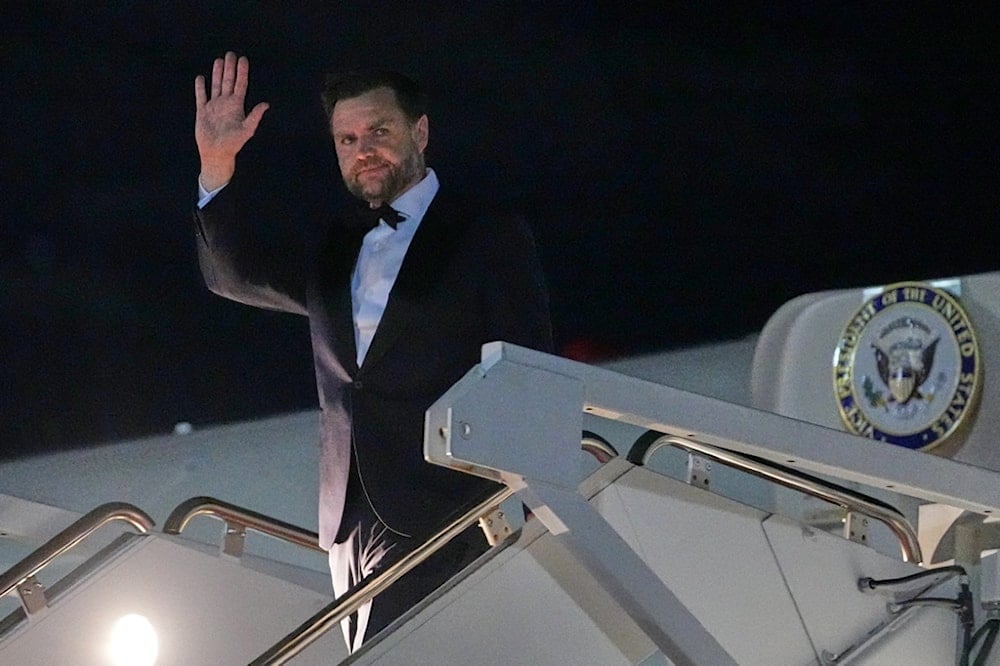
Vice President JD Vance arrives on Air Force Two at Joint Base Andrews, Md., Thursday, Nov. 12, 2026. (AP Photo/Matt Rourke, Pool)
US Vice President JD Vance is seriously considering not running in the 2028 presidential election following the Republican Party's losses in the midterm elections, CNN reported on Friday, citing around a dozen of his allies and advisers.
Although Vance has yet to make a final decision, the report said he is concerned about divisions within MAGA, the consequences of the US war on Iran, and the prospect of committing his family to another demanding presidential campaign.
His hesitation comes as the Republican Party faces growing uncertainty over its political direction after suffering major losses in the November 3 midterm elections. The results have complicated Vance's anticipated path to the Republican presidential nomination and encouraged other prominent Republicans to consider challenging him.
According to CNN, some of Vance's allies remain convinced that he will ultimately enter the race. The vice president has not established a deadline for deciding whether to run, leaving open the possibility that he could reassess his political prospects over the coming months.
Iran war complicates Vance's political prospects
The US war on Iran has emerged as a significant obstacle for Vance as he weighs his political future. Following the Republican Party's midterm losses, the vice president publicly linked the defeat to the war, while seeking to distinguish his political position from Trump's approach to the war.
In a lengthy post on X on November 4, Vance pointed to the need to end the war, address the rising cost of living, refocus on domestic priorities, and reconsider Washington's relationship with "Israel". His remarks were widely interpreted as an attempt to establish a political position distinct from Trump's foreign policy ahead of a possible 2028 campaign.
One of the things the data analysts on our side obsessed over was "composition"—whether the electorate looked close enough to 2024 for Republicans to win. And despite polls that showed a Democrat blowout, the data kept on telling us the same story: in some states turnout was merely OK, in other states it was downright amazing, and in no state was it catastrophic. There was a genuine sense of optimism on our team: our people were showing up. So, I asked the smartest data guy I know, does that mean we're going to shock the world? "No," he told me. "We might do better than the polls suggest. But the data is telling us that a lot of Trump/Vance 2024 voters are pissed and planning to vote for the other guys. Our voters are turning out, but they may not vote for us." Well, that looks prophetic now. Our voters did show up. In Florida, for example, the electorate was 9 points more Republican than Democrat, just a couple points worse than 2024. Undoubtedly there were places we could have done better on turnout. But the main problem is not turnout. The main problem is that many people who voted for Trump/Vance in 2024 voted for Democrats in 2026. There will be a lot of infighting and arguing over what happened and why that is. One of the pollsters I really respect told me that our economic messaging wasn’t sharp enough down the stretch. I’m sure that’s true. But the real reason we lost is obvious to almost everyone. Another pollster—one of the smartest people I know in politics, told me yesterday we’d lose the generic ballot by 13 points. I felt negative going into Tuesday, but even I was shocked by this. In his polling, he saw that a lot of Trump 2024 voters were angry and planning to vote for Democrats. He asked those voters who had abandoned us what would cause them to come back on our team. The top four answers, accounting for nearly all of the responses were: 1) End the war 2) Focus on cost of living/inflation 3) Put America First 4) Change our relationship to Israel Our voters showed up. And the above four reasons are why many of them voted for Democrats. This is according to a pollster who nailed the results. While many spent Monday attacking Rachel Campos Duffy for calling for a diplomatic resolution to the conflict, it turns out her political advice was sound. (She’s also a great person.) In the next few months, there's going to be a lot of gaslighting. Expect to hear any number of establishment politicians say the solution to our woes is amnesty. I'm open to the idea that we should change enforcement—by focusing more on businesses that hire illegal labor, for instance. But anyone pushing amnesty is lying to you. The reason we lost is the war. The president himself said so last night. If you'd like to argue it was worth it, that losing the Senate for the next 6 years was worth it, then do so. Argue it was a worthwhile cost to pay. Agree or disagree, that's at least honest. But everyone knows why we lost. And any honest conversation about where we go from here must start there. I remain hopeful about our country. To the people who are pissed off and want to say, “I told you so”: you’re right, you did tell us so. Take that energy into electing Republicans who share your worldview. To the people who are just pissed at the results, you should be. Let’s take that anger and get back to the work of saving our country.
— JD Vance (@JDVance) November 4, 2026
CNN reported on November 5 that the midterm results had made Vance's previously straightforward path to succeeding Trump considerably more uncertain. The vice president had been expected to consolidate support within the Republican Party, but the election defeat triggered a wider debate over Trump's influence and the party's future.
The political consequences of the war have also raised concerns among Vance's allies about whether he could distance himself from an administration whose policies he has helped defend. The vice president has previously expressed reservations about prolonged US military involvement abroad, although he has publicly supported Trump's handling of the war.
The Associated Press also reported that Vance blamed the war, alongside economic pressures and other voter concerns, for the Republicans' losses. His remarks drew criticism from Democrats, who argued that he could not distance himself from decisions made by an administration in which he serves as vice president.
Republican divisions weigh on decision
During an October CBS News town hall, Vance said there was "a chance" he would not run in 2028. He also described himself as a procrastinator when it came to major life decisions, indicating that he had not settled on his political future.
Meanwhile, the Republican Party's post-election divisions have created an opening for potential challengers. Florida Governor Ron DeSantis has stepped up his public appearances, while Georgia Governor Brian Kemp is weighing a possible presidential bid. US Senator Ted Cruz has also been linked to preparations for a potential campaign, according to The Washington Post.
Other figures, including Secretary of State Marco Rubio, have also been discussed as possible successors to Trump. The president has repeatedly avoided committing to a preferred successor and said on November 4, "Maybe he won't run. I don't know who is going to run."
CNN has also pointed to possible interest from members of Trump's Cabinet, including Health and Human Services Secretary Robert F. Kennedy Jr. and War Secretary Pete Hegseth, should Vance decide against running. Conservative commentator Tucker Carlson has also remained a subject of speculation, although he has publicly said he would not seek the presidency.
Despite the uncertainty, Vance remains a prominent potential Republican contender. A Reuters/Ipsos poll published on November 12 placed him among the leading prospective candidates for the 2028 election, alongside Rubio. Neither has formally announced a presidential campaign.
A separate Washington Post report published Friday indicated that Vance's allies still consider him more likely than not to seek the Republican nomination. They expect him to continue weighing the decision over the holidays or into early 2027, suggesting that the midterm defeat has not necessarily ended his presidential ambitions.
Trump is constitutionally barred from seeking a third presidential term, making the 2028 election the first open Republican succession contest since his return to the White House. Whether Vance enters the race will therefore have significant implications for the party's leadership and its direction beyond Trump's presidency.


