
Venezuela government, opposition agree on Supreme Court panel
 3 Min Read
Venezuela’s government and opposition agree on a committee to select Supreme Court judges as Caracas advances dialogue on judicial reform and elections.
-
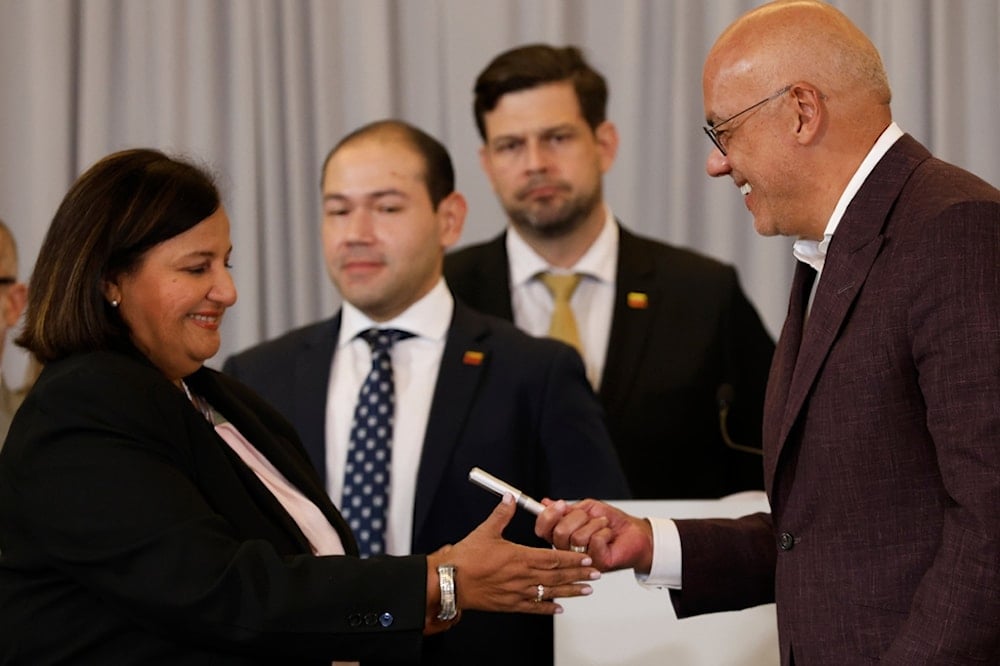
Venezuelan National Assembly President Jorge Rodriguez offers a pen to opposition representative Dinorah Figuera to sign agreements at the end of the second round of political talks in Caracas, Venezuela, Sept. 25, 2026. (AP Photo/Pedro Mattey)
The second round of dialogue between Venezuela’s government and opposition concluded Friday in Caracas with an agreement to establish a committee tasked with selecting members of the Supreme Court, marking an initial step toward what the opposition has called “comprehensive judicial reform.”
The process is also being presented by interim President Delcy Rodríguez as part of a broader political transition, amid pressure from Washington.
Read more: Machado fails Venezuela return bids as Rodriguez meets Trump
According to a statement issued at the conclusion of the talks, the two sides agreed to establish a committee to select Supreme Court judges.
The parties also agreed to “continue analyzing and reviewing the necessary legislative instruments to transform the judicial system.”
The agreement follows the first round of talks held in August, when the government and opposition agreed on the need to reform the judicial system and appoint new judges to the Supreme Court.
The dialogue comes as Caracas seeks to advance an internal political process while facing continued pressure from the United States and wider disputes over Venezuela’s political future.
Media restrictions and Venezuelan assets
The two sides also expressed support for “lifting the blocking imposed on online media after years of censorship,” with the stated objective of “strengthening freedom of expression, plurality of thought and the right to access information.”
The issue places media policy alongside judicial reform within the broader agenda being discussed by the Venezuelan government and opposition.
During the first round of talks, the parties also addressed efforts to secure the release of Venezuela’s international reserve assets held by the Bank of England.
A third round of dialogue between the interim government and opposition is scheduled for mid-October.
Rodriguez pledges elections
The latest talks come shortly after Rodriguez announced on Wednesday that Venezuela would hold elections as part of a transition toward “full democracy.”
Speaking before the United Nations General Assembly, Rodriguez did not provide a date for the elections.
She said Venezuela had “begun a process of democratic transformation so that it can be reborn…to build a freer, more prosperous country for everyone, and more reconciled with itself.”
The announcement places electoral arrangements alongside judicial reform, media policy, and the question of Venezuelan state assets as central issues in the ongoing dialogue.
The absence of a specific election date leaves the timetable for the proposed transition unresolved, while the planned third round of talks is expected to provide another forum for negotiations between the two sides.
Read more: Top Venezuelan delegation in NY eyes debt, energy, and mining deals


