
War on Iran exposes fragility of Gulf political order: Analysis
 4 Min Read
An opinion piece argues that the US–Israeli war on Iran is exposing the political, economic, and security vulnerabilities of Gulf monarchies, raising concerns about long-term instability and shifting regional dynamics.
-
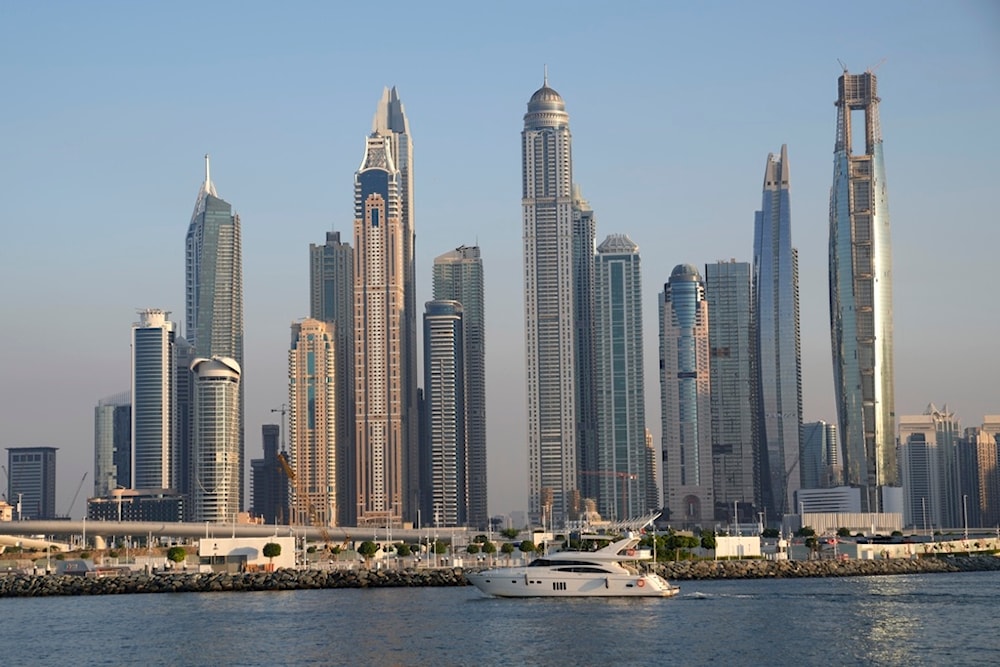
The skyline is visible as Dubai, United Arab Emirates, hosts the COP28 U.N. Climate Summit, Tuesday, Dec. 5, 2023. (AP Photo/Kamran Jebreili)
An opinion piece published by writer Nesrine Malik for The Guardian on Monday argues that the ongoing US-Israeli war on Iran is exposing the underlying fragility of the Gulf monarchies and could reshape the political order of the Middle East.
According to Malik, the crisis has revealed that the region’s image of stability rests on fragile foundations despite decades of wealth and Western-backed security arrangements. “There is a tendency to think of the Gulf powers as static and unchanging,” she writes, noting that countries in the region are often viewed as insulated by oil wealth, authoritarian governance, and strong ties with Washington.
The article argues that the US and Israeli airstrikes on Iran and Tehran’s retaliatory operations across the region have placed renewed attention on the Gulf states’ economic model and geopolitical positioning. Malik writes that the escalation is not simply a confrontation between Washington, Tel Aviv, and Tehran, but rather a moment exposing “a complex, overlapping political order in the Middle East that is much more fragile than it looks.”
Strategic shifts
The commentary focuses particularly on Saudi Arabia, Qatar, and the United Arab Emirates, arguing that these states have undergone significant transformations in recent years while attempting to maintain an image of stability. Their governments have pursued ambitious regional and global agendas, projecting influence from North Africa to the Levant while simultaneously competing with one another for political and economic dominance.
Malik suggests that the chain of events leading to the current escalation was shaped in part by the regional normalization process with "Israel." The October 7 events, she writes, were partly driven by an attempt to halt Saudi Arabia’s potential normalization with "Israel," following the UAE’s decision to sign the Abraham Accords in 2020.
The author argues that the Gulf states’ long-term strategy has been to transform themselves into global hubs for finance, tourism, and entertainment, an approach that depends heavily on regional stability. “The pivot that all three have made relies heavily on attracting international footfall,” Malik writes, explaining that such ambitions depend on “the absence of war.”
However, the expanding war on Iran has disrupted that vision. Missile and drone exchanges across the region, including strikes reaching Gulf territories, have exposed the vulnerability of the economic model these states have tried to build.
Divergent paths
The article also highlights the divergent approaches of the three countries. The UAE is described as pursuing assertive regional influence through involvement in conflicts in Yemen, Libya, and Sudan, while deepening its normalization with Israel.
Qatar, by contrast, is portrayed as balancing between competing alliances. It hosts the largest US military base in the region while maintaining ties with Iran and offering support for Palestinian political actors.
Saudi Arabia, meanwhile, has attempted to reshape its domestic and international image under Crown Prince Mohammed bin Salman, pursuing economic diversification and social reforms while competing with neighboring Gulf states to attract investment and global attention.
Regional fallout
Despite the immense financial resources available to these governments, Malik argues that the war on Iran has introduced a new level of insecurity across the Gulf. Prolonged conflict could disrupt energy exports, aviation routes, and key infrastructure, including desalination systems that supply drinking water to much of the region.
The article also raises questions about the political consequences of Gulf alignment with Washington and Tel Aviv during the war. According to Malik, the longer the conflict continues, the harder it may become for Gulf rulers to maintain claims of political independence while appearing tied to Western and Israeli regional strategies.
Concluding her analysis, Malik warns that the consequences of the war on Iran could extend far beyond the battlefield. Economic shocks, intensified regional competition, and the risk of instability spreading from Iran could reshape the balance of power across the Middle East for decades to come.
Read more: Gulf businesses buy political violence insurance amid US war on Iran


