
Gulf businesses buy political violence insurance amid US war on Iran
 3 Min Read
Businesses across the Gulf are securing political violence insurance as the US military presence strains regional security amid Iranian retaliatory strikes.
-
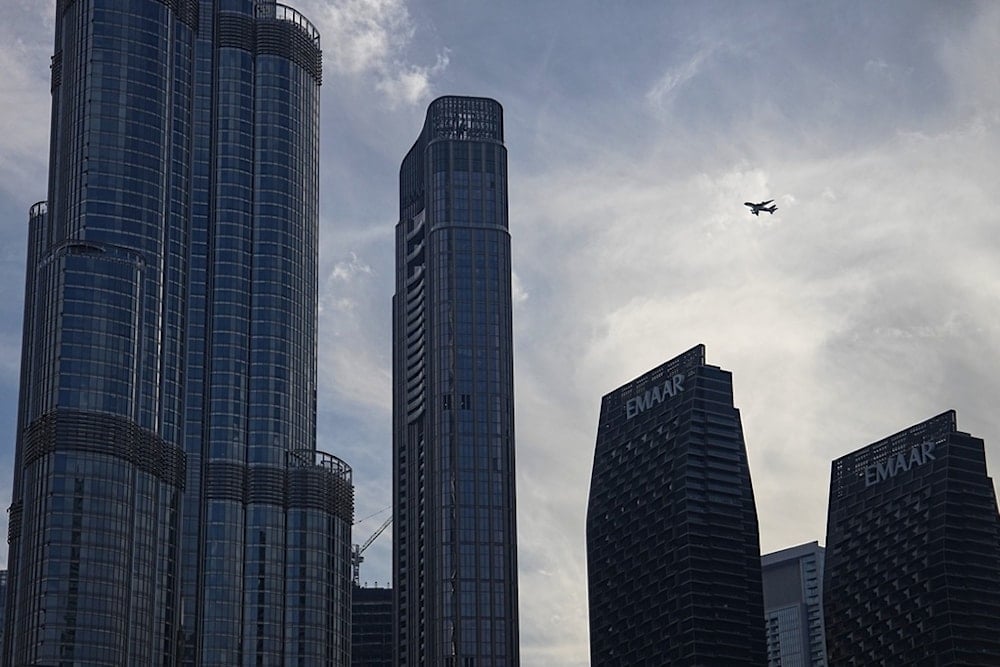
An Emirates Airlines plane flies over skyscrapers in downtown Dubai, United Arab Emirates, Saturday, March 7, 2026 (AP)
As the US-Israeli war on Iran escalates and Iran continues to respond to the aggression by targeting US military bases in Gulf countries, businesses across the Gulf are moving quickly to protect their assets from threats following the growing escalation, the Financial Times reported.
Data centers, energy projects, pipelines, ports, and hotels have flooded insurers with requests for millions of dollars in political violence coverage, aiming to shield themselves against risks from missiles, drones, and civil unrest.
Industry insiders report that hundreds of requests have arrived this week alone, reflecting heightened concern over property damage caused not only by military strikes but also by protests, strikes, and social instability.
War drives market anxiety
The rush for coverage highlights the economic consequences of the US-Israeli aggression on Iran and Tehran's subsequent retaliatory attacks on "Israel" and neighbouring countries that host US assets from which the aggression is launched.
Analysts warn that the resulting losses could be “significantly larger and more catastrophic” than anything in the past decade, particularly as drone and missile attacks increasingly target civilian and commercial infrastructure.
Western businesses operating in Gulf countries, seen as more vulnerable to direct attacks, are among the largest clients seeking expanded protection. Hotels in Bahrain and Qatar, as well as solar energy projects in Saudi Arabia, have all requested comprehensive political violence insurance, covering both collateral damage and targeted strikes.
Technology and data at risk, prices on the rise
Even the technology infrastructure is under threat. Amazon data centres in the UAE and Bahrain were reportedly targeted by Iranian drones this week, raising alarms about potential service disruptions. Microsoft, however, stated that its facilities in the region were not affected.
Prior to the war, many Gulf businesses maintained basic terrorism insurance. Now, brokers are advising clients to purchase full political violence coverage, which includes risks from strikes, riots, civil commotion, and state-backed military actions.
Prices for such coverage have soared, in some cases reaching five times prewar levels. For example, a $20 million development project that previously paid less than $100,000 for political violence coverage may now face premiums as high as $500,000.
Regional escalation fuels insurance surge
Iran has launched multiple waves of retaliatory drone and missile strikes targeting both Israeli-occupied territories and US military installations across the region, including facilities in the UAE, Kuwait, Qatar, Iraq, and Jordan.
Iranian officials report significant civilian and military losses from the ongoing US-Israeli aggression, while satellite imagery indicates key US defense assets, such as the THAAD radar network in Jordan, have been destroyed.
The growing effectiveness of Iran’s missile and drone capabilities has intensified fears of collateral damage to commercial and energy infrastructure, prompting businesses to seek broader insurance protection.
Iran’s parliamentary speaker, Mohammad Bagher Ghalibaf, emphasized that peace in the region remains unattainable as long as US military bases operate in West Asia, underscoring the persistent security risks faced by Gulf economies.
The expanding war is likely to increase both the cost and demand for comprehensive political violence insurance, reflecting the deepening uncertainty for investors and businesses in the region.
Read More: Iran hits US bases in Gulf, targets 'Israel' and Iraqi Kurdistan sites


