
War on Iran exposes glaring weakness in US military strategy: Report
 6 Min Read
The Iran war has depleted US missile stocks, forcing battlefield rationing and exposing weaknesses in Washington’s ability to sustain prolonged wars.
-
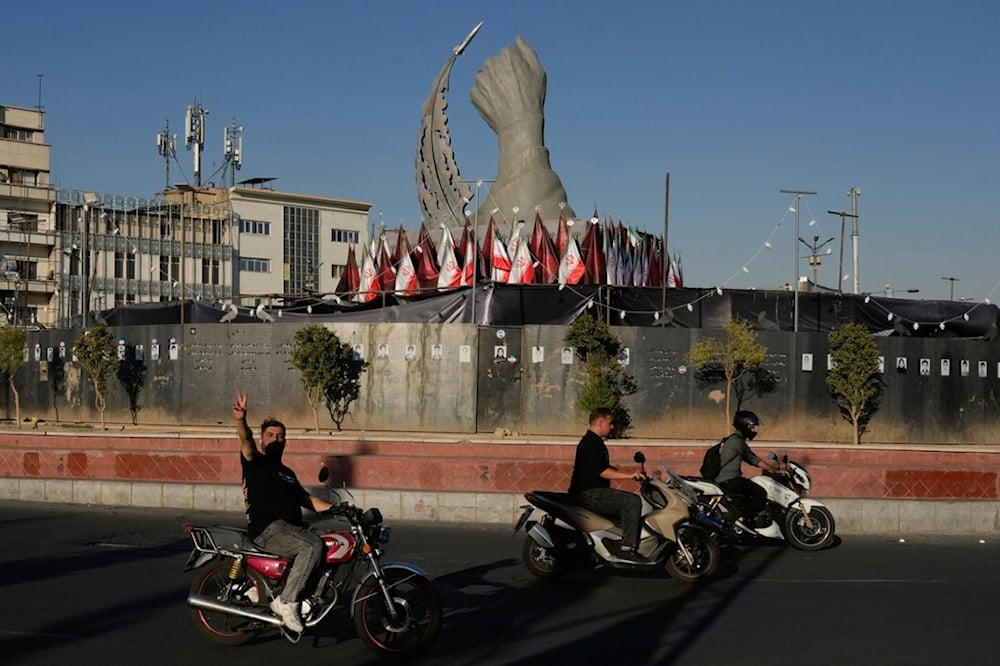
A man reacts to the camera while driving past a monument depicting the clenched fist of the late Iranian Leader Ayatollah Sayyed Ali Khamenei and a missile at the Islamic Revolution square in downtown Tehran, Iran, Sept. 15, 2026. (AP/Vahid Salemi)
The ongoing US war on Iran has exposed a glaring weakness in US military strategy, with depleted weapons stocks and shortages of missile interceptors increasingly undermining Washington’s deterrence capabilities, according to an analysis written by Asia Times.
The report said the war has highlighted a fundamental problem in US war planning: while Washington can escalate militarily within hours, rebuilding the weapons consumed during a prolonged confrontation can take years.
US interceptor shortages force battlefield rationing
The shortage of missile interceptors has already affected US military operations in the region, with commanders at US bases reportedly allowing some incoming Iranian missiles to land when they are headed toward unpopulated areas in order to preserve limited interceptor stocks for threats capable of causing significant damage.
Asia Times said the practice reflects wartime rationing that is raising concerns among US allies and exposing the pressure on Washington’s air defense capabilities.
The report noted that President Donald Trump recently downplayed a Pentagon assessment of munitions shortages in an interview with Time magazine, while acknowledging that some US weapons stocks were running low.
Independent estimates have underscored the scale of the depletion. According to the Center for Strategic and International Studies (CSIS), the US stockpile of Patriot and Terminal High Altitude Area Defense (THAAD) interceptors had fallen to fewer than 827 and 278, respectively, by July 27.
Pentagon races to replenish depleted missile stocks
The Pentagon’s recent contracts reflect the scale of the challenge facing the US military.
In recent days, the Pentagon announced a $24.4 billion contract with Raytheon to accelerate production of Standard Missile-6 (SM-6) interceptors. The deal followed a $20.7 billion contract for Advanced Medium-Range Air-to-Air Missiles (AMRAAM) and a $58.6 billion Patriot missile agreement with Lockheed Martin.
The contracts are intended to replenish stocks depleted by the war. However, Asia Times stressed that signing contracts does not immediately return consumed missiles to US arsenals, as manufacturing and delivery can take years.
The report noted that the Pentagon and Lockheed Martin had already agreed in January to increase annual THAAD production from 96 to 400 interceptors and Patriot PAC-3 production from around 600 to 2,000 by the end of the decade.
US weapons production cannot keep pace with wartime consumption
The depletion of US missile stocks predates the current escalation with Iran.
During the 12-day war in June 2025, US forces reportedly fired more than 150 THAAD interceptors and approximately 80 SM-3 missiles while supporting “Israel” against Iranian projectiles.
Yet expanding production remains constrained by industrial capacity, skilled labor, and supply chains. Asia Times cited manufacturing lead times for interceptors ranging from 25 to 51 months, meaning production cannot be expanded rapidly enough to compensate for battlefield consumption.
A Pentagon Inspector General report released in September found that the Iran war had exposed bottlenecks in the US defense industrial base and contributed to shortages of key munitions.
US deterrence in other theaters under pressure
While the US military can still sustain its current operations against Iran, the rapid depletion of high-value munitions could weaken Washington’s military commitments elsewhere.
The Congressional Budget Office estimates that US forces have likely used between half and two-thirds of their missile-defense interceptor inventory since June 2025. Rebuilding those stocks could take at least five years even with increased production, according to the report.
The impact is already being felt in Ukraine, where Kiev has reported an acute shortage of Patriot interceptors since the Iran war began.
In August, Ukrainian President Volodymyr Zelensky warned that Ukraine had two and a half times fewer interceptors than it had in 2025, while Russia was launching twice as many ballistic missiles each month.
Read more: Trump ditches Zelensky, says time for new Ukrainian president
Iraq war exposed similar weaknesses in US arsenal
Asia Times argued that Washington has repeatedly underestimated how long military commitments can last, placing additional strain on its weapons stockpiles.
The report pointed to the 2003 Iraq war, which Washington initially expected to produce a rapid victory. Just 11 days after the invasion began, US forces were already running critically low on some key weapons after firing 700 of their 1,200 Tomahawk cruise missiles, along with thousands of satellite-guided bombs.
The Pentagon subsequently moved to replenish its stocks, but production struggled to keep pace with wartime consumption.
Iran war stretches beyond Washington's initial timeline
The report drew a parallel between the Iraq war and the current war on Iran, arguing that Washington has once again pursued a rapid military victory while underestimating the resources required for a prolonged war.
President Trump initially said the Iran war would last only a few weeks, but the war has now entered its eighth month.
Asia Times said Washington had been warned about weaknesses in its defense industrial base and inadequate munitions stocks well before the current escalation. Such warnings had been issued since at least January 2023, including assessments that the US could not afford to wait until a war began before addressing the replenishment problem.
The Pentagon only moved earlier this year to expand production of PAC-3 and THAAD interceptors.
Depleted stocks threaten US commitments to allies
The report concluded that the central challenge is not simply whether the US can maintain its current military aggression, but whether it can sustain its broader global military commitments while rebuilding depleted arsenals.
Although Washington can allocate additional funding to weapons production, factories, workers and supply chains cannot be expanded at the same speed as wartime consumption.
Asia Times wrote that the unexpectedly prolonged war on Iran, combined with the lengthy process required to replenish depleted stocks, is weakening US deterrence in other theaters and affecting Washington’s ability to provide military support to allies worldwide.


