
War on Iran exposes vulnerabilities of US military bases in Gulf
 5 Min Read
Analysis highlights the vulnerability of the US military infrastructure during the Iran war as forward bases came under repeated Iranian missile and drone strikes.
-
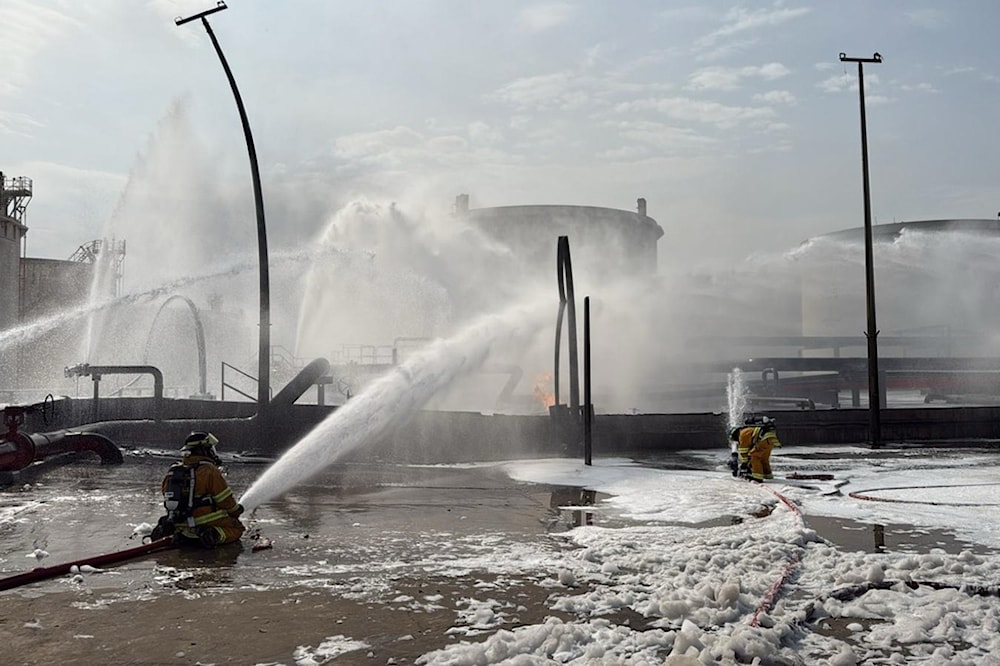
This image released by Bahrain's Interior Ministry shows firefighters extinguishing flames after an Iranian projectile struck an industrial area in Ma'ameer, Bahrain, March 9, 2026 (Bahrain Interior Ministry)
The United States’ military aggression against Iran, dubbed “Operation Epic Fury,” showcased Washington’s conventional military strength but failed to secure a decisive outcome, as Tehran maintained its ability to retaliate and push toward diplomacy, according to a CATO institute analysis.
The analysis details that US forces inflicted heavy damage early in the war, targeting Iran’s navy and air defense systems, but despite claims by US Defense Secretary Pete Hegseth that thousands of Iranian targets were struck, Iran remained capable of sustaining operations and influencing the trajectory of the war.
A key factor cited was Iran’s geographic advantage, operating within its own region while US forces projected power from a distance. The early closure of the Strait of Hormuz triggered immediate disruptions in oil and financial markets, strengthening Tehran’s leverage in negotiations.
Iran's region-wide strikes
Iran also demonstrated its capacity to carry out sustained strikes across the region. Missiles and drones targeted military sites in several US-aligned bases, including Saudi Arabia, Kuwait, the United Arab Emirates, and Qatar.
US military infrastructure in the region proved vulnerable during the war. Around 40,000 US troops stationed at major bases in the Gulf were exposed to repeated attacks. Iranian strikes reportedly hit multiple installations, including facilities in Bahrain, home to the US Fifth Fleet, and US-linked Al Udeid Air Base in Qatar. Additional strikes in Kuwait resulted in the deaths of US personnel, while attacks on US bases in Saudi Arabia damaged key surveillance and refueling aircraft.
The scale of the strikes raised concerns within the Pentagon over the survivability of forward-deployed forces. Reports indicated that some bases became difficult to operate from, prompting adjustments to troop deployments and operations.
Amid the escalation, Washington also moved to end its long-running military presence in Syria, signaling a shift in regional posture.
Beyond the region
The developments have prompted renewed debate over the strategic value of large, forward-deployed US bases, particularly when they can be targeted by adversaries with missile and drone capabilities.
Analysts warn that similar vulnerabilities could emerge in the Indo-Pacific, where tens of thousands of US troops are stationed across bases within range of China’s expanding missile arsenal. Concerns have been raised that such exposure could heighten instability during a crisis, increasing incentives for preemptive strikes.
While the Pentagon has explored dispersing forces across smaller installations, the longstanding reliance on large bases remains a central feature of US military strategy, raising questions about its effectiveness in future wars.
War on Iran leaves Tehran stronger, regional balance in its favor
Yet the implications of the war have stretched well beyond military outcomes, reshaping economic stability and regional power dynamics.
The war on Iran has significantly altered the strategic balance in West Asia, according to a commentary published by The Daily Star. The analysis says the war has undermined confidence in the United States’ security umbrella in the region.
The analysis says the war’s economic impact has been heaviest in West Asia, but its effects have also been global. Damage to energy infrastructure and disrupted oil and gas shipments have unsettled markets and driven prices higher worldwide.
It adds that the International Energy Agency called it “the largest supply disruption in the history of the global oil market,” noting that gas shortages and damage to LNG facilities may take years to recover from, leading some countries to raise prices and introduce rationing measures.
'Abrupt darkening' of global economic outlook
The IMF has described the situation as an “abrupt darkening” of the global economic outlook, marked by rising risks and difficult policy choices for countries. In its latest World Economic Outlook, it forecasts slower growth and higher inflation, according to The Daily Star.
The IMF report estimates global growth at 3.1% this year, with inflation expected to increase, calling it a “sharp deviation” from recent disinflation trends. The report warns that these conditions could even push the global economy toward a recession.
According to The Daily Star, the war’s economic impact varies, with Global South countries and net energy importers expected to be hit the hardest. A UNDP report warns the fallout could push over 32 million people into poverty, with rising energy and food costs and weaker growth reversing development gains in poorer states.
It adds that IMF Managing Director Kristalina Georgieva said that even if a lasting peace is reached, the conflict will permanently “scar” the global economy and leave lasting damage to living standards.


