
What's behind Syria-'Israel' security talks? Druze, Kurds, and Turkey
 6 Min Read
Talks between Syria and 'Israel' in Paris produce tentative agreements, including a US proposal for a joint operations room in Jordan, but Israeli skepticism toward Damascus grows amid Kurdish setbacks and Turkish influence.
-
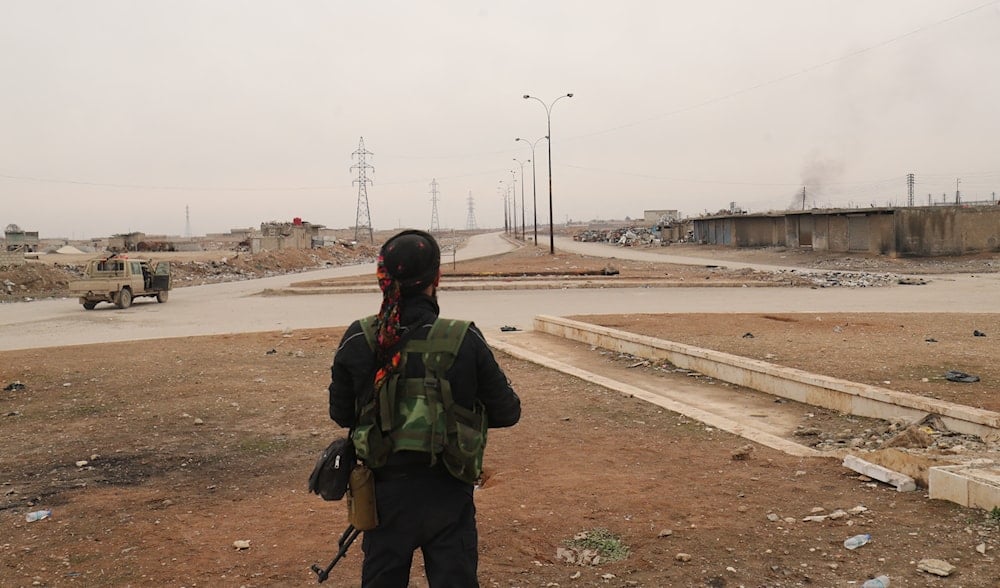
This photo, taken on January 22, 2026, shows Syrian Democratic Forces fighters who took positions to secure the frontline and the areas near the prison where IS detainees are held in Hasakeh. (Photo by DELIL SOULEIMAN / AFP)
The resumption of indirect negotiations between Syria and the Israeli regime in Paris has triggered a series of tentative understandings, amid continued Israeli military violations on the ground and mounting questions over whether US-brokered "coordination" mechanisms can meaningfully address occupation and sovereignty.
According to the Israeli newspaper Maariv, the talks resulted in agreements to establish mechanisms aimed at "preventing miscalculation," introducing confidence-building steps, and addressing the situation of the Druze community in southern Syria as an internal Syrian matter to be resolved without external interference or the use of force.
The report also said the United States proposed the establishment of a joint operations room in Jordan, alongside the creation of a demilitarized zone along the border. However, no details were disclosed regarding the scope or timeline of any Israeli withdrawal from areas occupied following the fall of the Assad government in December 2024.
The report noted that if a security agreement with Syria were to move forward, the Israeli regime's political leadership would face the challenge of presenting it convincingly to the public. The agreement would not involve normalization and would include territorial withdrawals, even though the entity is illegally occupying those areas in the first place.
Occupation continues despite 'coordination'
These discussions come against the backdrop of intensified Israeli aggression in southern Syria. Since early January, Israeli occupation forces have carried out repeated incursions into Quneitra and Daraa, levelled farmland, detained civilians, including children, and expanded engineering works inside occupied military bases near the disengagement line, in open violation of Syrian sovereignty.
Despite a US-announced "joint fusion mechanism" unveiled on January 6 following indirect Paris talks, Israeli violations have continued uninterrupted. Syrian officials have repeatedly stressed that technical coordination cannot substitute for an end to occupation, warning that any security framework that freezes Syrian deployments while Israeli forces remain entrenched risks institutionalizing a creeping occupation.
Earlier this month, Washington confirmed that the Paris talks addressed Israeli "security concerns" and included plans for continuous intelligence sharing and military de-escalation under US supervision. Damascus, however, has maintained that progress on political and security files is impossible without a clear, binding commitment by Israeli forces to withdraw from territories occupied after December 2024.
READ MORE: US says 'Israel', Syria agree to so-called 'de-escalation mechanism'
US mediation, shifting dynamics inside Syria
The renewed diplomatic push also unfolds amid shifting internal dynamics in Syria. On January 28, Syrian interim President Ahmad al-Sharaa held a lengthy phone call with US President Donald Trump focused on stabilization efforts, reconstruction, and security cooperation.
Trump expressed support for a ceasefire agreement reached earlier this month between Damascus and the US-backed SDF and backed the group's integration into Syria’s national military framework. The January 18 ceasefire, brokered under US sponsorship after weeks of clashes in northern Syria, has since been extended.
SDF commander Mazloum Abdi confirmed that talks are moving toward political rather than militarized solutions, stressing that international efforts to ease tensions depend on Damascus' commitment and the avoidance of imposed or unacceptable conditions.
According to Maariv, US officials appear to have confirmed, on the sidelines of the Paris talks, that the Israeli regime would refrain from military action against al-Sharaa's forces should they move against Kurdish groups, highlighting Washington's central role in managing the delicate balance between the entity and Turkey.
READ MORE: Perpetual cycle of abandonment: Washington abandons SDF in Syria
Israeli calculations: Kurds, Druze, and Turkey
According to Maariv, developments on the Kurdish front are a key source of concern for the Israeli regime, not only because they signal shifts inside Syria, but because they affect the balance of power along the entity's northern frontier.
The newspaper notes that recent advances by Damascus against Kurdish forces reduce the fragmentation that has characterized Syria since 2011. From the Israeli perspective, a more centralized Syrian state, especially one regaining control over border regions, is more difficult to contain or pressure than a divided landscape of competing actors. Maariv emphasized that the updated agreement between Damascus and Kurdish forces warrants Israeli scrutiny, particularly to determine whether it amounts to an effective Kurdish capitulation.
These developments are also closely linked to Turkey. Kurdish setbacks are widely seen as benefiting Ankara, which has long sought to curb Kurdish autonomy in Syria. "Israel," Maariv reports, views growing Turkish influence as an added strategic complication, particularly if Syrian stabilization proceeds in a way that aligns with Turkish regional interests.
At the same time, the fate of the Druze community in southern Syria has emerged as another point of concern. The report suggests that a strengthened central government in Damascus could reassert authority over Druze areas near the occupied Golan, narrowing one of the remaining pressure points through which "Israel" has historically sought to influence developments in southern Syria.
Washington's balancing act
According to Maariv, US officials have reportedly assured "Israel" that it would not face military repercussions should Syrian forces move against Kurdish groups, underscoring Washington's role in managing the balance between "Israel," Turkey, and the new Syrian leadership.
Israeli officials, according to Maariv, are fully aware of Trump's interest in consolidating al-Sharaa's rule in Syria, as well as the influence exerted by Saudi and Turkish leaders on the White House. Nevertheless, obstacles remain to a Syrian–Israeli agreement, requiring greater clarity and more measured, realistic messaging to the Israeli public.
The newspaper concluded that the core strategic question is whether the Israeli regime is prepared to extend "credit" to the establishment of a centralized authority in Damascus, thereby opening a new chapter in its approach to Syria since 2011.


