
When Israeli settlers attack, Washington speaks of 'friction'
 7 Min Read
As Israeli settlers beat an American journalist and assault European diplomats in the occupied West Bank, Washington's response exposes the gap between diplomatic rhetoric and accountability.
-
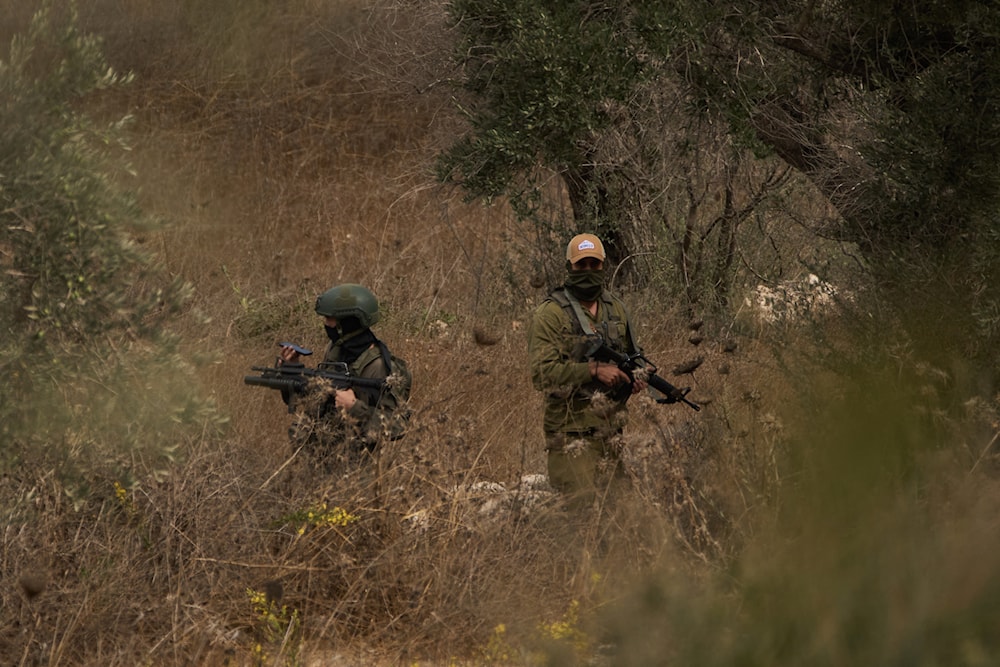
Armed men in military fatigues, identified by local residents as Israeli settlers, observe Palestinians harvesting olives in the West Bank town of Turmus Ayya, Wednesday, Oct. 14, 2026 (AP)
Four fractured vertebrae, a broken rib, repeated kicks, and stolen equipment. Yet when US Secretary of State Marco Rubio addressed the Israeli settler attack on American photojournalist Heidi Levine in the occupied West Bank, Washington described the images as "disturbing" and warned against further "friction".
A day later, Israeli settlers assaulted European diplomats accompanying Palestinian farmers during the olive harvest, attacking a French mayor and damaging a diplomatic vehicle.
The incidents exposed the contrast between the violence on the ground and the diplomatic language used to address it. While Western officials expressed concern over the attacks, Palestinians continued to face settler assaults threatening their lives, land, and livelihoods.
The disparity raises questions about the significance of condemnation when it is not accompanied by measures capable of ensuring accountability.
'Crack down on that stuff': Washington's language of restraint
Rubio's remarks followed Friday's attack on Levine, who was covering Palestinian farmers harvesting olives near Abu Falah, northeast of Ramallah.
According to reports, Israeli settlers attacked farmers, burned olive trees, and hurled stones. Levine, wearing protective clothing clearly identifying her as a journalist, was knocked to the ground, repeatedly beaten, and robbed of her equipment.
She described being kicked for approximately ten minutes while attempting to protect her belongings before being hospitalized with serious injuries.
Masked Israeli settlers attacked Palestinian villagers on Friday, setting olive groves on fire and slinging rocks. Caught in the attack was Post photographer Heidi Levine. “They just kept kicking me and kicking me, like probably 50 times,” Levine said. https://t.co/9YLUuU9ktP https://t.co/0SrFcIW4as
— The Washington Post (@washingtonpost) October 16, 2026
Despite the brutality, Rubio's response emphasized Washington's concern rather than announcing consequences for those responsible.
"We're very disturbed by those images and what we're seeing," he told reporters Saturday.
"We've asked the Israelis and continue to ask them to crack down on that stuff."
The phrase "that stuff" reduces repeated physical assaults and attacks on Palestinian agricultural land to a vague category of misconduct, while "disturbed" expresses disapproval without specifying accountability measures.
Rubio also emphasized that US President Donald Trump wanted to prevent further "friction".
"The president's been very clear. He said this repeatedly. He does not want to see friction or anything, a crisis going on in the West Bank."
The wording notably downplays the violence in the West Bank by framing it as “friction” or “a crisis", rather than directly acknowledging the attacks, killings, and destruction affecting Palestinians. The term “friction” suggests a relatively minor or mutual disagreement, obscuring the realities of military operations and settler violence, while “anything” further dilutes the seriousness of the situation.
By focusing on the president’s desire to avoid a crisis, the statement emphasizes political stability and the risk of escalation rather than the underlying violence, its perpetrators, or its impact on Palestinians.
Washington condemns violence after lifting settler sanctions
Rubio's statements also stand in contrast to Washington's policies toward Israeli settlers.
On January 20, 2025, Trump revoked an executive order introduced under former President Joe Biden that authorized sanctions against individuals and organizations implicated in violence and instability in the occupied West Bank.
The US Treasury subsequently terminated the sanctions program and removed those designated under it from its sanctions list.
Asked about the decision, Rubio insisted that lifting sanctions did not mean Trump supported settler attacks.
"Lifting sanctions…does not mean he's a supporter of what he's seeing now on television, what he's reading about," he said.
'What he’s reading about'
The wording creates distance between the decision to lift sanctions and the violence unfolding on the ground, framing the issue around what the official supposedly does or does not support rather than the consequences of the policy itself.
The phrase “what he’s seeing now on television, what he’s reading about” is particularly revealing: it reduces reported violence to information the official consumes, rather than acknowledging the experiences of those directly affected.
By insisting that lifting sanctions does not imply support for these events, the statement also attempts to separate policy from accountability, without explaining what concrete measures, if any, will be taken in response.
In fact, while Washington continues urging Israeli authorities to curb settler violence, it has dismantled a mechanism previously used to impose financial consequences on individuals implicated in such attacks.
Rubio announced no plans to reinstate the measures, underscoring the gap between Washington's condemnation and its willingness to impose punitive consequences.
Israeli attacks on diplomats become a 'new escalation'
A day after the journalist was attacked, Israeli settlers attacked an international delegation accompanying Palestinian farmers during the olive harvest in Taybeh.
The delegation included Belgian, French, and Polish diplomats, French Mayor Bernard Baudoux, and Catholic representatives.
According to Belgian Consul General Anick Van Calster, masked attackers carrying wooden and metal sticks assaulted Baudoux and damaged a vehicle as the delegation attempted to leave.
"Attacking diplomats is a new escalation," Van Calster said Sunday. "The violence has truly reached new heights."
Video of masked Israeli settlers striking European diplomats and elected officials near Taybeh, a Christian village in Palestine. The 78-year-old French mayor Bernard Baudoux was thrown to the ground and beaten with iron bars. Make no mistake: If the Israeli government wanted to put an end to this, they could within minutes. They don't. Just like Biden pretended that he wanted a ceasefire, but in reality worked tirelessly to enable Israel's genocide. They are playing the same trick on us again.
— Trita Parsi (@tparsi) October 18, 2026
The phrase “new escalation” frames the attack on diplomats as a turning point, implicitly suggesting that the violence had been at a lower or more tolerable level beforehand. Similarly, saying that violence has “reached new heights” emphasizes its recent intensification without acknowledging the violence that preceded it or the people who have endured it for years.
While the statement conveys concern, its language risks presenting the situation as a sudden deterioration rather than part of a longer pattern of violence, while leaving the perpetrators, the broader context, and the consequences for Palestinians largely unaddressed.
Belgium's Foreign Minister Maxime Prevot went a bit further, renewing calls for European sanctions, while the European Union condemned the attacks and demanded accountability.
Unlike Rubio's initial remarks, the Belgian response explicitly raised the prospect of punitive measures.
Netanyahu blames those attacked
Nevertheless, the incident highlighted how violence experienced by Palestinian communities for years acquires additional diplomatic significance when foreign representatives become direct targets.
Meanwhile, Israeli Prime Minister Benjamin Netanyahu's office questioned whether the delegation should have coordinated its visit with the Israeli military beforehand.
Van Calster rejected the argument, maintaining that diplomats were not required to coordinate such visits under the Oslo Accords.
The Israeli response shifted part of the discussion toward the conduct of those attacked, rather than focusing exclusively on the settlers responsible for the assault.
An 'act of terror' when the victim is American
Not all US officials adopted Rubio's restrained language.
US Ambassador to "Israel" Mike Huckabee described the attack on Levine as a "despicable act of terror carried out by masked cowards," demanding the arrest, prosecution, and imprisonment of those responsible.
His remarks contrasted sharply with Rubio's references to "friction" and "that stuff", demonstrating how differently the same attack could be characterized within the US administration.
Yet the forceful condemnation following the assault on an American journalist also raises questions about the attention given to Palestinian victims of similar violence.
What it's like for Palestinians
According to rights organization Yesh Din, at least 170 settler attacks against Palestinians were documented between September 27 and October 17, coinciding with the annual olive harvest.
The attacks have included physical assaults, intimidation, and the destruction of agricultural property, threatening Palestinian livelihoods and access to land.
For Palestinians living under occupation, settler violence is not simply a source of diplomatic embarrassment or regional "friction", but a continuing threat to their lives and communities.
While some Western officials have demanded prosecutions and sanctions, Washington's top diplomat defended the removal of punitive measures even as he condemned the latest attacks.
The contrast illustrates the distance between expressing concern over Israeli violence and pursuing accountability for those responsible.
Read more: US urges 'Israel' to act against settler attacks in West Bank


