
Writers boycott Hay Festival over invite of Venezuelan opposition
 5 Min Read
Latin American writers withdrew from the Hay Festival Cartagena to protest the invitation of María Corina Machado, accusing her of legitimizing US-led intervention and escalating pressure against Venezuela and President Nicolás Maduro.
-
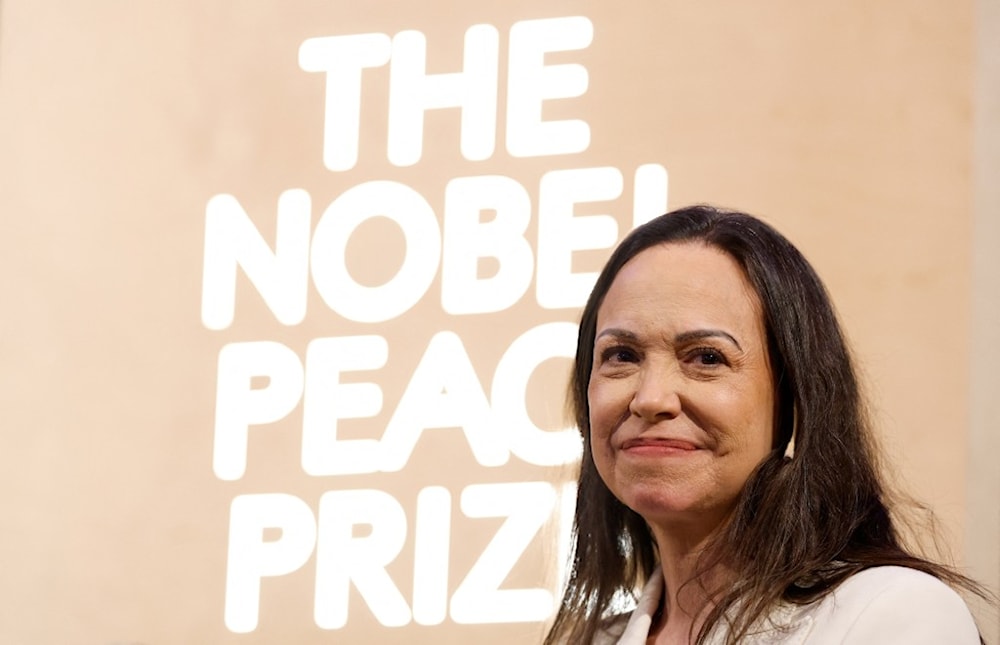
Nobel peace laureate Maria Corina Machado addresses a press conference at the Grand Hotel in Oslo, Norway, on December 11, 2025. (AFP)
Several prominent Latin American writers have withdrawn from the upcoming Hay Festival Cartagena in Colombia after the event invited Venezuelan opposition figure and Nobel Peace Prize laureate María Corina Machado.
The boycott comes at a moment of heightened confrontation between Washington and Caracas, as the United States intensifies sanctions, maritime enforcement measures, and political pressure aimed at weakening the government of President Nicolás Maduro. Critics across the region view these actions as part of a long-running US strategy to force political change in Venezuela by targeting its oil revenues and isolating its leadership internationally.
Against this backdrop, Machado’s vocal support for US-led pressure, including calls that endorse the use of force, has placed her at the center of controversy. Writers withdrawing from the festival argue that hosting her effectively normalizes interventionist policies that threaten Venezuelan sovereignty and regional stability.
Llegó la cultura genocida al HAY FESTIVAL DE CARTAGENA. pic.twitter.com/Z43q7fXplt
— Carlos Villegas 🇨🇴🇵🇸🇨🇴 (@Cjotavillegas) December 15, 2025
No platform for imperialism
Among those pulling out is Colombian novelist Laura Restrepo, who announced her decision in a public letter. Restrepo described Machado as "an active supporter of US military intervention in Latin America" and warned against turning cultural platforms into vehicles for legitimizing foreign aggression.
"No platform should be given, or audience facilitated for someone who, like Ms Machado, promotes positions and activities that subject our peoples and undermine the sovereignty of our countries. Imperialist intervention is not something to debate, but something to reject outright," Restrepo wrote.
Another Colombian author, Giuseppe Caputo, tied the festival’s invitation directly to ongoing US military actions in the Caribbean region, which borders Venezuela and has become a strategic theater for Washington’s show of force.
Referring to recent US airstrikes that have killed more than 90 people at sea, Caputo said the decision to host Machado was especially troubling given Cartagena’s geographic and symbolic location. "I think that, given the grave moment of escalating imperial violence, it is better to withdraw from a festival held on the shores of the bombarded Caribbean Sea, which has decided to invite someone who dedicated a peace prize to the fascist responsible for these crimes," Caputo wrote on social media, recalling that Machado dedicated her Nobel prize to Trump.
Machado supports force
Machado has openly aligned herself with Washington’s pressure campaign against Caracas. In a recent interview with CBS, she said she “absolutely supports President Trump’s strategy” and argued that the “cost of staying in power” for President Nicolás Maduro must be increased “by force”.
For critics, such statements reinforce the view that Machado functions as a political instrument of US interventionism at a time when Venezuela is facing intensified economic warfare, sanctions on oil exports, and threats to its maritime trade. Caracas has repeatedly denounced these measures as collective punishment designed to strangle the country’s economy and undermine its elected government.
The Venezuelan opposition leader recently resurfaced after a highly publicized departure from Venezuela, where she had reportedly spent more than a year in hiding. Her journey to Oslo to receive the Nobel Peace Prize involved clandestine travel across land and sea routes and assistance from foreign-linked networks. Although she missed the official ceremony, she later took part in events and press engagements abroad.
A third withdrawal was announced by Dominican writer and activist Mikaelah Drullard, who said the festival’s invitation effectively validated Machado’s political agenda at a moment of rising militarization in the region. She said the decision amounted to "an ideological weapon to promote her justifications for US intervention, invasion and militarisation of the Caribbean, and of her delight at the success of the ultra-right Kast in Chile’s election."
Far-right alignment
Machado had earlier welcomed the election of Chilean president José Antonio Kast, an outspoken admirer of former dictator Augusto Pinochet, aligning herself with far-right figures across the region who have supported harsher measures against left-leaning governments.
Despite the backlash, Machado remains scheduled to appear remotely at the festival on January 30, in a conversation with Venezuelan journalist and former minister Moisés Naím.
In response, the Hay Festival said it respected the authors’ decisions but defended its commitment to dialogue and pluralism. “It is important to clarify that the Hay festival does not align itself with or endorse the opinions, positions or statements of those who take part in its activities, nor their political views,” the statement said.
Read more: Oil lies in depths of Trump's campaign against Venezuela: NYT


