
China rejects Nvidia spying claims, accuses US of tech blockade
 3 Min Read
China has accused Washington of exploiting espionage allegations involving Nvidia CEO Jensen Huang to justify restrictions on China's technological development, rejecting reports linking Beijing to an alleged intelligence operation.
-
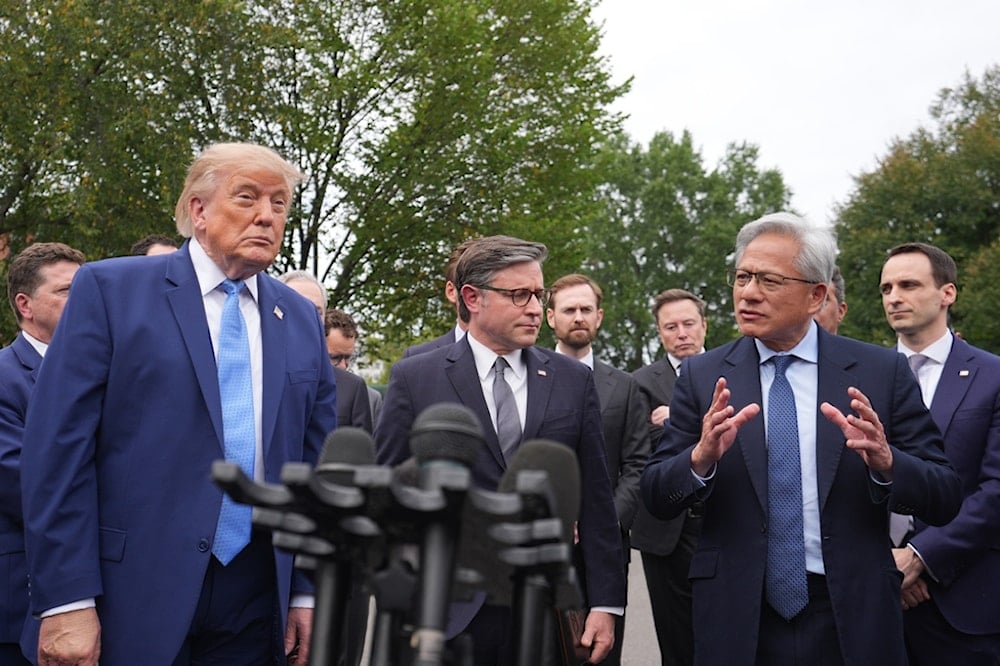
President Donald Trump listens as NVIDIA CEO Jensen Huang speaks to reporters at the White House in Washington, Sept. 29, 2026, after meeting with top executives of AI firms, as House Speaker Mike Johnson, R-La.. (AP/Alex Brandon)
China has accused the United States of exploiting fabricated allegations of espionage involving Nvidia CEO Jensen Huang to impose a technological blockade on Beijing, following reports alleging that the technology executive had been targeted in a Chinese intelligence operation.
Chinese Foreign Ministry spokesperson Mao Ning said on Thursday that China's technological progress was driven by independent innovation and open cooperation, rejecting the allegations surrounding Huang.
"China's technological progress is driven by independent innovation and open cooperation," Mao said during a regular press briefing.
She urged Washington to stop using fabricated espionage narratives to justify restrictions on China's technological development, saying, "The US side should stop fabricating such espionage narratives as an excuse to impose a technological blockade."
The remarks follow China's earlier rejection of a New York Times report alleging that Beijing had sought to spy on Huang. The Chinese Foreign Ministry dismissed the report as speculation without any factual basis, describing it as an attempt to smear China.
Allegations surrounding Nvidia CEO fuel US-China tensions
The dispute comes amid growing scrutiny of Huang's personal relationships and alleged links to a Chinese intelligence operation, which have also raised questions about his position at the helm of Nvidia.
Huang acknowledged that he had been involved in a personal relationship, reportedly with Alice Huang, a former Chinese executive at Singapore-based Megaspeed whom US officials suspect of having worked for Chinese intelligence.
The revelations have triggered turmoil around Nvidia's leadership. The company's shares fell nearly 9% in after-hours trading Wednesday after reports emerged that its board had convened to discuss Huang's future as chief executive.
Two people familiar with the matter told NBC News that the board was examining Huang's position during a meeting scheduled for Wednesday evening. A source also told the network that the White House was aware of the discussions. The Wall Street Journal first reported the meeting.
The developments have also drawn attention from US lawmakers, with Democratic Senators Elizabeth Warren and Chris Coons requesting that the Commerce Department, State Department, and White House preserve records concerning Nvidia's advanced AI chip exports to China and the reported intelligence operation involving Huang.
The controversy comes as Washington maintains restrictions on advanced semiconductor exports to China, while Beijing seeks to strengthen its domestic AI capabilities and narrow the technological gap with the US.
Read more: Musk: Hiring embattled Nvidia CEO Huang would be 'an honor'


