
Google Maps adopts Trump’s 'Lake America' name in US
 5 Min Read
The mapping giant now labels Lake Ontario as "Lake America" for US users after Trump ordered the renaming, prompting rejection from Canadian officials.
-
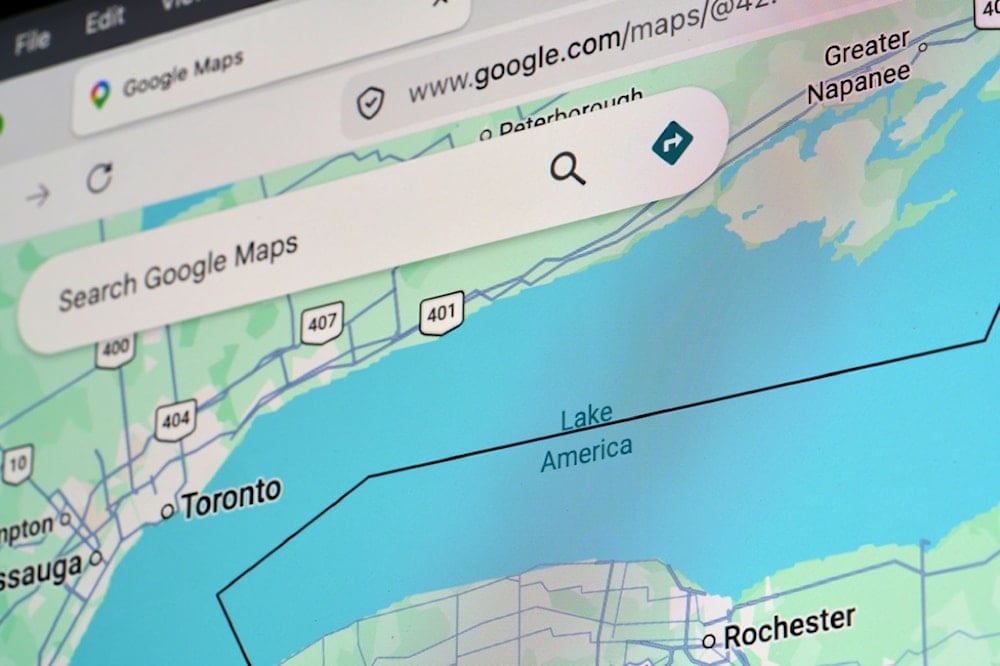
In the photo of a computer screen, a Google map showing Lake Ontario renamed as Lake America is seen on August 30, 2026, in St. Louis. (AP Photo/Jeff Roberson)
Google Maps has begun displaying “Lake America” instead of Lake Ontario for users in the United States, implementing a controversial name change ordered by US President Donald Trump amid escalating tensions between Washington and Ottawa.
Google announced on Saturday that the body of water bordering Ontario and New York would be labeled according to the user’s location. US users will see “Lake America,” Canadians will continue to see “Lake Ontario,” while users elsewhere will see “Lake Ontario (Lake America).”
The decision follows the formal adoption of the new US name by the Geographic Names Information System (GNIS), the federal geographic database.
Read more: Canadians embrace costly US boycott as Trump trade tensions deepen
Google Maps adopts Trump’s lake renaming
Google said the change follows its longstanding policy of using different names for geographic features when naming conventions vary between countries. The company’s decision nevertheless places the platform at the center of a political dispute that extends well beyond cartography.
Trump signed an executive order on Thursday directing the renaming of Lake Ontario, making the move another point of friction with Canada as relations between the two countries deteriorate over trade.
The US president has repeatedly used nationalist rhetoric toward Canada, including his calls for the country to become the “51st state” of the United States. The renaming comes after trade negotiations between Washington and Ottawa collapsed earlier this month and the two countries imposed retaliatory tariffs of up to 50% on some goods.
Canada rejects the new name
Canadian officials have rejected the US-imposed designation, insisting that the lake’s established name remains Lake Ontario.
Canadian Prime Minister Mark Carney dismissed the renaming on Thursday, saying Canadians would continue “calling it Lake Ontario—then, now and always.”
Ontario Premier Doug Ford reinforced that position by unveiling a 24-by-12-foot sign overlooking the lake in Winona, Ontario, reading “Lake Ontario Now and Always” in English and French.
Ford subsequently criticized the US decision in an interview with ABC, describing it as resembling something from "Saturday Night Live". "No one’s going to call it Lake of America. It’s been Lake Ontario for hundreds of years. It’s going to continue being Lake Ontario. It’s just so disappointing", he said.
The dispute has also reached provincial government websites and business platforms that rely on Google Maps data. Ontario officials said they were reviewing their websites to ensure the lake continued to be identified as Lake Ontario.
Ontario's Premier Doug Ford published a video statement responding to the American moves to change the lake's name, calling Lake Ontario a "crown jewel of our province and our country."
Ford stated that Trump's intention to change the body of water's name was due to Ontario and Canada "standing up" for themselves against US pressure. "Long before President Trump, this lake was called 'Lake Ontario,' and long after President Trump is gone, it will still be called 'Lake Ontario'", the Premier affirmed.
It’s Lake Ontario, now and always. pic.twitter.com/KNahtPAMeJ
— Doug Ford (@fordnation) August 29, 2026
Map companies take different positions
Google’s decision has not been followed uniformly across the mapping industry.
MapQuest said it would not rename the lake, posting on X that it was “not changing the name of Lake Ontario.” The company also launched a satirical tool allowing users to assign their own name to the body of water.
We're not changing the name of Lake Ontario. Name it whatever you want at your leisure: https://t.co/E2I0Ezd57W
— MapQuest (@MapQuest) August 27, 2026
(tag us so we can see your work 🙂) pic.twitter.com/x8lIAMt6ab
Apple had not changed the lake’s designation on Apple Maps in the US as of Sunday.
Trump’s broader campaign to rename US landmarks
The Lake Ontario dispute follows other geographic renaming decisions pursued by the Trump administration.
In February 2025, Google Maps began displaying “Gulf of America” for US users after Trump ordered the Gulf of Mexico renamed. Users in Mexico continued to see “Gulf of Mexico,” while users elsewhere saw both names.
Apple subsequently adopted the new Gulf designation for its US users.
Mexico challenged Google’s decision in court, arguing that Washington had no authority to rename the entire gulf, including waters under Mexican jurisdiction. The case remains pending before Mexico City’s Superior Court of Justice.
Google and Apple also changed their US labels for North America’s highest peak from Denali to Mount McKinley after Trump ordered the reversal of the 2015 restoration of the Alaska Native name.
MapQuest again retained “Denali” and “Gulf of Mexico.”
Read more: Canada 'foolish' if it thinks it can win trade war, US official says


